

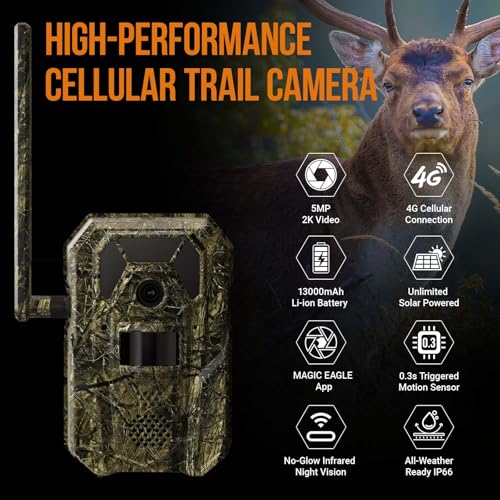

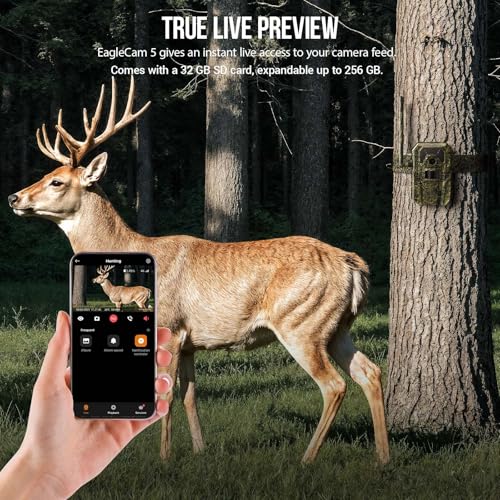

- Resolution: 5MP photo & 2K video
- Trigger Speed: .3s
- Field of View: 108°
- Cellular: Yes
- Night Vision: 92' range





MagicEagle Trail Camera
Overview and real-world performance

The MagicEagle Trail Camera is designed for anyone who wants reliable, hands-off monitoring in the outdoors, whether that means scouting deer patterns before the season, keeping an eye on a remote property, or simply capturing wildlife activity that happens when you are nowhere near the trail. What most people want from a trail camera is straightforward: it should notice motion quickly, take clear photos and video, and keep doing that for weeks without fuss. The MagicEagle aims to cover those essentials with a compact, weather-ready body, infrared night vision, and a motion-triggered recording system that prioritizes capturing the moment rather than demanding constant attention from the owner.
In day-to-day use, the most noticeable strengths of a good trail camera show up in the situations where you would otherwise miss the action. Trigger speed and recovery time matter because wildlife rarely pauses for a perfect shot. When a deer steps into frame and continues walking, the camera needs to detect, fire, and be ready again fast enough to capture a useful sequence rather than a single tail-end blur. In practical terms, you want a camera that is consistent: it triggers when it should, doesn’t trigger constantly when it shouldn’t, and produces a reasonable percentage of “keepers” across a full memory card. The MagicEagle’s value depends on that consistency more than any headline feature, because impressive specs are less meaningful if the camera misses the moment that matters.
Image quality is the next practical concern. For wildlife scouting, sharpness and exposure that let you identify animals and, ideally, distinguish antlers or unique markings can be more important than artistic color. The MagicEagle’s daytime captures are typically where you’ll see the best detail, while night captures depend heavily on infrared illumination and how well the camera balances brightness with motion blur. If you plan to place the camera on a game trail at dusk or in thick cover, expect that night performance will be the deciding factor in whether the footage is merely “proof something was there” or truly informative.
Finally, durability and stability are what make a trail camera feel trustworthy. A camera that handles rain, wind, cold mornings, and the occasional curious animal without losing its seal or draining its batteries too quickly is one you can set and forget. The MagicEagle is built for outdoor exposure, but its real advantage comes from pairing the camera with sensible placement: mount it securely, aim it away from direct sun, and keep vegetation from swaying in front of the sensor to reduce false triggers and wasted storage.
Key factors to consider before buying (and what matters most)
Before purchasing the MagicEagle Trail Camera, the first factor to consider is how you plan to use it, because the “best” trail camera changes depending on your goal. If your priority is scouting and identifying animals, prioritize trigger speed, detection range, and night image clarity over extra convenience features. If your priority is property monitoring, you may care more about consistent motion alerts, longer recording times, and reliable date/time stamping so clips are useful as documentation.
The most important factor for most buyers is motion detection reliability. A trail camera can have excellent resolution on paper, but if it triggers too late, triggers too often, or misses animals moving at the edge of the frame, the experience becomes frustrating. Look for a model that is known for stable detection in the environment you will use: open fields behave differently than dense woods, and extreme heat can reduce the contrast that motion sensors rely on. If you can only focus on one thing, focus on dependable triggering and sensible sensitivity settings, because that is what determines whether you get footage at all.
The second most important factor is night performance. Many of the most active wildlife hours are low-light or after dark, and property events you care about may occur at night as well. Pay attention to infrared range and how the camera handles movement in darkness, since that’s when blur and noise can hide details. Even with strong infrared LEDs, placement matters; mounting too close to a reflective surface like a light-colored tree trunk can wash out the subject, while mounting too far from the expected path can produce dim, less useful clips.
Battery life and power options are another major consideration. Trail cameras often spend most of their time waiting, and the combination of sensor standby, nighttime illumination, and frequent triggers determines how long a set of batteries will last. If you expect high activity, short videos, bursts of photos, and colder temperatures, you should anticipate faster drain. The MagicEagle will feel much more convenient if you choose settings that match your needs rather than maxing everything out; higher video resolution, longer clips, and very high sensitivity can all reduce runtime. If the model supports external power, that can be a practical advantage for long deployments, but it may also limit where you can mount it.
Storage and file management deserve attention because they affect how usable your footage is. Make sure you are comfortable with the camera’s memory card requirements and your workflow for reviewing files. If you want quick checks in the field, you’ll appreciate an interface that makes playback and deletion straightforward. If you plan to archive clips for a season or for security purposes, consider how the camera organizes files and whether the timestamps are clear and consistent.
Build quality and weather resistance are essential, even if they’re less exciting than resolution claims. Look for a housing that seals well and a latch that won’t loosen. The MagicEagle’s long-term value depends on whether it can stay outdoors through storms without fogging the lens or letting moisture reach the electronics. Also consider how easy it is to mount and aim. A camera that is difficult to align leads to weeks of footage of empty trails or tree bark. For many users, ease of setup is quietly one of the most important factors, because it determines whether the camera is actually used effectively.
Lastly, think about discretion and security. If the camera will be used in a public or semi-public area, a smaller profile, quiet operation, and the ability to lock the unit to a tree can make a big difference. Trail cameras are sometimes targets for theft, and even wildlife can bump or twist an unsecured mount. A solid strap system and the option to add a security box or cable can protect your investment.
Common Questions
Does the MagicEagle Trail Camera work well at night?
It can, but night results depend on placement and expected distance. For the clearest nighttime clips, mount the camera at an appropriate height, aim it along a trail rather than across it, and avoid reflective surfaces in the immediate foreground that can cause overexposure. If your main goal is identifying details at night, prioritize shorter distances and avoid overly long video settings that increase blur during movement.
How should I position the camera to reduce false triggers?
Aim it away from direct sunrise or sunset, keep branches and tall grass out of the detection zone, and mount it so the lens is not facing a heat source or a highly reflective background. In windy areas, trimming a small amount of vegetation in front of the camera can dramatically reduce empty clips.
What settings are best for scouting wildlife versus home security?
For scouting, many users prefer photo bursts or short video clips with a moderate sensitivity setting so they capture an animal’s approach and direction of travel without filling the card too quickly. For security, longer clips and clear time stamping can be more useful, along with a sensitivity level that balances detecting people while avoiding constant triggers from small animals or moving foliage.
How long will the batteries last?
Battery life varies widely based on temperature, how often the camera triggers, and how bright the infrared illumination runs at night. A low-traffic location with shorter clips can run significantly longer than a busy trail where the camera records frequently. If you expect heavy activity or winter conditions, plan to check batteries more often or consider an external power option if supported.
Overall, the MagicEagle Trail Camera is a practical choice for users who want dependable motion-activated monitoring and are willing to focus on the fundamentals that matter most: consistent triggering, usable night footage, and stable outdoor durability. If you choose settings that match your real needs and take a few minutes to mount it thoughtfully, it can deliver the kind of hands-off, evidence-rich capture that makes trail cameras worth owning.