


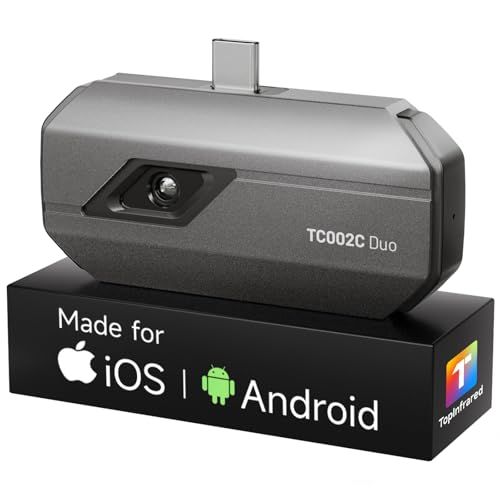
- Type: Smartphone enabled (USB-C)
- IR Resolution: 512 x 384
- Temperature Range: -4°F to 1022°F
- Thermal Sensitivity: <40 mK
- Battery Life: N/A





TOPDON TC002C Duo Thermal Camera
Review and real-world performance

The TOPDON TC002C Duo Thermal Camera is designed to make thermal inspection practical for everyday troubleshooting while still offering enough capability to satisfy more demanding users. The defining feature of the “Duo” concept is the combination of thermal imaging with a standard visual view, allowing you to interpret what you are seeing with more confidence. In many situations, thermal images alone can be ambiguous, especially when edges, textures, and objects of similar temperature blend together. A dual-view approach makes it easier to identify exactly which connector, bearing, fuse, pipe segment, or wall cavity corresponds to the heat pattern on screen.
In use, the camera’s value shows up in speed and clarity. When you’re chasing an electrical hot spot, trying to confirm whether a radiator line is flowing, or checking for drafts and insulation gaps, the TC002C Duo helps you move from “something is warm over here” to “this exact component is running hot” with fewer false assumptions. The viewing experience is typically improved by having multiple palette options and adjustable contrast, since thermal work often depends on choosing a palette that makes subtle differences obvious. A good thermal camera is not just about seeing “hot and cold,” but about seeing small differences quickly and repeatedly.
Ergonomics and day-to-day handling matter more than people expect. If the camera is comfortable to hold, quick to wake, and easy to aim, you will use it more often and get better results. For homeowners, that means you are more likely to grab it for a quick check of a suspicious breaker, a drafty window, or a warm spot on the ceiling. For technicians, it means faster scans and less time wrestling with menus. The Duo layout is particularly helpful when you need to create documentation or share a finding with a customer or colleague, because the visual context makes the thermal evidence easier to explain.
It’s also worth emphasizing that thermal cameras are diagnostic tools, not magic wands. Reflective surfaces, sunlight warming exterior walls, airflow, and thermal inertia can all affect readings. The TC002C Duo is best treated as a way to locate anomalies and trends, then confirm the cause with follow-up checks. Used that way, it can meaningfully reduce troubleshooting time for electrical, mechanical, automotive, HVAC, and building-envelope work.
What to consider before buying and what matters most
Before purchasing a thermal camera like the TOPDON TC002C Duo, the most important factors are the ones that determine whether it will reliably reveal the problems you care about. Thermal imaging quality is usually the first priority. Resolution and sensitivity determine how clearly the camera distinguishes one component from another and how well it shows small temperature differences. If you plan to inspect electronics, small connectors, or distant targets, higher effective detail becomes more important. If you primarily do home energy checks at close range, you can often prioritize ease of use and workflow features over the absolute highest specs.
Temperature measurement accuracy and emissivity handling are also critical. A thermal image is a map of infrared radiation, and shiny metal, glossy paint, and some plastics can trick the sensor into reading reflections instead of true surface temperature. A camera that provides flexible emissivity settings and user-friendly spot/area measurement tools will be more trustworthy across varied materials. For many buyers, the most important takeaway is that repeatability and the ability to compare relative temperatures across a scene often matter more than chasing a single “perfect” temperature number.
The dual-camera workflow is a major reason to choose a Duo-style device. Thermal-only images are powerful but can be hard to interpret in tight spaces like electrical panels or engine bays. A visual image alongside the thermal overlay reduces misidentification. If you expect to share reports, train others, or document warranty issues, having a visual reference can be as important as the thermal data itself. This is one of the highest-impact features for practical problem-solving, because it improves confidence in what you are looking at.
Consider the refresh rate and responsiveness if you plan to scan moving targets or sweep across a large area. A smoother, more responsive view is easier on the eyes and helps you notice quick changes. Battery life and charging also affect real ownership. A thermal camera that runs out mid-job becomes a frustration, so look for a setup that fits your routine, whether that means long runtime, quick charging, or the ability to power from common sources.
Software and export options matter more than many first-time buyers realize. Being able to save images reliably, add notes, and share them to a phone or computer can turn a one-off inspection into a repeatable maintenance habit. If you are a professional, this can be the difference between “I think I saw something” and “here is a clear, time-stamped record showing the issue before and after.” Even for homeowners, the ability to compare seasonal scans can be surprisingly useful.
Durability and support are the practical final filters. Thermal cameras get used in garages, basements, job sites, and around machinery. A device that can handle everyday bumps, has a readable screen in varied light, and comes from a brand with accessible support is usually a better long-term choice than a spec-sheet champion that feels fragile. If you only focus on one or two priorities, focus on imaging clarity for your target sizes and distances, and on the dual-view workflow that helps you correctly identify what the heat pattern belongs to.
Common Questions
Does the TOPDON TC002C Duo replace a multimeter or clamp meter? It complements them rather than replaces them. The thermal camera helps you find where heat is building up, which can point you toward a loose connection, overloaded circuit, failing bearing, or airflow issue, but electrical verification and load measurements still require a meter.
Is it useful for home energy audits and insulation checks? Yes, especially for locating drafts, missing insulation, thermal bridging, and air leaks around doors and windows. For best results, scan when there is a strong temperature difference between indoors and outdoors and minimize sunlight effects on exterior walls.
Can it accurately measure the temperature of shiny metal pipes or reflective surfaces? It can show patterns, but absolute temperature readings on reflective surfaces can be misleading due to low emissivity and reflections. A common workaround is to place matte tape or a non-reflective marker on the surface and measure that area, or adjust emissivity settings when appropriate.
What makes the Duo view better than thermal-only imaging? The visual reference helps you pinpoint the exact object causing the hot or cold region, reducing mistakes and speeding up troubleshooting. This is especially valuable in cluttered scenes like breaker panels, engine compartments, and mechanical rooms.
Is it beginner-friendly? It can be, as long as the user learns a few basic thermal concepts like emissivity, reflections, and the importance of environmental conditions. The dual imaging approach typically shortens the learning curve because it is easier to orient yourself and interpret what you see.
Conclusion: The TOPDON TC002C Duo Thermal Camera stands out as a practical thermal inspection tool because the dual thermal-and-visual approach makes findings easier to interpret and share. If you prioritize clear imaging for your typical working distance, reliable measurement tools, and a workflow that supports saving and communicating results, it can be a strong choice for both serious DIY diagnostics and professional troubleshooting.