
Best Thermal Cameras Updated November 2026

Best Thermal Cameras
2026 Buyer's GuideUpdated November 2026
Sort by:
1

10.0

Flagfront Thermal Camera, 240 x 240 TISR Resolution for Home Inspection | 25Hz Refresh Rate , -4°F to 1022°F Temp Range with Hi...
Type: Handheld
IR Resolution: 240 x 240
Temperature Range: -4°F to 1022°F
Thermal Sensitivity: Not indicated
Battery Life: Not indicated

10.0

1
Flagfront Thermal Camera, 240 x 240 TISR Resolution for Home Inspection | 25Hz Refresh Rate , -4°F to 1022°F Temp Range with Hi...
Type: Handheld
IR Resolution: 240 x 240
Temperature Range: -4°F to 1022°F
Thermal Sensitivity: Not indicated
Battery Life: Not indicated
2

9.9

Thermal Master P3 Thermal Camera for iOS & Android (Black) | 512×384 X³IR Resolution, Manual Focus, ±3.6℉ Accuracy, -4°F to 111...
Type: iPhone (Lightning) or smartphone (USB-C) enabled
IR Resolution: 512 x 384
Temperature Range: -4℉ to 1112℉
Thermal Sensitivity: <35 mK
Battery Life: 8 hours
Compare

9.9

2
Thermal Master P3 Thermal Camera for iOS & Android (Black) | 512×384 X³IR Resolution, Manual Focus, ±3.6℉ Accuracy, -4°F to 111...
Type: iPhone (Lightning) or smartphone (USB-C) enabled
IR Resolution: 512 x 384
Temperature Range: -4℉ to 1112℉
Thermal Sensitivity: <35 mK
Battery Life: 8 hours
Compare
3

9.8

Thermal Master P1 Thermal Camera for USB-C iOS/Android, 320x240 Resolution | -4°F to 1112°F, ±3.6℉ Accuracy Thermal Imaging Cam...
Type: iPhone (Lightning) or smartphone (USB-C) enabled
IR Resolution: 320 x 240
Temperature Range: -4°F to 1112°F
Thermal Sensitivity: Not indicated
Battery Life: Not indicated
Compare

9.8

3
Thermal Master P1 Thermal Camera for USB-C iOS/Android, 320x240 Resolution | -4°F to 1112°F, ±3.6℉ Accuracy Thermal Imaging Cam...
Type: iPhone (Lightning) or smartphone (USB-C) enabled
IR Resolution: 320 x 240
Temperature Range: -4°F to 1112°F
Thermal Sensitivity: Not indicated
Battery Life: Not indicated
Compare
4

9.6

AccuMEMS GT14S Thermal Imaging Camera, Thermometer Mode, Ultra-Light 240g | 4°F~1022°F Range, 14H Runtime, Live Tracking with E...
Type: Handheld
IR Resolution: Not indicated
Temperature Range: -4°F to 1022°F
Thermal Sensitivity: <50 mK
Battery Life: 14 hours
Compare

9.6

4
AccuMEMS GT14S Thermal Imaging Camera, Thermometer Mode, Ultra-Light 240g | 4°F~1022°F Range, 14H Runtime, Live Tracking with E...
Type: Handheld
IR Resolution: Not indicated
Temperature Range: -4°F to 1022°F
Thermal Sensitivity: <50 mK
Battery Life: 14 hours
Compare
5

9.5

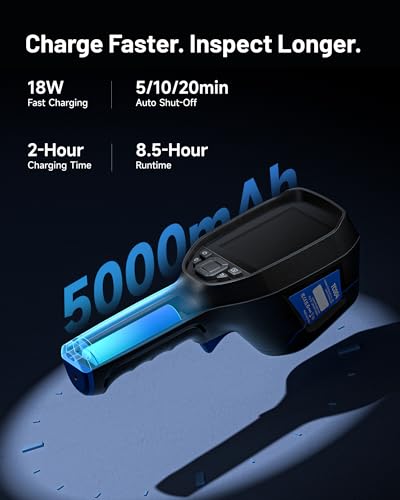
GOYOJO GH192 Thermal Imaging Camera, Thermal & 2MP Visible Light Fusion | 240x240 Super Resolution, -4°F~1022°F, 25Hz, High/Low...
Type: Handheld
IR Resolution: 240 x 240
Temperature Range: -4°F to 1022°F
Thermal Sensitivity: <40 mK
Battery Life: 8 hours
Compare

9.5

5
GOYOJO GH192 Thermal Imaging Camera, Thermal & 2MP Visible Light Fusion | 240x240 Super Resolution, -4°F~1022°F, 25Hz, High/Low...
Type: Handheld
IR Resolution: 240 x 240
Temperature Range: -4°F to 1022°F
Thermal Sensitivity: <40 mK
Battery Life: 8 hours
Compare
6

9.4

TOPDON TC004 3.5" Thermal Imaging Camera, -4°F~1022°F Temp Range | 512 x 384 TISR Resolution, 8-Hour Battery Life Handheld Infr...
Type: Handheld
IR Resolution: 256 x 192
Temperature Range: -4°F to 662°F
Thermal Sensitivity: <40 mK
Battery Life: 12 hours
Compare

9.4

6
TOPDON TC004 3.5" Thermal Imaging Camera, -4°F~1022°F Temp Range | 512 x 384 TISR Resolution, 8-Hour Battery Life Handheld Infr...
Type: Handheld
IR Resolution: 256 x 192
Temperature Range: -4°F to 662°F
Thermal Sensitivity: <40 mK
Battery Life: 12 hours
7

9.3

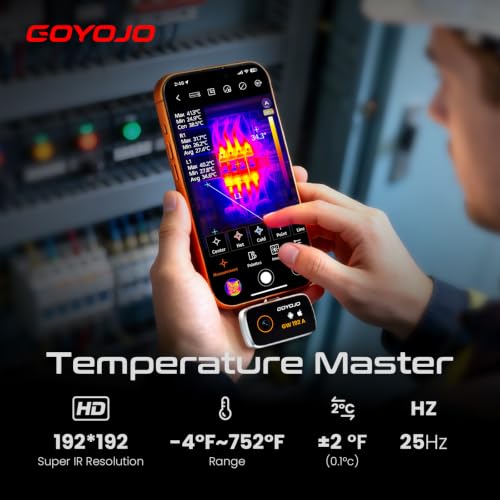
GOYOJO GW192A Thermal Imaging Camera for iPhone Android Any USB-C 192x192 | 192 x 192 Super Resolution, -4℉-752℉, 25Hz Spot Tra...
Type: Smartphone enabled
IR Resolution: 192 x 192
Temperature Range: -4°F to 752°F
Thermal Sensitivity: Not indicated
Battery Life: N/A
Compare

9.3

7
GOYOJO GW192A Thermal Imaging Camera for iPhone Android Any USB-C 192x192 | 192 x 192 Super Resolution, -4℉-752℉, 25Hz Spot Tra...
Type: Smartphone enabled
IR Resolution: 192 x 192
Temperature Range: -4°F to 752°F
Thermal Sensitivity: Not indicated
Battery Life: N/A
Compare
8

9.2

Thermal Master P4 Dual-Lens Thermal Camera for Android , -4°F to 1112°F | 512×384 X³IR Resolution, IR Eraser, NETD<35mK, 25Hz, ...
Type: Smartphone enabled (USB-C)
IR Resolution: 512 x 384
Temperature Range: -4°F to 1112°F
Thermal Sensitivity: <35 mK
Battery Life: Not indicated
Compare

9.2

8
Thermal Master P4 Dual-Lens Thermal Camera for Android , -4°F to 1112°F | 512×384 X³IR Resolution, IR Eraser, NETD<35mK, 25Hz, ...
Type: Smartphone enabled (USB-C)
IR Resolution: 512 x 384
Temperature Range: -4°F to 1112°F
Thermal Sensitivity: <35 mK
Battery Life: Not indicated
Compare
9

9.0

REVASRI Thermal Imaging Camera,320x240 Super IR Resolution | -4℉ to 842℉ Temp Range, 25Hz USB-C Thermal Camera for iPhone & And...
Type: iPhone (Lightning) or smartphone enabled (USB-C)
IR Resolution: 320 x 240
Temperature Range: -4℉ to 842℉
Thermal Sensitivity: <40 mK
Battery Life: N/A
Compare

9.0

9
REVASRI Thermal Imaging Camera,320x240 Super IR Resolution | -4℉ to 842℉ Temp Range, 25Hz USB-C Thermal Camera for iPhone & And...
Type: iPhone (Lightning) or smartphone enabled (USB-C)
IR Resolution: 320 x 240
Temperature Range: -4℉ to 842℉
Thermal Sensitivity: <40 mK
Battery Life: N/A
Compare
10

8.9

Thermal Master Thor002 Thermal Camera, 3.5" IPS Screen, ±3.6℉ Accuracy | 512×384 X³ IR Resolution, 5 Imaging Modes, -4°F to 102...
Type: Handheld
IR Resolution: 512 x 384
Temperature Range: -4℉ to 1022℉
Thermal Sensitivity: Not indicated
Battery Life: 10.5 hours
Compare

8.9

10
Thermal Master Thor002 Thermal Camera, 3.5" IPS Screen, ±3.6℉ Accuracy | 512×384 X³ IR Resolution, 5 Imaging Modes, -4°F to 102...
Type: Handheld
IR Resolution: 512 x 384
Temperature Range: -4℉ to 1022℉
Thermal Sensitivity: Not indicated
Battery Life: 10.5 hours
Compare

Our Top Choice

1

10.0

Flagfront Thermal Camera, 240 x 240 TISR Resolution for Home Inspection | 25Hz Refresh Rate , -4°F to 1022°F Temp Range with Hi...
Type: Handheld
IR Resolution: 240 x 240
Temperature Range: -4°F to 1022°F
Thermal Sensitivity: Not indicated
Battery Life: Not indicated

10.0

1
Flagfront Thermal Camera, 240 x 240 TISR Resolution for Home Inspection | 25Hz Refresh Rate , -4°F to 1022°F Temp Range with Hi...
Type: Handheld
IR Resolution: 240 x 240
Temperature Range: -4°F to 1022°F
Thermal Sensitivity: Not indicated
Battery Life: Not indicated

Compare Features

Thermal Sensitivity
Best Thermal Camera
1. Flagfront Thermal Camera
FLAGFRONT Preview FLAGFRONT Preview
FLAGFRONT
at Amazon
Black Friday Deal
2. Thermal Master P3 Thermal Camera
THERMAL MASTER Preview THERMAL MASTER Preview
THERMAL MASTER
at Amazon
Black Friday Deal
3. Thermal Master P1 Thermal Camera
THERMAL MASTER Preview THERMAL MASTER Preview
THERMAL MASTER
at Amazon
Best Value
4. AccuMEMS GT14S Thermal Imaging Camera, Thermometer Mode, Ultra-Light 240g | 4°F~1022°F Range, 14H Runtime, Live Tracking with E...
ACCUMEMS Preview ACCUMEMS Preview
ACCUMEMS
at Amazon
5. GOYOJO GH192 Thermal Imaging Camera
GOYOJO Preview GOYOJO Preview
GOYOJO
at Amazon
6. Topdon Thermal Imaging Camera
TOPDON Preview TOPDON Preview
TOPDON
at Amazon
7. Goyojo ‎GW192A Thermal Camera
GOYOJO Preview GOYOJO Preview
GOYOJO
at Amazon
8. Thermal Master P4 Dual-Lens Thermal Camera for Android , -4°F to 1112°F | 512×384 X³IR Resolution, IR Eraser, NETD<35mK, 25Hz, ...
THERMAL MASTER Preview THERMAL MASTER Preview
THERMAL MASTER
at Amazon
9. REVASRI Thermal Camera
REVASRI Preview REVASRI Preview
REVASRI
at Amazon
Premium Pick
10. Thermal Master Handheld Thermal Imager
THERMAL MASTER Preview THERMAL MASTER Preview
THERMAL MASTER
at Amazon
Deal
-15% -20% -20% -20% -40% -24% -34% -20% — -20%
Deal -15% -20% -20% -20% -40% -24% -34% -20% — -20%
Type
Handheld iPhone (Lightning) or smartphone (USB-C) enabled iPhone (Lightning) or smartphone (USB-C) enabled Handheld Handheld Handheld Smartphone enabled Smartphone enabled (USB-C) iPhone (Lightning) or smartphone enabled (USB-C) Handheld
Type
Handheld iPhone (Lightning) or smartphone (USB-C) enabled iPhone (Lightning) or smartphone (USB-C) enabled Handheld Handheld Handheld Smartphone enabled Smartphone enabled (USB-C) iPhone (Lightning) or smartphone enabled (USB-C) Handheld
IR Resolution
240 x 240 512 x 384 320 x 240 Not indicated 240 x 240 256 x 192 192 x 192 512 x 384 320 x 240 512 x 384
IR Resolution
240 x 240 512 x 384 320 x 240 Not indicated 240 x 240 256 x 192 192 x 192 512 x 384 320 x 240 512 x 384
Temperature Range
-4°F to 1022°F -4℉ to 1112℉ -4°F to 1112°F -4°F to 1022°F -4°F to 1022°F -4°F to 662°F -4°F to 752°F -4°F to 1112°F -4℉ to 842℉ -4℉ to 1022℉
Temperature Range
-4°F to 1022°F -4℉ to 1112℉ -4°F to 1112°F -4°F to 1022°F -4°F to 1022°F -4°F to 662°F -4°F to 752°F -4°F to 1112°F -4℉ to 842℉ -4℉ to 1022℉
Thermal Sensitivity
Not indicated <35 mK Not indicated <50 mK <40 mK <40 mK Not indicated <35 mK <40 mK Not indicated
Thermal Sensitivity
Not indicated <35 mK Not indicated <50 mK <40 mK <40 mK Not indicated <35 mK <40 mK Not indicated
Battery Life
Not indicated 8 hours Not indicated 14 hours 8 hours 12 hours N/A Not indicated N/A 10.5 hours
Battery Life
Not indicated 8 hours Not indicated 14 hours 8 hours 12 hours N/A Not indicated N/A 10.5 hours
How we rank

The order above is not editorial opinion, and it is not paid placement. It comes from what shoppers across our network actually do - which thermal cameras they compare, and which they ultimately buy. We re-rank as new data comes in, so the long-term favorites have to keep earning their spot against new entrants. The full method, including how we make money.

Thermal Cameras Buyer's Guide

Buying a thermal camera is a tradeoff between sensor detail, measurement reliability, and the form factor you can actually use in walls, panels, vehicles, HVAC runs, or electronics work. The sharpest concerns are whether it can resolve the size of the problem you are hunting and whether its temperature readings are trustworthy under real surfaces, distances, and lighting conditions.

Image

Clear thermal imagery helps you spot temperature differences accurately, especially when you’re inspecting small components, hidden leaks, electrical hot spots, or insulation gaps. Look for enough thermal resolution and image detail to make targets easy to distinguish, plus a display that stays readable in the lighting conditions where you’ll use it. Be cautious of cameras that produce blurry, overly blocky, or hard-to-interpret images, because they can make diagnosis slower and less reliable.

For thermal cameras, prioritize usable thermal detail over marketing screenshots: look for enough IR resolution, good thermal sensitivity, adjustable focus or a suitable focus range, and a field of view that matches your job. Home inspectors and HVAC users need contrast for broad wall, ceiling, duct, and insulation patterns, while electronics or mechanical troubleshooting benefits from sharper close-range detail; avoid very low-resolution units that turn studs, radiant lines, or small hot components into vague blobs. Owner feedback supports this priority: buyers consistently value cameras that show crisp thermal contrast, make small temperature differences easy to see, and reveal practical targets such as drafts, insulation gaps, HVAC patterns, electrical hot spots, radiant floor lines, and hot/cold zones without looking like blurry “heat vision.”

Function

A thermal camera’s usefulness depends on whether its features match the jobs you need it to handle, from spotting insulation gaps and moisture patterns to checking electrical panels, HVAC issues, or mechanical heat buildup. Look for practical diagnostics such as clear image blending, adjustable emissivity, temperature markers, and easy reporting or storage, and be wary of models that offer flashy extras while lacking the accuracy, resolution, or controls needed for dependable troubleshooting.

Match the camera’s functions to the inspections you actually do: wide-area home diagnostics need spot/area temperature tools, palettes, image capture, and enough range for HVAC or boiler checks, while automotive, electrical, soldering, and 3D-printer work may need close-focus capability, fast response, and a temperature range high enough for hot components. For electrical panels or machinery, look for hot-spot tracking and alarms, but remember a thermal camera flags abnormal heat—it does not replace safe lockout procedures, a multimeter, or a qualified inspection. Owner sentiment aligns with this: users report that capable units are useful across walls, pipes, equipment, vehicles, boilers, ducts, electronics, 3D printer beds, and insulation checks, with controls approachable enough for non-specialists.

Build

A thermal camera’s build quality matters because it affects whether you can trust it in real job-site, inspection, or outdoor conditions. Look for a solid housing, protected lens and ports, reliable controls, and clear durability ratings for drops, dust, and water; watch out for flimsy attachments, loose battery doors, or designs that feel more like fragile electronics than field tools.

Choose a build style that fits where the camera will live: a dedicated handheld is usually better for ladders, crawlspaces, electrical rooms, and dusty garages, while a phone-connected module is compact but depends on the phone port, battery, app, and physical connector strength. Check for a lens cover, protective case, grippy body, drop resistance, weather/dust protection if used on job sites, and a battery setup that will last through an inspection route; avoid delicate exposed connectors if you expect rough garage or field use. Owner feedback reinforces that shoppers appreciate compact, sturdy, well-made tools with included storage and enough durability for garage, shop, job-site, home, automotive, and electronics troubleshooting.

Accuracy

You need reliable accuracy so the hot or cold spots you see actually reflect real conditions, especially when you’re troubleshooting electrical systems, insulation gaps, HVAC issues, or machinery. Look for clear stated temperature accuracy, stable repeat readings, adjustable emissivity settings, and a suitable temperature range for your work; be cautious of cameras that produce impressive images but lack trustworthy measurement specs or consistent monitoring performance.

For meaningful readings, look beyond the advertised temperature range and check whether the camera allows emissivity adjustment, reflected-temperature compensation, and clear spot/box measurement tools. Shiny metal, glass, wet surfaces, distance, and viewing angle can badly skew readings, so a careful buyer should plan to use matte tape/paint targets on reflective surfaces and treat the image as a comparison map unless conditions are controlled; for safety-critical electrical or mechanical work, verify with other instruments. Owner reports are strongest when accuracy is judged practically: buyers find readings responsive and precise enough to identify unusual hot/cold areas, track heat changes, locate radiant-floor trouble spots, find likely shorts, and follow heat loss or mechanical issues.

Ease

A thermal camera should let you start scanning quickly, adjust key settings without digging through confusing menus, and understand what the image is telling you with minimal trial and error. Look for clear controls, intuitive temperature palettes, easy image capture or transfer, and straightforward calibration or focus steps; watch out for cameras that hide basic functions behind awkward interfaces or require a steep learning curve before you can trust what you’re seeing.

Ease of use matters most when you are scanning under time pressure, so look for fast startup, obvious palette and measurement controls, smooth live scanning, simple image saving, and an interface that lets you adjust emissivity and measurement boxes without digging through menus. If buying a phone-connected model, confirm the exact connector, operating-system support, app requirements, case clearance, orientation, and whether the camera works without awkward adapters; avoid units that depend on poorly maintained apps if you need long-term reliability. Owner sentiment backs this: users repeatedly praise thermal cameras that are point-and-shoot, quick to set up, intuitive for beginners, smooth in live scanning, and ready to use within seconds or minutes through a simple handheld interface or plug-and-open app workflow.

Value

Value matters because thermal cameras can vary widely in what they deliver for the money, from basic heat-spotting to sharper imaging and more useful analysis features. Look for a camera that matches your actual use case rather than paying for specs you will not use, and watch out for low-cost options that save money upfront but compromise too much on image clarity, accuracy, durability, or software support.

The best value in this category usually comes from paying for the specs that prevent missed problems: real IR resolution, low thermal sensitivity, stable readings, useful measurement tools, adequate refresh rate, and a durable form factor. Do not overpay for decorative palettes, exaggerated “HD” visual overlays, or unrealistic claims if the underlying thermal sensor is weak; conversely, do not choose the cheapest option if it cannot resolve the size of the studs, ducts, traces, pipes, or hot components you need to inspect. Owner feedback supports this value equation: buyers feel satisfied when a camera delivers practical thermal clarity, real-time troubleshooting, compact construction, and dependable performance for home, shop, soldering, electrical, automotive, and general inspection work without feeling like a novelty gadget.