Best Scooter Hitch Carriers Updated September 2026

Best Scooter Hitch Carriers
2026 Buyer's GuideUpdated September 2026
Sort by:
1

10.0

MaxxHaul 50945 50 inch x 29.5 inch Trailer Hitch Mount Aluminum Mobility Carrier with 47 inch Ramp and Hitch Tightener for RV T...
Functionality
Assembly
Ease of use
Sturdiness
Value for money
Portability

10.0

1
MaxxHaul 50945 50 inch x 29.5 inch Trailer Hitch Mount Aluminum Mobility Carrier with 47 inch Ramp and Hitch Tightener for RV T...
Functionality
Assembly
Ease of use
Sturdiness
Value for money
Portability
2

9.9

Silver Spring Folding Steel Wheelchair Scooter Carrier, 500 lb, 42 in Ramp
Assembly
Functionality
Ease of use

9.9

2
Silver Spring Folding Steel Wheelchair Scooter Carrier, 500 lb, 42 in Ramp
Assembly
Functionality
Ease of use
3

9.7

ECOTRIC 46.2 X 26.8 X 38.7 Inch Hitch Cargo Carrier W/Ramp Foldable 500 Lbs

9.7

3
ECOTRIC 46.2 X 26.8 X 38.7 Inch Hitch Cargo Carrier W/Ramp Foldable 500 Lbs
4

9.5

Rockland Foldable Electric Mobility Scooter Carrier, 350 lb Capacity

9.5

4
Rockland Foldable Electric Mobility Scooter Carrier, 350 lb Capacity
5

9.4

MaxxHaul 70275 Aluminum Hitch Mount Wheelchair/Mobility Carrier – 53.5" x 29.75" Cargo Basket with Folding 60" Ramp – Fits 2" C...
Functionality
Assembly
Ease of use
Sturdiness
Value for money
Portability

9.4

5
MaxxHaul 70275 Aluminum Hitch Mount Wheelchair/Mobility Carrier – 53.5" x 29.75" Cargo Basket with Folding 60" Ramp – Fits 2" C...
Functionality
Assembly
Ease of use
Sturdiness
Value for money
Portability
6

9.3

ALMULOO Hitch Mount Carrier with Folding Ramp for Wheelchairs and Lawn

9.3

6
ALMULOO Hitch Mount Carrier with Folding Ramp for Wheelchairs and Lawn
7

9.1

Black Widow Aluminum Motorcycle Hitch Carrier with Ramp, 400 lb, 2 in Hitch
Quality
Functionality
Sturdiness
Suitability

9.1

7
Black Widow Aluminum Motorcycle Hitch Carrier with Ramp, 400 lb, 2 in Hitch
Quality
Functionality
Sturdiness
Suitability
8

9.0

Goplus Mobility Scooter Carrier, 50” x 29.5” Folding Wheelchair Carrier for Car with 42” Ramp, Stabilizer & 2 Tie Down Straps, ...
Assembly
Functionality

9.0

8
Goplus Mobility Scooter Carrier, 50” x 29.5” Folding Wheelchair Carrier for Car with 42” Ramp, Stabilizer & 2 Tie Down Straps, ...
Assembly
Functionality
9

8.8

Folding Wheelchair Scooter Carrier Rack 250KG Medical Rack Ramp Hitch Mount, 48 * 27 * 42 inch

8.8

9
Folding Wheelchair Scooter Carrier Rack 250KG Medical Rack Ramp Hitch Mount, 48 * 27 * 42 inch
10

8.7

ECOTRIC Hitch Mount Wheelchair Carrier with Mobility Ramp
Quality
Sturdiness
Functionality

8.7

10
ECOTRIC Hitch Mount Wheelchair Carrier with Mobility Ramp
Quality
Sturdiness
Functionality
We also considered 10 others:

Our Top Choice

1

10.0

MaxxHaul 50945 50 inch x 29.5 inch Trailer Hitch Mount Aluminum Mobility Carrier with 47 inch Ramp and Hitch Tightener for RV T...
Functionality
Assembly
Ease of use
Sturdiness
Value for money
Portability

10.0

1
MaxxHaul 50945 50 inch x 29.5 inch Trailer Hitch Mount Aluminum Mobility Carrier with 47 inch Ramp and Hitch Tightener for RV T...
Functionality
Assembly
Ease of use
Sturdiness
Value for money
Portability
How we rank

The order above is not editorial opinion, and it is not paid placement. It comes from what shoppers across our network actually do - which scooter hitch carriers they compare, and which they ultimately buy. We re-rank as new data comes in, so the long-term favorites have to keep earning their spot against new entrants. The full method, including how we make money.

Scooter Hitch Carriers Buyer's Guide

Scooter hitch carriers live at the intersection of mobility access and vehicle limits: the carrier must be easy enough to load, but rigid and compatible enough to trust behind the vehicle at road speed. The sharpest buying concerns are not just advertised weight capacity; they are hitch tongue-weight math, ramp geometry, wobble control, and whether the carrier can be installed or removed by the person who actually needs to use it.

Fit & Capacity

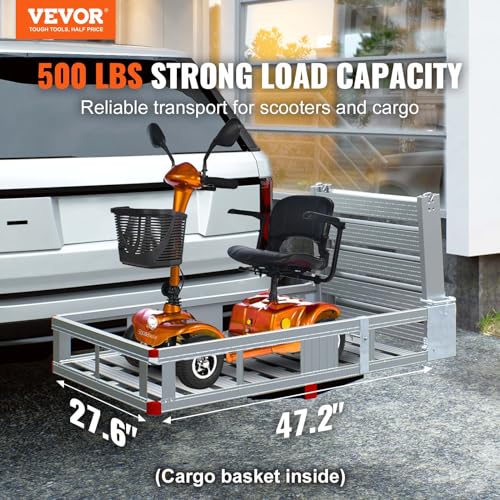
A hitch carrier adds both cargo weight and leverage behind the vehicle, so fit is more than whether the receiver size matches. The safest choice is one that suits the hitch rating, vehicle tongue-weight limit, scooter weight, wheelbase, tire width, and ground-clearance needs.

Start by adding the scooter’s real weight, any batteries or accessories left on it, and the carrier’s own weight, then compare that total to the vehicle and hitch tongue-weight ratings. Check receiver size, hitch class, rear-door or liftgate clearance, exhaust clearance, license-plate and light visibility, and whether the scooter’s wheelbase and tire track actually sit on the deck without riding the rails. Be cautious with loads near the advertised limit, because owners are more divided when heavier scooters or equipment push the rack hard; some report acceptable stability for scooters, lawn equipment, and lighter hauling, while confidence drops for heavier loads near capacity. Positive owner feedback also shows why correct fit matters: when matched well, these carriers are trusted for mobility scooters, wheelchairs, electric chairs, luggage, and similar cargo.

Ramp Usability

A scooter carrier should reduce lifting, not create a new struggle at the back of the vehicle. Ramp length, deck layout, rail height, and tie-down access determine whether loading feels controlled or awkward, especially for daily mobility use.

Look for an integrated folding ramp with a secure latch, a manageable ramp angle for the scooter’s ground clearance, enough deck width for the tires, and close enough slats that small wheels do not drop or catch. Side rails, multiple tie-down points, and a deck that lets straps pull down and outward are important because mobility scooters can shift under braking or cornering; avoid designs where the ramp must be loaded sideways or where the ramp can flex under off-center wheel pressure. Owner sentiment strongly supports built-in ramps and practical deck details: buyers like folding ramps because they are more convenient than separate trailers, and they call out close slats, side rails, tie-down points, anti-rattle hardware, and basket-style decks as useful for scooter hauling. The same feedback also flags a failure mode to inspect carefully: some owners warn that ramp security, folding action, or sideways loading can be compromised when holes, pins, or hardware do not align well.

Road Stability

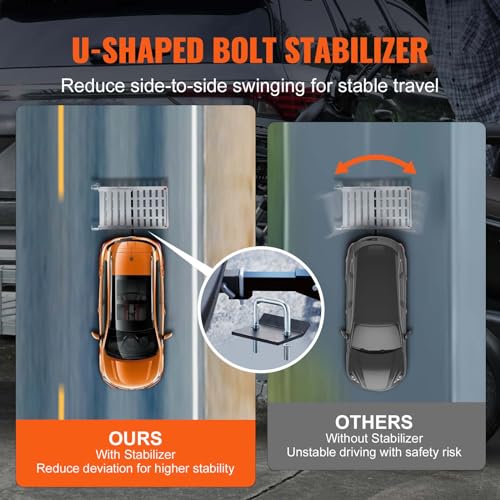
Once loaded, the carrier becomes a lever hanging behind the vehicle, so small looseness at the hitch can feel much larger on the road. Good stability depends on rigid construction, tight hitch hardware, secure ramp locks, and strap points that keep the scooter from rocking.

Prioritize a carrier with an anti-rattle device, a tight hitch pin setup, a positive ramp latch, reinforced hitch tube, and tie-down points placed so the scooter can be restrained in four directions. After loading, test for hitch wobble, rear sag, ramp rattle, and strap movement before highway use; if the rack visibly shakes unloaded, it will usually feel worse with a scooter aboard. Owner feedback is split here: many describe sturdy, confidence-inspiring carriers for scooters, wheelchairs, dirt bikes, and light motorcycles, but others warn about wobble, latch security, sagging, shaking, and reduced confidence with heavier loads. Several buyers also recommend checking or upgrading hardware, which reinforces that road security is not just about the frame but also pins, bolts, locks, and how tightly everything clamps together.

Weight Handling

The carrier’s own weight affects both the vehicle’s available tongue capacity and the user’s ability to install, remove, fold, or store it. A heavy carrier may be strong, but it can become impractical if the buyer needs help every time it goes on the hitch.

Decide first whether the carrier will stay mounted or be installed only when needed. For frequent removal, prioritize lighter construction, good handholds, a folding or upright storage position, and a weight the primary user can safely lift into the receiver; for heavier steel designs, assume installation may require two people or a dolly. Owner sentiment repeatedly highlights this tradeoff: lightweight aluminum builds are praised for one-person handling, rust resistance, and keeping extra vehicle or RV cargo weight down, while all-steel construction is often called heavy to handle, install, and move. Several buyers specifically note that older users or people with limited strength may need help mounting or removing heavier carriers, even when the carrier performs well once installed.

Assembly & QC

Many hitch carriers ship partially assembled, so setup quality directly affects safety and frustration. Misaligned holes, weak fasteners, or unclear instructions can prevent the ramp from locking correctly or leave the rack feeling loose before it ever reaches the road.

Before relying on the carrier, inventory every bolt, lock nut, pin, washer, ramp hinge, latch, and weld, then dry-fit the folding mechanism and hitch connection without the scooter loaded. Avoid assuming that “some assembly required” is harmless: a ramp carrier with misaligned pin holes or missing locking hardware can be unsafe even if the deck itself looks strong. Owners often say assembly can be straightforward with basic tools, clear instructions, and parts that line up, and several report completing setup themselves in roughly an hour or two. But the negative pattern is important: buyers also report vague instructions, hole and pin alignment problems, missing lock nuts, broken tack welds, small hardware issues, and parts that needed drilling, bending, replacement, or repair before reliable use.

Durability Value

A scooter carrier is often bought to support everyday independence, so long-term reliability matters as much as the first successful trip. Materials, finish quality, weld consistency, and hardware durability determine whether a carrier remains trustworthy after weather exposure and repeated loading.

Choose corrosion-resistant materials or a well-protected finish if the carrier will live outdoors, behind an RV, or in road-salt areas, and inspect welds, hinge points, ramp pivots, and fasteners periodically. A lower-cost carrier can still be a smart buy, but only if you are not immediately spending time or money correcting rust, missing parts, poor alignment, or weak hardware. Owner sentiment is broadly positive on value and build when the carrier is well executed, with many buyers describing sturdy, good-quality racks that work well for scooters, wheelchairs, luggage, and other hauling tasks. The caution is that durability feedback is not uniform: some owners cite quality-control issues, sagging or shaking under load, hardware upgrades, ramp bending under sideways loading, and even early surface rust, so long-term value depends on more than the initial deal.