


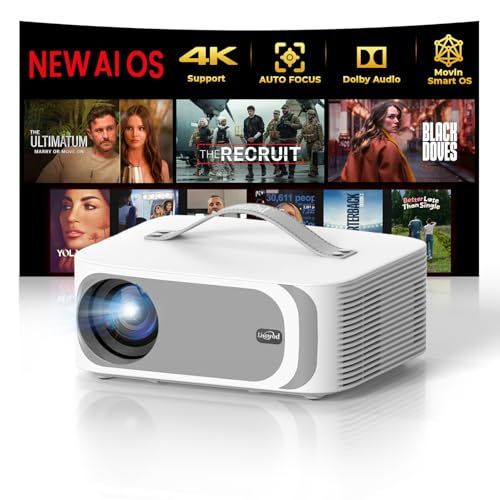
- Type: Portable LED
- Outdoor Use: Yes
- Resolution: 1080p FHD with 4K support
- Brightness: 1800 ANSI lumens
- Projection Screen: 50" to 300"
- Sound: Dolby audio & stereo speaker





Lisowod Portable Projector
Overall impressions and real-world performance

The Lisowod Portable Projector is designed for people who want a flexible, carry-anywhere display without committing to a permanent TV or a full home theater setup. Its appeal is simple: a compact body, quick setup, and the promise of turning a blank wall into a movie night, a casual gaming screen, or a presentation surface. In day-to-day use, the experience tends to be defined less by the projector’s “spec sheet” and more by how and where you plan to use it. In a dim bedroom or living room, it can be an enjoyable way to watch streaming content, share photos, or put on a show for kids. The picture feels more cinematic than a small television, and the portability encourages spontaneous use, like moving from a bedroom to a backyard or taking it along on a weekend trip.
What stands out most about a portable projector like this is how sensitive it is to environment. If you can control light, the image can look surprisingly pleasing for the size and price category, with good perceived sharpness at moderate screen sizes. If you cannot control light, any portable projector will struggle, and the Lisowod is no exception. Bright rooms, daytime viewing, and strong overhead lighting can wash out contrast and make colors look flat. In other words, the “wow” factor depends on the setting. When the room is properly darkened, it delivers the sort of relaxed, big-screen experience that makes portable projectors fun; when it’s not, it can feel like you’re constantly trying to coax the best image out of the space.
Audio is another practical part of the experience. Built-in speaker sound can be convenient and “good enough” for casual viewing, especially at close range, but it generally won’t replace a soundbar or a Bluetooth speaker if you care about strong dialogue clarity or impactful bass. If you already own a small external speaker, pairing it with the projector can elevate the entire setup more than you might expect. The same is true for placement and stability. A steady surface, a reasonably flat projection area, and a consistent distance from the wall will do more to improve your results than chasing minor settings tweaks. Portable projectors reward simple discipline: darker room, stable placement, and sensible screen size.
Factors to consider before buying (and what matters most)
Before purchasing the Lisowod Portable Projector, the most important factor to consider is brightness relative to your intended viewing conditions. Many buyers imagine outdoor movies, family gatherings, or daytime sports, but projectors are far more demanding than TVs when it comes to ambient light. If you will mostly watch at night or in a room where you can close curtains and dim lights, you’re in the best scenario. If you need reliable daytime viewing, you should be realistic about the limitations and consider whether a higher-brightness model or a TV fits better. In practice, the ability to control room lighting is often the difference between being delighted and feeling disappointed.
The next major consideration is native resolution and how you plan to feed content. Portable projectors sometimes advertise support for high-resolution input, but the viewing experience is determined by the projector’s native display resolution and processing. If you’re primarily watching streaming shows, YouTube, or casual movies, many users find the result acceptable at a moderate image size, especially from typical couch distance. If you’re expecting crisp small text, detailed spreadsheets, or perfectly sharp subtitles on a very large wall, you’ll want to pay closer attention to the projector’s real resolution, focus consistency across the screen, and how well it handles compression artifacts from streaming sources.
Keystone correction and focus are also worth weighing, especially if you anticipate projecting from a side table, an angled position, or frequently changing locations. Portable use often means imperfect placement, and features that help square the image can make setup feel effortless. The trade-off is that heavy correction can reduce perceived sharpness and introduce slight distortions, so the best results still come from placing the projector as centered and level as possible. If you know you’ll be moving it between rooms, the convenience of quick image alignment may matter almost as much as brightness.
Connectivity may be the deciding factor for some buyers. Think about how you plan to watch. If you rely on a streaming stick, game console, or laptop, you’ll want easy access to HDMI and reliable input switching. If you intend to play files from a USB drive, check compatibility with your preferred formats. If you want to use Bluetooth for audio or wireless casting from a phone, be mindful that wireless convenience can vary based on the device you pair with, the app you use, and the stability of your Wi-Fi environment. It’s wise to plan a “primary” setup method, like HDMI to a streaming stick, and treat wireless options as a bonus rather than the only way you’ll watch.
Noise and heat are often overlooked until after purchase. Portable projectors use fans, and fan noise can be noticeable during quiet scenes, particularly if the projector sits close to you on a bedside table. If you’re sensitive to noise, consider placing it farther away or routing audio to an external speaker so the soundtrack masks the fan. Similarly, portable units can warm up, which is normal, but it’s a good reminder to provide ventilation and avoid soft surfaces that block intake or exhaust vents.
Finally, consider your typical screen size and projection surface. Many people start by projecting on a wall, and that can look great if the wall is smooth and light-colored. A dedicated screen can improve perceived contrast and uniformity, but it’s not mandatory. The bigger you go, the more brightness and focus uniformity matter. For most casual use, choosing a reasonable image size for your room and sitting distance will provide a more satisfying picture than pushing for the largest possible projection.
Common Questions
Can the Lisowod Portable Projector replace a TV?
It can replace a TV for some households, but only if you’re comfortable watching mainly in the evening or in a darkened room. If you watch a lot of daytime content or want a “turn it on and it always looks great” experience, a TV is still the more consistent option.
Is it good for outdoor movie nights?
Outdoor use can be fun, but it’s best after sunset with minimal nearby lighting. A simple setup with a portable screen or a light-colored wall, plus an external speaker, usually delivers the most satisfying outdoor experience.
Do I need external speakers?
You don’t need them for casual viewing, but external speakers are one of the most impactful upgrades you can make. Even a small Bluetooth speaker can noticeably improve dialogue clarity and make movies feel more immersive.
What’s the easiest way to stream content?
For most people, using an HDMI streaming stick is the simplest and most reliable method. It avoids the unpredictability of wireless casting and keeps the experience consistent across different phones and apps.
Will it work well for presentations?
It can work for light presentations, especially in dim rooms, but brightness and text sharpness are key. If you frequently present in well-lit meeting rooms or need crisp small text, you’ll want to test those conditions or consider a model built specifically for business brightness demands.
As a portable projector, the Lisowod is at its best when you treat it as a flexible, fun big-screen solution rather than a perfect all-lights-on TV replacement. If you prioritize controllable lighting, sensible screen size, and reliable connectivity, it can deliver a highly enjoyable viewing experience that feels far more cinematic than its compact form suggests.