








We also considered 10 others:


Our Top Choice
Compare Features


The order above is not editorial opinion, and it is not paid placement. It comes from what shoppers across our network actually do - which lithium 48 volt golf cart batteries they compare, and which they ultimately buy. We re-rank as new data comes in, so the long-term favorites have to keep earning their spot against new entrants. The full method, including how we make money.
Lithium 48-Volt Golf Cart Batteries Buyer's Guide
A 48V lithium golf cart battery is not just a lighter replacement for lead-acid; it has to work with your cart’s controller, charger wiring, mounting space, and peak current demands. The sharpest buying risks are a BMS that trips on hills or acceleration, and an incomplete conversion kit that leaves you solving charger, meter, cable, or mounting problems after the battery arrives.
Power
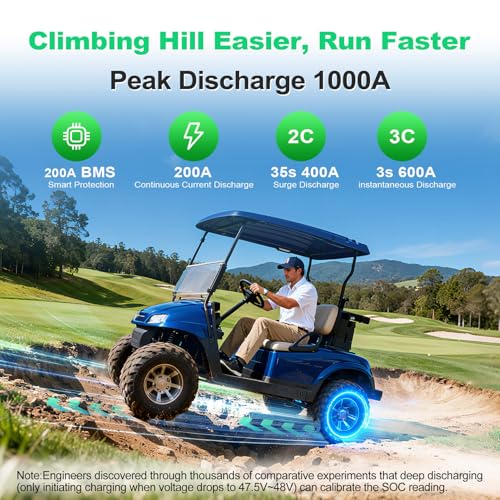
Power determines how well your 48V lithium golf cart battery delivers acceleration, starting performance, hill-climbing strength, and consistent speed under load. Look for a battery with enough continuous and peak power output for your cart, passengers, cargo, and terrain, and watch out for options that meet the voltage requirement but lack the cranking power or discharge capacity to maintain performance on hills or during hard starts.
Match the battery’s BMS output to your cart’s real current demand, not just the “48V” label: stock carts often need solid continuous amperage plus high peak current for starts, hills, rear seats, larger tires, or upgraded controllers. Look for a 51.2V LiFePO4 pack with a BMS that will not trip under acceleration, a clear peak-duration rating, proper main fuse sizing, and compatibility with your controller and solenoid. Owner feedback supports this priority: many buyers describe lithium swaps as a major upgrade over lead-acid, with steadier voltage, stronger acceleration, better hill performance, quicker pickup, and more consistent cart behavior across a ride.
Quality
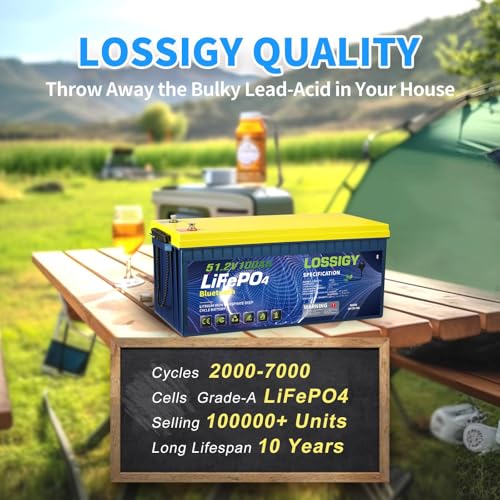
Quality matters because a 48V lithium golf cart battery has to handle vibration, heat, charging cycles, and regular high-current use without becoming unreliable. Look for solid construction, well-protected cells, a dependable battery management system, clean terminals, and clear safety certifications, and be cautious of vague specs, flimsy casing, or sellers that do not explain the battery’s components and protections.
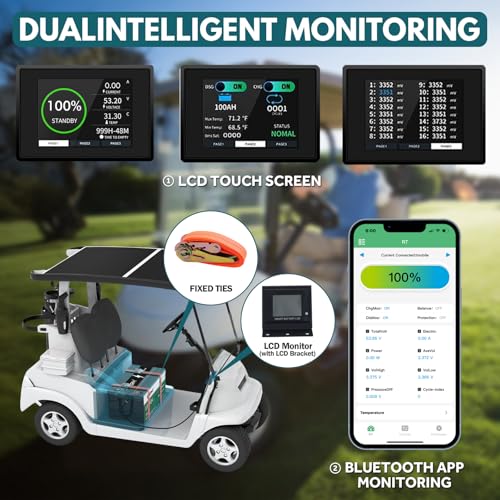
Prioritize a complete, well-protected LiFePO4 system with a reputable BMS, cell balancing, over-current protection, high/low-temperature cutoffs, short-circuit protection, and a rugged case that can tolerate vibration under a golf-cart seat. Check for clear documentation, accessible support, a usable state-of-charge display or app, and certifications or test documentation; avoid vague listings that do not publish BMS amperage, temperature limits, dimensions, or charging requirements. Owner sentiment backs the importance of a complete, consistent system: buyers repeatedly praise kits that arrive well packaged, include the needed parts, hold voltage well, free under-seat space, and make the cart feel refreshed after replacing lead-acid batteries.
Installation
A 48V lithium golf cart battery should be simple to install, especially if you’re replacing older lead-acid batteries or upgrading from a multi-battery setup. Look for a true drop-in fit with clear wiring instructions, compatible voltage and charger requirements, secure mounting, and straightforward connections to the cart’s controller and accessories. Watch out for conversions that need extra cables, trays, charger changes, or professional help, because those can add cost and complexity beyond the battery itself.
Before buying, map your cart’s exact conversion path: battery tray dimensions, hold-down method, cable reach, terminal orientation, charger-port wiring, key switch/solenoid wiring, and whether an onboard computer or factory charge circuit must be bypassed. Do not assume every 48V cart is plug-and-play; some models need bracket changes, wire rerouting, a new SOC meter, a lithium charger, or revised mounting hardware, and multiple lithium batteries should only be wired in series or parallel if the manufacturer explicitly allows it. Owner reports generally support DIY installation for handy shoppers, with many kits described as straightforward swaps that include a charger, display, cables, straps, or accessories, though some carts still require small fitment adjustments.
Runtime
Runtime determines how far you can drive on a single charge, so it matters if you use your cart for long rounds, neighborhood trips, hills, passengers, or accessories. Look for a 48V lithium battery with enough usable capacity for your normal route plus a safety margin, and remember that load, terrain, speed, tire pressure, and weather can all shorten real-world battery life. Also watch for owner feedback on whether the battery maintains range over repeated cycles, not just how it performs when new.
Size runtime by watt-hours and terrain, not by amp-hours alone: a 48V-class lithium pack with higher usable capacity can outperform lead-acid because it holds voltage flatter, but hills, soft tires, heavy passengers, cargo beds, rear seats, high speeds, and lifted carts can sharply increase draw. Choose enough capacity for your longest outing with reserve, and confirm the BMS can deliver that capacity continuously without cutting out on grades. Owner feedback aligns with this: buyers commonly report longer rides, multi-day use between charges, better range on hilly courses, and more usable power compared with older wet-cell or lead-acid banks.
Value
You want a 48V lithium golf cart battery that justifies its higher upfront price through longer life, lower maintenance, better usable capacity, and fewer replacements compared with lead-acid. Look beyond the purchase price and consider total cost over time, including charger compatibility, warranty strength, included accessories, and whether the battery’s range and performance match how you actually use your cart.
Evaluate total conversion cost, not just the battery: the best value for this niche includes a lithium-specific charger, charge port or adapter, SOC display or Bluetooth monitoring, main cables, fuse/breaker guidance, mounting straps or brackets, documentation, and warranty support. Avoid “battery-only” deals if you still need to buy a charger, meter, cables, or hardware separately, and factor in the saved maintenance from no watering, no acid corrosion, and fewer heavy batteries to replace. Owner sentiment supports complete kits as the stronger value, with buyers often saying the package delivers meaningful performance gains, includes key accessories, compares favorably with replacing multiple lead-acid batteries, and makes DIY conversion more economical than dealer-installed options.
Weight
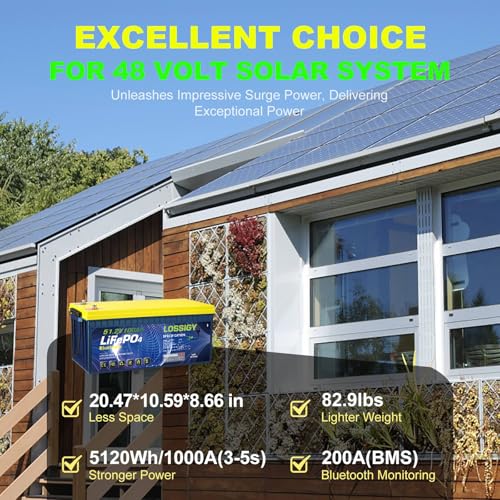
Weight matters because a lighter 48V lithium battery can make your golf cart easier to handle, reduce overall load, and sometimes improve responsiveness or range compared with a heavier setup. Look for a battery or battery kit you can safely lift and mount in your cart’s available space, but don’t judge by weight alone—verify that the capacity, discharge rating, and mounting hardware still match your cart and driving needs.
Use the weight savings deliberately: lithium can remove a large amount of mass from the cart, but the new pack must still be firmly restrained so it cannot shift during braking, bumps, or trail use. Expect quicker acceleration and a higher ride feel, but also check suspension stance, tire traction, braking behavior, and weight distribution, especially on lifted carts or carts with rear seats. Owner feedback strongly reinforces this benefit, with buyers repeatedly noting that replacing multiple lead-acid batteries makes installation easier, frees space, improves handling, increases pickup, and makes the cart feel lighter, quicker, and sometimes faster.
1,000,000+ shoppers use Buyer's Guide every week to find the best products and services online.

Helping millions of users make smarter purchases online.


