


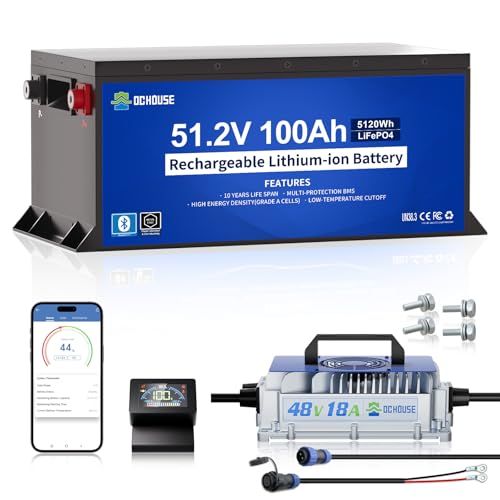
- Type: LiFePO4
- Voltage: 48V
- Capacity: 100Ah
- Monitoring: App, LCD screen
- Ideal For: Golf carts,





DC House 48V Pro Lithium Golf Cart Battery
Overview and real-world impressions

The DC House 48V Pro Lithium Golf Cart Battery is aimed at golf cart owners who want to move beyond traditional lead-acid packs and into a modern lithium setup that is lighter, more efficient, and generally easier to live with. In day-to-day use, the first thing most people notice is the change in how the cart feels. A lithium pack typically weighs far less than a comparable lead-acid bank, and that reduced weight can translate into more responsive acceleration, less strain climbing hills, and a cart that feels less “bogged down,” especially when carrying passengers or cargo. You also tend to get steadier power delivery across the charge cycle. Instead of the gradual sag that many users associate with lead-acid as voltage drops, lithium systems often keep performance more consistent until the battery management system decides it’s time to protect the pack and shut things down.
DC House markets the “Pro” angle as an upgrade-oriented battery with an integrated BMS (battery management system) designed to handle key protections such as overcharge, over-discharge, and over-current scenarios. In practical terms, that BMS is a big part of what makes a lithium golf cart battery approachable for regular owners rather than hobbyists. If your cart is used for regular rounds, neighborhood errands, property maintenance, or short commutes around a gated community, a 48V lithium pack like this can be a meaningful convenience upgrade because it reduces the maintenance routine. There’s no watering cells, no corrosion cleanup at the same scale, and far less guessing about whether the “last bar” on your gauge is about to drop you into crawling speed.
Another element that stands out with lithium conversions is charging behavior. Charging is typically faster and more efficient, and you’re not tied to the slow “finish” stage that lead-acid needs to balance and fully saturate. That said, it is still important that the charger is appropriate for the chemistry and voltage profile expected by the pack. When everything is matched correctly, the DC House 48V Pro Lithium Golf Cart Battery should feel like a modernized powertrain component rather than a consumable that constantly demands attention.
What to consider before buying (and what matters most)
Before purchasing the DC House 48V Pro Lithium Golf Cart Battery, the most important factor is compatibility with your cart’s electrical system. “48V” golf carts can be configured in multiple ways, and controllers, solenoids, and onboard electronics can behave differently under lithium’s flatter voltage curve and different charging characteristics. The safest approach is to confirm the nominal voltage and the maximum charge voltage expected by your setup, and to verify the battery is intended for golf cart use rather than generic deep-cycle applications. If your cart has a stock controller that is sensitive to voltage thresholds, you’ll want to ensure low-voltage cutoffs and controller settings won’t cause nuisance shutoffs.
The second most important factor is capacity, often expressed in amp-hours, because it is the best rough predictor of range in similar conditions. Range depends on terrain, tire pressure, payload, driving style, and cart condition, but capacity is still the lever you control at purchase time. If you routinely drive long loops, climb hills, or carry multiple passengers, erring toward higher capacity typically delivers the most satisfying ownership experience. A lithium pack that is “good enough” on paper can feel limiting if you frequently end trips near empty or if you want to avoid charging between outings.
Next, pay attention to discharge capability and surge current. Golf carts can demand significant current during starts, hill climbs, or when towing. A battery may be rated for a certain continuous discharge and a higher peak discharge for brief bursts. If those ratings are too low for your controller and motor combination, you can end up with BMS cutoffs under load, which feels like the cart suddenly losing power at the worst time. For users who have upgraded motors or controllers, current capability often becomes as important as capacity, because a higher-performance drive system can pull more current than the battery’s BMS is willing to allow.
Charging is another purchase-defining area. Many owners assume their existing lead-acid charger will work, but that is not always true. The best results usually come from using a lithium-compatible charger matched to the battery’s recommended charge voltage and algorithm. If DC House includes a charger or specifies an approved charger model, treat that guidance as essential rather than optional. Using the wrong charger can lead to incomplete charging, reduced longevity, or BMS protection events that interrupt charging.
Physical fitment and installation details matter more than people expect. Measure your battery tray and verify cable lengths, terminal orientation, and clearance for accessories. Some carts have tight under-seat compartments with limited airflow or limited room for securing the battery safely. Also consider whether you need additional components such as a reducer for 12V accessories, since many carts power lights, stereos, or USB outlets from a tap or separate 12V system. Lithium conversions are often cleanest when accessories are supported properly rather than improvised with questionable wiring.
Finally, climate and storage habits should influence your decision. Lithium batteries generally dislike being charged when the cells are below freezing unless the pack includes low-temperature charge protection or internal heating. If you store the cart in an unheated space during winter, you may need to plan around that with charging schedules or storage state-of-charge practices. Warranty terms, customer support responsiveness, and the clarity of documentation should also weigh into your choice, because these are high-value components and you want a manufacturer that can help if you run into a configuration question.
Common Questions
Will the DC House 48V Pro Lithium Golf Cart Battery work with my existing 48V golf cart? In many cases it will, but you should confirm your cart’s controller compatibility, your charger compatibility, and that the battery’s BMS discharge limits meet your motor’s peak current demands. If your cart has performance upgrades, double-check current draw requirements before buying.
Do I need a special charger, or can I keep my lead-acid charger? You generally should use a lithium-compatible charger that matches the voltage and charging profile specified for the battery. A lead-acid charger can undercharge, overcharge, or behave unpredictably with a lithium BMS, so it’s usually not the best choice even if it seems to “work.”
How much range will I get on a charge? Range depends on the battery’s amp-hour rating, terrain, payload, tire condition, and driving style. Lithium can help maintain consistent performance, but it doesn’t override physics. If you want more reliable all-day use, prioritize higher capacity over minimum upfront cost.
Is the installation difficult? Many owners find lithium installation straightforward, especially because it can reduce the number of individual batteries compared with multi-battery lead-acid setups. The key is securing the battery properly, using correctly sized cables, confirming fuse protection, and ensuring accessory power is handled safely.
What happens if the battery gets too low? The BMS typically prevents damaging over-discharge by cutting power at a set threshold. This protects the battery, but it can feel abrupt, so it’s wise to use a reliable state-of-charge meter and develop a charging routine that avoids routinely running to empty.
Overall, the DC House 48V Pro Lithium Golf Cart Battery is a compelling modernization upgrade for owners who value reduced maintenance, consistent power delivery, and the potential for better everyday performance. The best purchase outcomes come from focusing first on compatibility, current capability, and proper charging, then dialing in capacity based on how you actually use your cart. If those priorities line up with your needs, this battery can deliver a noticeably more convenient and confidence-inspiring golf cart experience.