


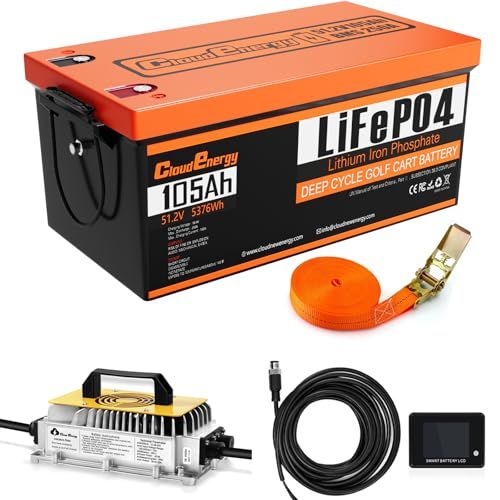
- Type: LiFePO4
- Voltage: 48V
- Capacity: 105Ah
- Monitoring: App, LCD screen
- Ideal For: Golf carts, trolling motors, marine engines





Cloudenergy 48V Lithium Golf Cart Battery
Overview and Real-World Performance

The Cloudenergy 48V Lithium Golf Cart Battery is aimed at golf cart owners who want to move beyond traditional lead-acid setups and into a lighter, more efficient, lower-maintenance power system. In practical terms, a 48V lithium battery can deliver steadier voltage under load than many lead-acid banks, which often translates into more consistent acceleration, less noticeable power sag on hills, and a cart that feels “stronger” later into the discharge cycle. For users who drive across varied terrain, carry passengers, or regularly climb moderate grades, that stability can be one of the most immediately noticeable upgrades.
Another major benefit is reduced maintenance. Lithium batteries are sealed and do not require watering, corrosion cleanup around terminals due to acid mist, or the same level of vigilance regarding equalization charging that flooded lead-acid packs demand. For many owners, that convenience alone justifies the switch, especially if the cart is stored in a garage where spills and fumes are a concern. The weight savings can also be meaningful. Replacing multiple heavy lead-acid batteries with a single lithium pack often reduces overall cart weight, which can slightly improve handling and efficiency and may reduce wear on some components over time.
Charging behavior is typically more user-friendly as well. Lithium packs generally accept charge efficiently and can recharge faster than lead-acid in many cases, depending on the charger and the battery management system. The Cloudenergy 48V Lithium Golf Cart Battery is designed to fit into this kind of modern ownership experience: plug in, charge, and drive without routine battery chores. The most important caveat is that “plug and play” depends on having compatible charging equipment and a system designed to work with lithium’s preferred charging profile.
Key Purchase Factors and What Matters Most
Before purchasing the Cloudenergy 48V Lithium Golf Cart Battery, the first factor to consider is compatibility with your cart’s voltage and electrical system. A 48V battery must match a 48V cart system, and it is important to confirm whether your cart is truly a 48V setup or a different configuration. Beyond voltage, verify that the battery’s continuous discharge capability aligns with your cart’s controller and motor demands. If your cart has been upgraded with a higher-amp controller, larger motor, or heavy accessory load, the battery must be able to supply the necessary current without triggering protective shutoffs. Among all factors, ensuring the battery can comfortably handle your cart’s peak and continuous current draw is one of the most important because it determines whether the cart will run reliably under acceleration and hill climbs.
Range expectations are the next major consideration. Range is influenced by capacity, terrain, driving style, tire choice, passenger load, and accessory use. A lithium upgrade often feels like it provides “more usable range” because voltage stays steadier until the battery is more deeply discharged, but you still need enough capacity to match your typical driving pattern. If you regularly take long neighborhood rides, use the cart for work around property, or drive on hilly routes, selecting a capacity that supports those habits will matter more than chasing a bargain price. For most buyers, capacity and current capability are the two most important purchase criteria because they define whether the battery meets daily needs without compromises.
Charging equipment and charge profile compatibility is another essential factor. Some users can reuse an existing charger if it supports lithium charging parameters and the correct termination behavior, while others should plan on a dedicated lithium charger designed for a 48V lithium pack. A mismatched charger can lead to incomplete charging, reduced performance, or long-term battery stress. It is also worth considering how and where you charge. If the cart is stored in a location where temperature swings are common, you should pay attention to the battery’s supported charging temperatures and any low-temperature charging protection features provided by the battery management system.
Battery management and protection features deserve careful attention because they influence safety and durability. A well-designed battery management system typically provides protection against overcharge, over-discharge, overcurrent, and overheating. These protections can prevent damage from user mistakes and help the battery last longer. In day-to-day use, good protection behavior can also prevent annoying interruptions. For instance, if a cart briefly demands high current during a steep climb, you want a battery that can supply that demand without frequently tripping into protection mode.
Physical fit and installation requirements can also be decisive. Some carts have tight battery bays, specific hold-down hardware, or cable routing that was designed around multiple lead-acid batteries. Switching to a lithium pack may require new mounting solutions, cable adjustments, or a different main disconnect arrangement. You should confirm dimensions, terminal type, and whether any adapter kit is needed. This is less glamorous than performance specs, but it can be the difference between a smooth weekend install and a frustrating series of return trips to the hardware store.
Finally, consider total cost of ownership rather than only the purchase price. Lithium batteries often cost more upfront but can deliver savings through longer service life, reduced maintenance, better efficiency, and less frequent replacement. The most important financial question is whether the battery’s expected lifespan and performance benefits match how often and how hard you use your cart. If your cart is used daily or seasonally with frequent cycling, the long-term value proposition tends to look better than it does for a cart that is only driven occasionally.
Common Questions
Will the Cloudenergy 48V Lithium Golf Cart Battery work with my existing 48V golf cart charger? It depends on the charger’s output profile. Many lead-acid chargers use charging stages and voltage targets intended for lead-acid chemistry, which may not be ideal for lithium. If your charger is specifically lithium-compatible for a 48V lithium pack, it may work well; otherwise, a lithium-specific charger is usually the safer choice for performance and battery health.
Do I need to modify my golf cart to install a 48V lithium battery? Some installs are straightforward, but it varies by cart. You may need different mounting hardware, adjusted cabling, or a new charger. It is also important to confirm that the battery’s discharge capability matches your controller and motor so the cart doesn’t experience protective shutoffs under high load.
How will lithium change the way my cart feels compared to lead-acid? Many users notice more consistent power delivery, especially as the battery state of charge drops. Instead of gradually feeling slower, the cart often maintains stronger performance for longer and then drops off more noticeably near the low end, depending on how the battery management system is configured.
Is it safe to leave the battery on the charger? With a proper lithium charger and a battery management system designed for the pack, charging is generally well controlled. That said, best practice is to follow the manufacturer guidance for storage and charging habits, especially if the cart will sit for long periods. Using the correct charger and avoiding extreme temperatures are key parts of safe long-term ownership.
What are the most important specs to verify before buying? Confirm that it is truly a 48V battery for a 48V system, verify capacity aligns with your range needs, and ensure the continuous and peak discharge ratings are sufficient for your cart’s controller, motor, and typical terrain. Those items most directly determine whether the battery will perform reliably in real driving.
Conclusion: The Cloudenergy 48V Lithium Golf Cart Battery is a compelling upgrade for owners seeking stronger, more consistent performance and a lower-maintenance ownership experience. The purchase decision is best guided by a few high-impact checks: current capability for your cart’s demands, capacity for your real range needs, and charger compatibility for safe, effective charging. If those fundamentals align, a 48V lithium pack can meaningfully modernize how a golf cart drives and how easy it is to own.