












We also considered 10 others:


Our Top Choice
Compare Features


The order above is not editorial opinion, and it is not paid placement. It comes from what shoppers across our network actually do - which countertop reverse osmosis filters they compare, and which they ultimately buy. We re-rank as new data comes in, so the long-term favorites have to keep earning their spot against new entrants. The full method, including how we make money.
Countertop Reverse Osmosis Filters Buyer's Guide
Countertop reverse osmosis is a tradeoff between serious contaminant reduction and countertop inconvenience: you avoid plumbing changes, but you must live with refilling tanks, dumping reject water, slower batch production, and a powered appliance on the counter. The sharpest checks are whether the unit has real RO certification or reduction data for your contaminants, and whether its tank size, wastewater handling, and filter schedule match how much drinking and cooking water your household actually uses.
Purity
Purity matters because it determines how much a filtration system can improve the water you drink, cook with, and use every day, including taste, odor, clarity, and the “softness” feel that affects skin, hair, fixtures, and appliances. Look for systems that target the specific issues in your water, such as sediment, chlorine, metals, chemicals, microbes, or hardness minerals, and be wary of vague filtration claims that do not clearly state what contaminants are reduced or how often filters need replacement.
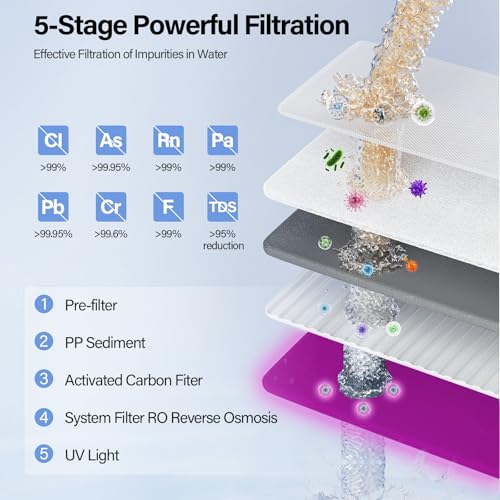
For purity, do not buy on “crisp water” claims alone: look for a true RO membrane with published reduction data or certification for the contaminants you care about, such as TDS, lead, arsenic, fluoride, nitrate, PFAS, VOCs, chlorine/chloramine, or cysts. If you use well water, check the incoming-water limits for hardness, iron, manganese, sediment, and bacteria; RO can polish water, but it is not a substitute for disinfection or whole-house pretreatment when the source water is biologically unsafe or heavily fouled. Also confirm whether the system includes prefilters, carbon stages, post-carbon, UV, or remineralization, and avoid units that show only a TDS meter as “proof,” because low TDS does not verify removal of every health contaminant. Owner feedback supports the upside here: buyers often report clearer, cleaner-tasting water, lower TDS, removed odors, and reassuring test results, especially when replacing chlorinated tap water, hard water, well water, or bottled-water hauling.
Taste
If your filtered water still tastes or smells off, you’re less likely to drink it or use it for coffee, tea, ice, and cooking. Look for a system designed to reduce common taste and odor issues such as chlorine, sulfur-like smells, or earthy notes, and check that its filter type matches the source of your problem. Watch for systems that improve taste without addressing broader contaminants if you also need filtration for health-related concerns.
For taste, decide whether you want pure RO water or RO water that has been remineralized, because straight RO can taste flat, slightly acidic, or “empty” to some people even when it is very clean. If your main complaint is chlorine smell, swampy odor, sulfur notes, or hard-water mineral taste, prioritize strong carbon pre/post-filtration and a fresh storage path; if you like mineral water, choose a system with a remineralization stage or plan to add minerals separately. Also check whether the clean-water tank or carafe is easy to wash, because stale stored RO water or neglected reservoirs can undo the taste benefit. Owners strongly reinforce that taste is a major reason to buy this category, with many describing the output as clean, crisp, refreshing, free of tap-water flavor, and a noticeable upgrade over hard, well, or chlorinated water.
Build
Build quality matters because a water filtration system sits under pressure and often near cabinets, floors, or appliances where leaks can cause damage. Look for sturdy housings, secure fittings, well-made valves, and clear installation hardware; watch out for flimsy plastic threads, vague connector specs, or owner reports of leakage, cracking, or difficult seal-ups.
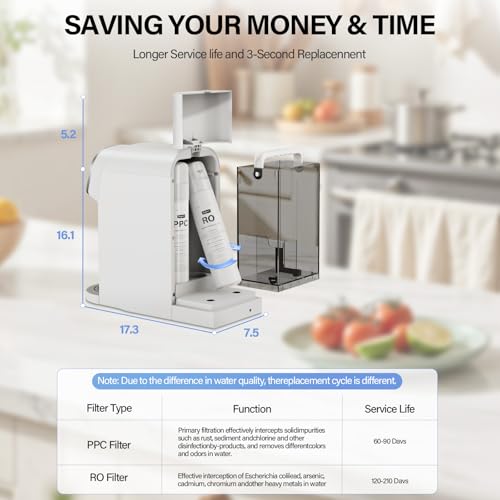
For build quality, focus on the parts that countertop RO units stress every day: removable feed and waste tanks, seals, pump, carafe, lid hinges, dispense buttons, and any hot-water components. Prefer sturdy BPA-free wetted materials, easy-to-seat tanks, leak detection or overflow protection, replaceable filters that lock in positively, and a design that does not tip or splash when the reservoirs are full. Avoid flimsy carafes, awkward tank handles, proprietary parts with unclear availability, or layouts that trap water in hard-to-clean corners. Owner sentiment generally backs well-designed units as dependable daily appliances, with buyers appreciating straightforward operation, reliable output, and designs that avoid complicated plumbing while still feeling solid once set up.
Usability
You’ll live with a water filtration system every day, so ease of use can matter as much as filtration performance. Look for straightforward controls, clear filter-life indicators, simple installation or refilling steps, and filter changes you can do without special tools or mess. Watch out for systems with awkward access points, frequent maintenance, or hard-to-find replacement filters, since those hassles can make you less likely to keep the system working properly.
For usability, calculate the real daily routine before buying: how often you will refill the raw-water tank, how often you will empty the reject-water tank, how quickly the clean carafe fills, and whether the batch size covers coffee, pets, cooking, humidifiers, or multiple people. Look for auto shutoff, clear tank markings, filter-life indicators based on use rather than vague time alone, simple priming, and controls that are readable in your kitchen lighting. If you choose a model with instant hot water, check temperature options, child-lock behavior, burn risk, descaling needs, and whether the hot function requires more frequent cleaning. Owners commonly find countertop RO appealing because setup and daily use are simple, plug-in operation avoids plumbing, automatic fill-and-stop behavior reduces attention, and guided interfaces or clear manuals make the machines approachable for renters and countertop-only kitchens.
Performance
You want a filtration system that consistently improves your water quality without slowing to a trickle, leaking, clogging too often, or requiring constant attention. Look for clear performance certifications or test data tied to the contaminants you care about, and make sure the system’s flow rate and capacity match your household’s daily use. Be wary of vague claims that it “purifies” water without specifying what it removes and under what conditions.
For performance, match output rate and recovery ratio to your household rather than assuming any RO unit is fast enough. Countertop RO often works in batches, so check clean-water capacity, time per tank, gallons per day, pure-to-drain ratio, membrane life, and whether high-TDS or hard water will slow production or shorten filter life. If you plan to use the water for ice, coffee machines, kettles, humidifiers, or cooking, make sure the unit can keep up without constant refilling; also check noise level, pump cycling, and whether it resumes correctly after power interruptions. Owner reports support strong real-world performance when the system is sized well, with buyers citing large TDS drops, dependable day-to-day use, quiet or unobtrusive operation, easy filter changes, and efficient designs that avoid under-sink complexity.
Installation
Installation matters because it determines whether you can set up the water filtration system yourself, need a plumber, or risk leaks and poor performance from an improper fit. Look for clear instructions, all necessary hardware, and compatibility with your sink, faucet, plumbing, countertop, or available under-sink space. Watch out for systems that require drilling, electrical access, unusual fittings, or frequent repositioning if you want a simpler setup.
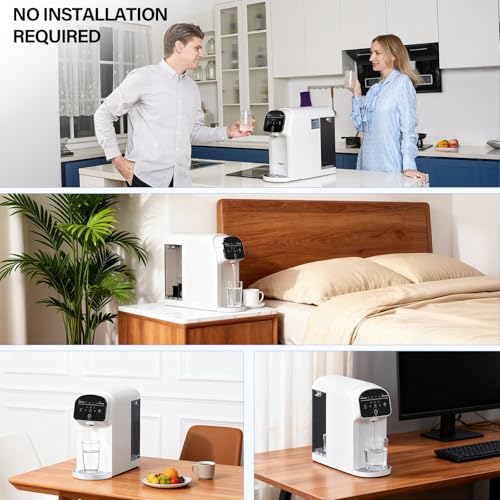
For installation, “countertop” does not always mean the same thing: some units are true plug-in tank systems, while others may need a faucet diverter, adapter, drain routing, or specific clearance. Before buying, measure counter depth, overhead cabinet height, carafe removal space, distance to an outlet, and whether the unit can sit level near a sink for filling and dumping. If it connects to a faucet, verify aerator thread compatibility and avoid setups that will not work with pull-down, sprayer, nonstandard, or touchless faucets. Also account for the first-use flush, filter priming, possible wastewater disposal, and rental rules. Owner sentiment is favorable for this dimension: shoppers often praise countertop RO systems because they avoid drilling, plumbing changes, and permanent installation, and many find setup manageable when instructions are followed closely.
1,000,000+ shoppers use Buyer's Guide every week to find the best products and services online.

Helping millions of users make smarter purchases online.


