Back Massagers Buying Guide
Posted on Wednesday, March 18, 2026
To keep this site free for consumers, we receive compensation for customer referrals.
Back Massagers Buying Guide
Back massagers are designed to provide targeted mechanical stimulation to muscles along the upper, middle, and lower back. These devices aim to replicate certain elements of manual massage through vibration, rolling nodes, compression, or percussive motion. For many people, they represent a convenient way to introduce muscle relief or relaxation into daily routines without requiring a separate appointment or specialized setup.
The category has expanded considerably in recent years, with many formats designed for different living spaces, mobility levels, and comfort preferences. Some models are built into cushions or pads, while others are handheld or wearable. Understanding how back massagers work and how their features vary can make evaluating options much more manageable.
How Back Massagers Support Muscle Relaxation
Muscle tension in the back is common in modern routines that involve extended sitting, repetitive movement, or physical strain. Back massagers are designed to apply rhythmic pressure or vibration to muscle groups in order to stimulate circulation and loosen tight areas. Many users incorporate them into short sessions during the day or as part of a relaxation routine in the evening.
Unlike manual massage, which relies on another person’s technique, these devices use mechanical systems to produce consistent movement patterns. This consistency allows users to focus on specific areas such as the lower back, shoulder blades, or spine-adjacent muscles. The goal is not to replicate professional therapy exactly, but to provide accessible muscle stimulation within a home environment.
How Back Massagers Deliver Muscle Stimulation
Most back massagers operate through a motorized system that drives movement patterns across the surface of the device. Depending on the design, this motion may involve rotating nodes, vibration plates, percussion heads, or compression chambers. Each mechanism produces a different sensation and level of pressure.
Rotating nodes are commonly used to simulate kneading movements along the back. Vibration-based systems distribute energy across a wider surface area, creating a lighter but more generalized stimulation. Percussive mechanisms deliver rapid pulses that concentrate pressure in smaller zones.
Many devices combine multiple mechanisms, allowing users to adjust intensity levels or switch between massage styles. This variability can help accommodate different comfort preferences or muscle sensitivity levels.
Common Types of Back Massagers
The back massager category includes several design formats, each suited to different environments and usage habits.
Cushion-Style Units
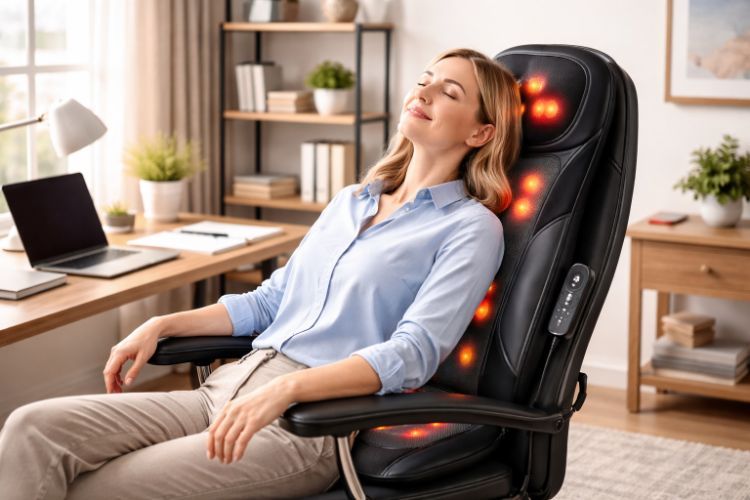
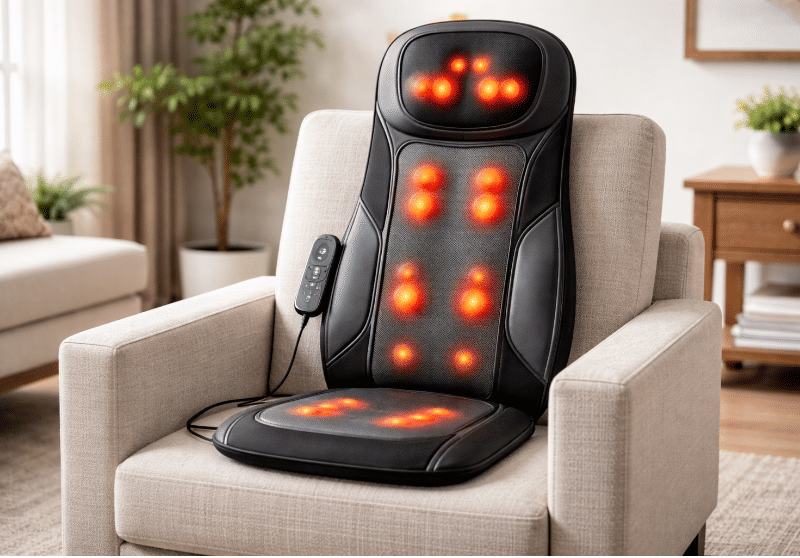
These devices are typically placed on a chair or sofa and include built-in massage nodes within a padded structure. Users sit or lean against the cushion while the device applies pressure along the back. This format often targets the full length of the back from shoulders to lower lumbar areas.
Handheld Devices
Handheld massagers allow users to guide the massage head directly across specific muscle groups. They are often used for targeted areas that may require more precise positioning. This design can also be used on other parts of the body beyond the back.
Wearable Wraps and Straps
Some back massagers are designed as wearable wraps that secure around the waist or shoulders. These devices provide localized pressure while allowing the user to move around more freely during use.
Full-Back Pads or Mats
Larger pad-style designs extend across the entire back and sometimes the seat area. These are commonly used on reclining chairs or flat surfaces and can deliver multiple massage zones simultaneously.
Features That Shape the User Experience
Back massagers vary significantly in how they deliver pressure, how adjustable they are, and how easily they fit into different routines. Evaluating these features can help clarify how a device may perform in daily use.
- Massage Mechanism – The type of motion, such as vibration, rolling nodes, or percussion, affects how pressure is distributed across the back.
- Intensity Controls – Adjustable power levels allow users to tailor the massage to their comfort level or muscle sensitivity.
- Target Zones – Some devices focus on specific regions like the lower back or shoulders, while others cover the entire back.
- Heat Function – Certain models include a warming element that adds gentle heat during operation.
- Ergonomic Shape – The design and curvature of the device influence how well it aligns with the natural contour of the spine.
- Portability – Compact designs may be easier to store or transport between rooms.
- Control Interface – Devices may use onboard buttons, handheld controllers, or simple preset programs.
- Session Timing – Some units automatically stop after a set period to structure usage sessions.
Understanding these elements can help readers recognize how different designs may influence comfort and usability.
Practical Performance Considerations
While back massagers can deliver noticeable muscle stimulation, their effectiveness often depends on positioning and duration of use. Cushion-style models rely on the user’s body weight to create pressure against the massage nodes. Handheld units rely on the user’s arm movement to guide the device.
Session length also plays a role in how the device feels over time. Short sessions may provide a gentle relaxation effect, while longer sessions may apply more sustained pressure to targeted muscles. Many users experiment with placement and duration to determine what feels most comfortable.
Noise level is another factor that may affect the experience. Motor-driven mechanisms can produce audible sound during operation, which may influence where and when the device is used.
Design Constraints and Practical Limits
Back massagers provide mechanical stimulation but do not replicate the adaptability of human touch. Manual massage therapists can adjust pressure and technique in response to muscle tension or feedback, while mechanical devices operate through preset movement patterns.
Pressure depth can also vary depending on the design. Some devices provide surface-level vibration, while others apply deeper pressure through rotating nodes or percussion mechanisms. The level of intensity that feels comfortable can differ widely from one user to another.
Additionally, body shape and height may influence how well certain devices align with specific muscle areas. For example, massage nodes designed for shoulder positioning may sit higher or lower depending on the user’s posture and chair height.
Evaluating Options with a Clear Perspective
The back massager category includes a wide range of designs that vary in size, mechanism, and intensity. Identifying how and where the device will be used can help narrow the field of possibilities. For example, some households prioritize portability, while others may focus more on full-back coverage.
Understanding the different formats, mechanisms, and feature sets can make the evaluation process much more structured. With a clear sense of personal comfort preferences and intended use, comparing available options becomes easier and more informed.
For readers exploring the category further, continuing to review educational resources and category overviews can provide additional perspective. Visit our site for more resources that break down product categories and what to look for when evaluating them.

Related Blog Posts