


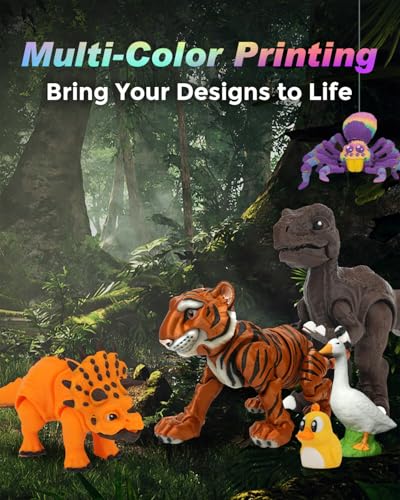


- Type: FDM
- Build Volume: 220mm x 220mm x 220mm
- Max Print Speed: 600mm/s
- Build Plate: Magnetic spring steel
- Resume Printing: Power failure, filament exhaustion





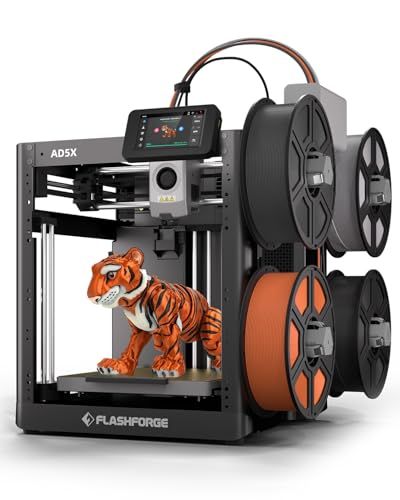
FLASHFORGE AD5X 3D Printer
Overview and First Impressions

The FLASHFORGE AD5X 3D Printer positions itself as a practical, modern FDM printer aimed at users who want reliable day-to-day printing without turning every project into a calibration exercise. It’s the kind of machine that tends to appeal to a wide range of makers: beginners who want a smoother on-ramp to 3D printing, hobbyists who print often and value consistency, and small workshops that need a dependable tool for prototypes, jigs, fixtures, and functional parts. In that sense, the AD5X is less about flashy gimmicks and more about the experience of getting from model to finished part with fewer headaches.
In typical use, what stands out most is the “workflow feel” of the printer. A good 3D printer isn’t just about peak speed or a single spec on a datasheet; it’s about whether the printer behaves predictably across many prints, whether it recovers gracefully from small mistakes, and whether routine actions like loading filament, starting a print, or cleaning up a bed are straightforward. The AD5X is designed to deliver a controlled and repeatable experience, which is ultimately what most users want after the novelty of the first few prints wears off.
Print quality on a printer in this class is usually strongest when the machine is mechanically stable, the extrusion system is consistent, and the bed leveling system is dependable. Those are the fundamentals that keep layer lines uniform, help corners stay sharp, and prevent first-layer issues that can ruin a long print early. When evaluating the AD5X, it’s worth thinking in terms of complete prints rather than test cubes: tall parts that can wobble, large flat parts that can warp, and functional parts where dimensional accuracy matters. A printer that handles those scenarios well is far more valuable than one that only excels at quick demos.
Noise, footprint, and general livability also matter. Many people print in a home office, bedroom-adjacent space, or shared workshop. If a printer is too loud, too fiddly, or too messy to maintain, it gets used less, no matter how good the specs look. The AD5X aims to be a printer you can live with, not just a printer you tolerate. For most buyers, that’s an underrated advantage.
What to Consider Before Buying (and What Matters Most)
Before purchasing the FLASHFORGE AD5X, it helps to be clear about what you want to print and how you plan to use the machine. The most important factors are reliability of the first layer, consistency over long prints, material compatibility for your intended filaments, and the overall ecosystem of software and replacement parts. Many buyers focus heavily on maximum speed, but for real-world use, a printer that finishes prints successfully is usually more valuable than one that prints fast on paper. Speed is only meaningful when it doesn’t trade away adhesion, accuracy, and surface finish.
Build volume is another consideration, though it’s often misunderstood. Bigger isn’t always better if it comes with compromises in heating uniformity or rigidity, but too small can be limiting if you want to print helmets, enclosures, or larger functional assemblies. If your projects are mostly brackets, mounts, figurines, and household parts, a moderate build area can be perfect. If you routinely need large cosplay parts or big architectural models, you should confirm the AD5X can accommodate them without excessive splitting and gluing. The most important part is matching the build volume to your actual projects rather than hypothetical future ones.
Bed leveling and Z-offset control are central to the ownership experience. New users often struggle most with first-layer calibration, so an automatic leveling system that is easy to run and holds its settings can dramatically reduce frustration. Equally important is how accessible the fine adjustment is for the first layer. Even with auto leveling, different filaments and build surfaces sometimes want small tweaks. A printer that makes that adjustment intuitive will save time and wasted filament.
Material support is where you should be honest about your needs. If you primarily print PLA and PETG, most modern printers can do a good job. If you plan to print TPU, you’ll care more about the extrusion path and how well the printer handles flexible filament without buckling. If you plan to print ABS, ASA, nylon, or other engineering materials, you’ll care about higher stable nozzle temperatures, bed temperature, and ideally an enclosure to manage warping and fumes. If the AD5X is used mostly for PLA and PETG with occasional specialty filament, it can be a strong fit; if your goal is heavy use of warp-prone materials, you should factor in the environment you’ll print in and whether you’re willing to add an enclosure or control drafts.
Software and workflow can make or break the experience. A printer that integrates smoothly with your slicer, has sensible default profiles, and provides consistent results with minimal tweaking is a practical advantage. Many people underestimate the value of good profiles because they only learn the hard way how much time can be lost chasing stringing, poor overhangs, or inconsistent infill. If the AD5X comes with well-tuned profiles and a clean path to printing from your computer or network, that convenience becomes a daily benefit.
Maintenance and parts availability are the unglamorous but crucial topics. Nozzle clogs happen, build surfaces wear out, and fans eventually get noisy. The key question is whether those parts are easy to access and whether replacements are affordable and easy to source. If you are buying your first printer, you want a machine that doesn’t require frequent deep maintenance. If you are an experienced user, you may prioritize how quickly you can service the hotend, swap a nozzle, or replace a worn consumable. For most people, the most important purchasing factor after basic print quality is maintainability, because it determines whether the printer remains enjoyable after months of ownership.
Finally, consider safety and placement. If you print around kids or pets, you’ll care more about exposed hot parts, moving mechanisms, and whether the printer can be placed where it won’t be bumped. If you plan to print long overnight jobs, thermal protection, stable wiring, and a machine that behaves predictably are essential. It’s easy to focus on what the printer can do when you’re watching it, but the real test is how confidently you can let it run when you’re not.
Common Questions
Is the FLASHFORGE AD5X a good choice for beginners? Yes, especially if you want a printer that emphasizes consistency and a smoother setup experience. Beginners benefit most from stable first layers, straightforward filament loading, and slicer profiles that work without endless trial and error.
What filaments should I plan to use with the AD5X? PLA is the easiest starting point and is ideal for decorative parts, prototypes, and many household prints. PETG is a good next step for parts that need more heat resistance and toughness. If you want to print TPU or more demanding materials, confirm the printer’s recommended temperature range and be prepared for extra tuning and environmental control.
How important is automatic bed leveling, and does it replace manual calibration? Automatic leveling is very important because it reduces first-layer failures and compensates for slight bed unevenness. It doesn’t completely replace manual calibration because you may still need to fine-tune Z-offset for different filaments or build surfaces, but it makes the process far easier and more repeatable.
Should I buy this printer mainly for speed? It’s better to buy it for successful prints and ease of ownership rather than chasing maximum speed. If you print too fast without the right tuning, you can lose surface quality and dimensional accuracy. A printer that can print at reasonable speeds consistently will outperform a “fast” printer that fails often.
What should I check right after unboxing? Check that the frame is tight, the bed is clean and properly mounted, the filament path is unobstructed, and that the first-layer calibration process makes sense to you. Running a small test print is useful, but a larger flat print soon after is an even better indicator of bed adhesion and leveling consistency.
Overall, the FLASHFORGE AD5X 3D Printer is a sensible choice for users who value a reliable printing routine and a printer that stays manageable over time. The most important buying considerations are dependable first layers, long-print consistency, realistic material needs, and how easy the printer is to maintain. If those priorities match what you want from 3D printing, the AD5X is likely to feel less like a finicky project and more like a tool you can count on.