


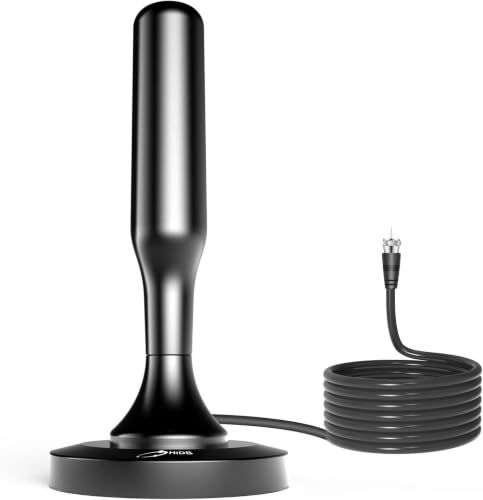
- Range: 150 miles
- Location: Indoor
- Signal Booster: Yes
- Cable Length: 10'
- Supports: 4K, 1080p





HIDB TV Antenna
Overview and real-world performance

The HIDB TV Antenna is designed for viewers who want to pull in local broadcast channels without paying ongoing cable or satellite fees. Like most modern over-the-air antennas in this category, it aims to receive free HD signals from nearby TV towers, including major networks and local stations, as long as reception conditions cooperate. In practice, the experience of using an antenna like the HIDB tends to be less about the “HD” label on the box and more about your home’s geography, building materials, and how thoughtfully you set it up. When placement is favorable, the antenna can deliver a clean picture that looks excellent, since broadcast TV quality is determined primarily by the station’s transmission and your signal integrity rather than an antenna “upscaling” anything.
Setup is typically straightforward: connect the coaxial cable to the antenna input on your television (or a tuner box), position the antenna, and run a channel scan. The scan step matters more than people expect; rescanning after repositioning can turn “no signal” channels into stable ones because the TV locks onto whatever is strongest at the moment of the scan. Day-to-day use is usually hands-off once you find a sweet spot, though changing seasons, new construction nearby, or even moving furniture can sometimes affect reception in fringe areas.
Where the HIDB TV Antenna tends to succeed is as a cost-effective solution for households that mainly watch local news, sports broadcasts carried on local affiliates, and major network programming. It can be especially appealing as a companion to streaming services, filling in live channels without another monthly bill. That said, expectations should be realistic: an indoor antenna may not match the stability of an outdoor roof-mounted model if you are far from towers, surrounded by hills, or dealing with a lot of signal reflections in dense neighborhoods. The antenna can still be worth trying, but the deciding factor is almost always your reception environment rather than the brand name alone.
Key purchase factors and what matters most
Before buying the HIDB TV Antenna, the most important consideration is your distance and line-of-sight to broadcast towers. Many people focus on claimed range, but range figures are often marketing shorthand rather than a guarantee. What truly predicts success is whether you have relatively unobstructed signal paths and whether the strongest towers are within a practical distance for an indoor setup. If you live close to towers in a metro area, you can often get many channels reliably. If you live farther out, an attic or outdoor antenna, a higher mounting point, or a more directional design may be more dependable.
Indoor placement conditions are the next major factor. Antennas generally perform better when mounted high, near a window, and away from large metal objects, appliances, and dense walls. If your home has foil-backed insulation, metal siding, radiant barriers, or thick masonry, signals can be weakened before they ever reach the antenna. Even in apartments, simply moving the antenna from behind a television to a window-facing wall can change results dramatically. If you’re evaluating the HIDB, consider whether you have good placement options and whether you can route the cable neatly to a preferred location without creating clutter.
Another key factor is whether your area uses both UHF and VHF for the channels you care about. Many modern antennas are optimized primarily for UHF because so many digital stations broadcast there, but some markets still rely on VHF for important channels. Before purchasing, it helps to look up your local stations and note their real channel frequencies, not just the virtual channel numbers you see on-screen. If your must-have station is VHF and your antenna placement is challenging, that can be the difference between consistent reception and constant dropouts.
Amplification is also worth thinking about, but it is not automatically better. Some antenna packages include an amplifier or allow one to be added. An amplifier can help when cable runs are long, when you split the signal to multiple TVs, or when signals are weak but not too noisy. However, if you are close to towers, amplification can overload the tuner and actually reduce stability. A user deciding on the HIDB should consider whether they plan to connect multiple televisions or run long coaxial distances, because that is where amplification tends to offer the most benefit. If you are within a strong-signal area and connecting to one TV, keeping the signal path simple is often best.
Cable quality and connectors matter more than most shoppers expect. A flimsy coaxial cable, loose fittings, or cheap splitters can introduce loss and noise that shows up as pixelation, audio dropouts, or channels disappearing during bad weather. If you purchase the HIDB TV Antenna, it’s wise to plan for a clean cable run and minimize unnecessary adapters or splitters. If you must split to multiple TVs, a quality splitter rated for the right frequencies, and possibly a distribution amplifier, will provide a better experience than the cheapest option in a drawer.
Finally, consider usability details such as aesthetics and mounting flexibility. Indoor antennas are visible, so whether it can be placed flat, discreetly mounted, or positioned in a way that suits your room can affect satisfaction. The “best” antenna on paper is not helpful if it ends up tucked behind a cabinet where signal is poor. The most important factors overall are tower proximity and direction, placement options in your home, and whether your channels require VHF as well as UHF. Everything else tends to be secondary compared to those fundamentals.
Common Questions
Will the HIDB TV Antenna give me every channel in my area? It can receive the channels that broadcast from towers your antenna can reliably pick up, but it will not guarantee every station. Availability depends on tower distance, terrain, building interference, and whether your local stations broadcast on frequencies your setup can capture well.
Do I need an amplifier with the HIDB TV Antenna? Not always. An amplifier can help if signals are weak, if your coaxial cable run is long, or if you split the signal to multiple TVs. If you are close to broadcast towers, amplification may cause overload and make reception worse, so it’s often best to try without one first.
Why do some channels break up or disappear at night or during bad weather? Signal conditions can change due to atmospheric effects, wind moving trees, rain, or shifting interference from electronics. If you are on the edge of reception, small changes can push a channel from stable to unstable. Repositioning the antenna, raising it, or improving cable quality often helps.
Do I have to rescan channels after moving the antenna? Yes, in many cases. TVs and tuner devices “lock” channels during a scan based on the current signal. If you move the antenna and do not rescan, the tuner may not discover newly receivable stations or may keep a weaker version of a channel that could be stronger after repositioning.
Can I use the HIDB TV Antenna with a streaming device or smart TV? You can use it with any TV that has a coaxial antenna input and an ATSC tuner, which most modern TVs include. The antenna delivers live broadcast TV; streaming devices do not replace the tuner, but they pair nicely because you can switch between free live channels and apps.
Overall, the HIDB TV Antenna is a practical option for cutting monthly TV costs and adding live local channels to a streaming-first setup. Its success will hinge less on the product label and more on the fundamentals of antenna reception: tower distance, home layout, and careful placement. If you can place it near a window, aim it toward your strongest towers, and keep your cabling clean, it can provide a satisfying lineup of free HD channels with minimal ongoing effort.