


- Speed: 0.6 - 6.2 mph
- Incline: 2 manual positions
- Presets: 12 workouts
- Belt: 15" wide x 38" long
- Weight Limit: 300 lbs





Aiteid Treadmill with Incline Review
Overall Experience and Performance

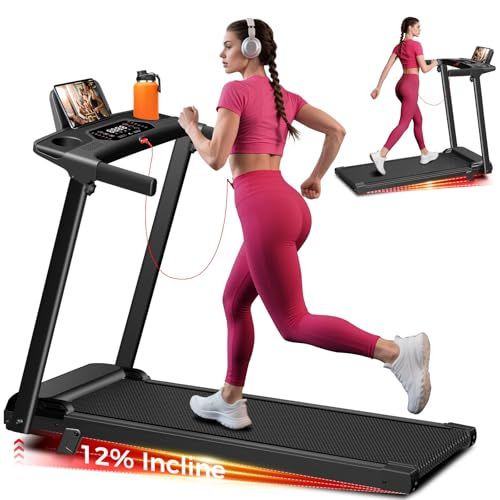
The Aiteid Treadmill with Incline is aimed at home users who want a compact cardio solution with the added training flexibility that incline provides. In day-to-day use, it’s best understood as a practicality-first treadmill: it prioritizes convenience, space awareness, and approachable features over the heavy-duty feel and high top-end speed you’d expect from commercial machines. For many households, that tradeoff is exactly the point. It’s the kind of treadmill you can set up in a spare room or shared space, use for daily walking, light jogging, or interval sessions with incline, and then tuck away when you need the floor back.
The headline benefit is the incline function, which helps you increase intensity without necessarily increasing speed. That matters for users who prefer brisk walking or are easing into running because incline can raise heart rate, build leg strength, and add variety while staying at manageable speeds. If your main goal is to burn calories, improve endurance, or get more out of shorter workouts, incline capability can be a meaningful upgrade compared to flat-only treadmills. It also makes steady-state sessions feel less monotonous because you can modulate effort in small steps rather than relying solely on pace changes.
In terms of ride quality, what most users notice is whether the belt feels stable underfoot and whether footfalls sound controlled or harsh. Home treadmills in this class tend to do best when they’re used as intended: walking, power walking, and moderate jogging rather than sustained, high-speed running. If you’re primarily a walker or you mix walking with short jogging bursts, the Aiteid format can make sense because it’s built around everyday usability. If you’re training for long-distance running at faster speeds, you’ll likely care more about a larger deck, a more powerful motor, and a heavier frame than this type of treadmill typically provides.
The console experience generally centers on the basics: speed and incline adjustments, a readable display, and simple workout tracking. The key question is less about whether it has every metric and more about whether the controls are easy to reach and responsive while you’re moving. Convenience features like preset workouts, quick-access buttons, and stable handrails tend to matter most for new treadmill owners because they reduce friction and increase the likelihood that you’ll actually use the machine consistently.
Factors to Consider Before Buying
Before purchasing the Aiteid Treadmill with Incline, the most important factors come down to how you plan to use it, where you’ll place it, and what kind of long-term reliability you expect. The first consideration is your primary training style. If your workouts are mostly walking, incline walking, and occasional jogging, incline becomes a high-value feature because it significantly broadens workout variety without demanding a larger footprint. If your goal is frequent running with longer sessions, pay close attention to the treadmill’s continuous power expectations, deck size, and overall weight capacity, since those elements correlate strongly with stability and comfort at higher speeds.
Space and storage needs are often the deciding factor in home purchases. Measure the area where you’ll use the treadmill, but also think about clearance behind the belt and to the sides for safe step-off and airflow. If you’ll be folding or moving the treadmill regularly, consider how easy it is to tilt, roll, and lock in place. A treadmill that is theoretically foldable can still be annoying if it’s awkward to lift or if the folded footprint blocks a doorway or closet. In many households, the “will I actually put it away” question matters more than the folded dimensions printed on the listing.
Incline type is another key detail. Some treadmills offer manual incline (you stop and adjust), while others offer powered incline you can change mid-workout. Powered incline is far more useful for intervals and for keeping your training engaging because you can transition smoothly without breaking rhythm. If the Aiteid model you’re considering includes powered incline, that tends to be one of the biggest practical upgrades for real training variety. If it’s manual, it can still be worthwhile, but you’ll likely use it less frequently unless you enjoy set-it-and-forget-it sessions.
Comfort is strongly influenced by deck length and belt width, especially for taller users or anyone with a longer stride. Walkers can tolerate smaller decks more easily, but runners often feel cramped if the usable belt area is short. A related point is cushioning. Some cushioning helps reduce joint impact, but too much softness can feel unstable for faster running. The best approach is to align the expected “feel” with your primary activity: walkers tend to appreciate cushioning more, while runners often prioritize firmness and stability.
Noise is also worth considering if you live in an apartment, have sleeping children nearby, or plan to exercise early or late. Motor noise, belt sound, and vibration through the floor can vary widely depending on the surface. A mat can help protect flooring and reduce vibration, but the treadmill’s inherent stability still matters. Reliability and maintenance should be viewed realistically: home treadmills generally need periodic belt lubrication, occasional belt alignment checks, and basic cleaning to keep dust out of moving parts. If you want the lowest-hassle ownership experience, prioritize a model that makes these tasks straightforward and has clear instructions and accessible support.
If you had to rank what matters most for the majority of buyers, the top priorities are fit for your workout type, available space, incline usability, and stability at your intended speed. Features like app connectivity and extra metrics are nice, but they typically matter less than whether you feel safe, comfortable, and motivated to use the treadmill multiple times per week.
Common Questions
Is the Aiteid Treadmill with Incline good for beginners? Yes, it can be a good fit for beginners because incline allows you to increase intensity without needing to run, and the overall home-focused design tends to emphasize straightforward controls. Beginners should still confirm that the speed range and deck size match their comfort level.
Can I use incline for interval training? If the model has powered incline that can be adjusted during the workout, incline intervals are one of its best uses. You can alternate between flat and elevated segments to raise heart rate and build leg strength. If the incline is manual, you can still do intervals, but you’ll need to pause to adjust, which interrupts the flow.
How much space do I need? You’ll need enough room for the treadmill’s footprint plus clearance to step on and off safely. Plan for extra space behind the belt in case you need to step off quickly, and consider ceiling height if you’re taller and will use incline, since incline effectively raises your standing height.
Is it suitable for running? It can work for light to moderate jogging depending on your size, stride length, and the treadmill’s deck dimensions and motor capability. For frequent, faster running or longer sessions, you should prioritize a longer deck, higher continuous motor capacity, and a heavier frame, which may point you toward a more robust category of treadmill.
What maintenance should I expect? Expect basic upkeep such as keeping the belt clean, checking alignment, and lubricating as recommended by the manufacturer. Regular maintenance helps reduce noise, improves belt feel, and can extend motor life.
As a home treadmill, the Aiteid Treadmill with Incline is most compelling for users who want a space-conscious machine with the extra challenge and variety that incline provides. If you match the treadmill to your primary use case, confirm the deck size and incline type, and plan for simple routine maintenance, it can be a practical way to build consistent cardio training at home.