







We also considered 10 others:


Our Top Choice
The order above is not editorial opinion, and it is not paid placement. It comes from what shoppers across our network actually do - which solar panels for rvs they compare, and which they ultimately buy. We re-rank as new data comes in, so the long-term favorites have to keep earning their spot against new entrants. The full method, including how we make money.
Solar Panels for RVs Buyer's Guide
RV solar is a space-and-compatibility problem as much as a wattage problem: the best panel is the one that produces usable charging on your roof, at your campsite angle, and within your battery or power-station input limits. Shoppers should look past headline watts and check real-world output, shade behavior, mounting format, connector/controller compatibility, and whether the build can survive road vibration and outdoor handling.
Real Output
Panel ratings are measured under ideal lab conditions, while RV use involves heat, changing sun angle, haze, clouds, and imperfect placement. A good RV panel should deliver dependable charging across a range of conditions, not only during peak midday sun.
Prioritize panels with credible real-world output, not just a high nameplate wattage. For RV use, compare expected daily watt-hours, not only peak watts: a panel that briefly touches its rating may still underperform if it drops sharply with heat, haze, or imperfect angle. For portable panels, expect output to depend heavily on tilt and orientation; for roof panels, remember that vents, air conditioners, antennas, and roof racks can steal production during parts of the day. Owner feedback strongly supports weighting this dimension heavily: buyers repeatedly reported panels meeting, nearing, or even exceeding rated wattage in favorable sun, while others noted meaningful charging in thick fog, poor weather, and less-than-perfect conditions. The main caution from owners is that a 100W-class panel should not be expected to deliver a constant full 100W unless sun and positioning are ideal.
System Fit
RV solar only works well when the panel’s voltage, current, connectors, and charge-control path match the system being charged. Mismatches can reduce output, trip input limits, or create unsafe battery charging conditions.
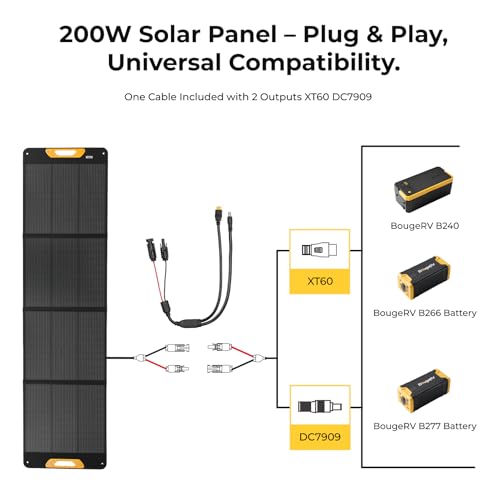
Before buying, match the panel’s open-circuit voltage, operating voltage, current, and connector type to your charge controller, RV solar port, battery chemistry, or portable power station input limit. A raw panel should normally charge a 12V RV battery through a suitable solar charge controller, not directly, unless the kit includes proper regulation. Check polarity on RV sidewall ports, MC4-style connectors, SAE adapters, alligator clips, extension cables, and fused battery leads; reversed or undersized wiring is a common failure point in RV installs. Owner sentiment backs this as a major separator: shoppers praised panels that worked reliably with common power stations, RV and van batteries, 12V setups, and backup-generator-style systems. Included cables, adapters, alligator clips, and direct battery hookup options were repeatedly called out as making setup and charging easier.
RV Fit
RV shoppers must decide between permanently mounted roof panels and portable folding panels, each with different tradeoffs. Roof panels save campsite effort but live with fixed angles and roof shade, while portable panels can chase sun but require setup, storage, and cable management.
Choose the format around how you camp. Rigid roof panels are best when you want automatic daily charging while driving or parked, but measure roof space carefully around vents, skylights, air conditioners, antennas, and walkable zones. Portable folding panels are better when you park in shade and place the panel in sun, but look for stable kickstands, enough cable length, manageable folded size, strain-relieved hinges, and a case that protects connectors during travel. Owners valued compact panels that produced useful power in tight installs and folding kits that packed easily for vehicle and camping setups. They also praised handles, carry bags, storage pockets, and light-enough designs, while noting that high-wattage folding panels can still be heavier than expected.
Outdoor Build
RV panels face road vibration, wind load, UV exposure, moisture, dust, and repeated setup or stowage. Strong construction matters because a small frame, hinge, cable, or junction-box weakness can turn into lost charging far from shore power.
For roof-mounted RV panels, look for rigid frames, solid corner protection, sealed junction boxes, UV-resistant cabling, corrosion-resistant hardware, and mounting methods rated for highway vibration and wind. For portable panels, inspect hinge design, fabric or laminate edges, kickstand hardware, cable strain relief, and whether the surface can tolerate repeated packing, grit, and outdoor moisture. Avoid treating “water resistant” as equal to submersion-proof, and do not rely on a flimsy stand or loose roof hardware in gusty campsites. Owner reports were largely positive on sturdy frames, clean assembly, heavy-duty materials, and reliable months-long use. The mixed evidence is important too: some buyers described dents from inadequate packaging, panels arriving damaged, or early failures that required replacement support.
Shade Handling
RV roofs and campsites often create partial shade, which can hurt solar production more than new buyers expect. Cell layout, bypass behavior, panel efficiency, and placement strategy determine how much charging remains when conditions are imperfect.
If your RV roof has obstructions or you often camp under trees, prioritize shade-tolerant layouts, efficient cells, and wiring plans that limit one shaded panel from dragging down the whole array. Higher-efficiency panels help when roof space is limited, and bifacial designs can add production from reflected light when mounted or placed where the rear side can actually see bright surfaces. Consider parallel wiring or multiple controllers for shade-prone arrays, and leave air gap under roof panels where possible because heat reduces output. Owner sentiment repeatedly praised strong behavior in imperfect light, partial shade, poor weather, and non-ideal placement. Buyers also noticed that compact high-output panels can make smaller roof or vehicle installs more practical.
Array Value
The best value in RV solar is not simply the cheapest panel; it is the most dependable usable charging for the space, wiring, controller capacity, and battery bank. Expansion planning prevents buying panels that work alone but become awkward when the system grows.
Judge value by usable watt-hours per day, roof square foot, controller headroom, and installation effort. If you plan to expand, buy panels with electrical specs that can be combined cleanly with future panels, and make sure the charge controller, fusing, wire gauge, and roof routing can handle the larger array. A lower-output panel may be a smart portable backup, while a compact higher-output panel can be worth it when roof space is the limiting factor. Owners frequently described strong value when output compared favorably with expectations, when panels delivered their advertised class instead of feeling overhyped, and when construction quality matched the use case. Several also reported that effective battery-bank charging reduced or avoided generator use after installation.
1,000,000+ shoppers use Buyer's Guide every week to find the best products and services online.

Helping millions of users make smarter purchases online.


