












We also considered 10 others:


Our Top Choice
Compare Features


The order above is not editorial opinion, and it is not paid placement. It comes from what shoppers across our network actually do - which seated ellipticals for seniors they compare, and which they ultimately buy. We re-rank as new data comes in, so the long-term favorites have to keep earning their spot against new entrants. The full method, including how we make money.
Seated Ellipticals for Seniors Buyer's Guide
For seniors, a seated elliptical has to balance meaningful leg movement with safety: it should improve daily activity without demanding balance, deep knee bend, or bending down to adjust controls. The sharpest checks are chair fit and knee clearance, stable non-skid operation, easy controls or remote access, and whether the unit is light enough to reposition without creating a fall or back-strain risk.
Ease
You’ll use an elliptical more consistently if starting, adjusting, and ending a workout feels straightforward. Look for intuitive controls, clear resistance and incline adjustments, an easy-to-read display, and handles or pedals that feel natural to use. Watch out for cluttered consoles, confusing menus, or features that require too much setup before you can simply get moving.
Choose a seated elliptical that can be started, stopped, and adjusted from the seated position, ideally with a simple remote or clearly reachable controls; avoid models that require frequent bending to the floor, confusing mode sequences, or awkward setup. For seniors, also check that the pedals are easy to place feet into, the motion starts smoothly at low speed or resistance, and the unit works with the chair they actually use without causing knees to hit a desk or forcing hip strain. Owner feedback supports this priority: buyers often say these machines are quick to set up, straightforward to operate, practical for limited mobility, and easier to keep in a daily routine when remote controls eliminate bending down.
Build
A well-built elliptical feels steady under you, with a frame that doesn’t wobble, creak, or flex when you increase resistance or pick up your pace. Look for sturdy construction, smooth-moving parts, and enough overall weight or floor contact to keep the machine planted, especially if you’re taller, heavier, or plan to train hard. Watch out for lightweight frames, loose-feeling handlebars, or pedals that shift side to side, since poor stability can make workouts feel less comfortable and less safe.
Prioritize a stable, low-wobble frame with non-slip feet, smooth pedal travel, and enough weight to stay planted during use; avoid flimsy units that creep forward, rock side to side, or feel jerky at the start of each stride. For older users, build quality is also a safety issue: a machine that shifts underfoot can encourage overreaching from the chair, while rough motion can irritate knees or hips. Owner sentiment lines up with this: many buyers describe well-made units as sturdy, smooth, quiet, stable during pedaling, and reliable enough for daily seated routines, including gentle circulation and recovery-style use.
Workout
Your workout experience determines whether an elliptical feels effective enough to use consistently, so look for smooth resistance changes, a stride that feels natural, and programs or controls that help you vary intensity without interrupting your rhythm. Pay attention to whether the motion engages both your lower and upper body comfortably, supports your fitness goals, and leaves you feeling challenged rather than awkward or strained. If circulation benefits are important to you, choose a machine that makes it easy to maintain steady, low-impact movement for the duration you need.
Look for gentle, low-impact movement with very low starting resistance or motorized/passive modes if the user has weakness, stiffness, edema, wheelchair use, or post-surgery limitations; avoid machines that only offer demanding resistance or require strong active pedaling from the start. The goal in this niche is often circulation, range of motion, and consistency—not an aggressive cardio workout—so adjustable speed or resistance matters more than maximum intensity. Owner reports support this use case: buyers value seated ellipticals for keeping legs moving when walking is limited, bad weather prevents outings, stiffness is an issue, or long desk and TV sessions would otherwise be inactive.
Features
Features determine how much flexibility you have beyond a basic stride, from resistance and incline options to workout modes, heart-rate inputs, and controls that are easy to reach while moving. Look for functionality you’ll actually use, such as quick adjustments, clear programs, and convenient extras like remote control or device holders, but be cautious of feature lists that sound impressive yet make the machine harder to operate or maintain.
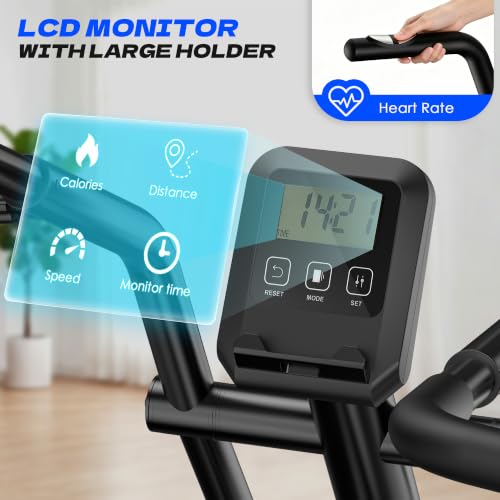
For seniors, the most useful features are not flashy programs but safety and access: remote control, readable display, large textured pedals, anti-slip base, multiple gentle speeds or programs, forward/reverse motion if tolerated, and an automatic shutoff or easy stop. If the unit is powered, check cord placement so it will not cross a walking path, and if the user has limited dexterity, avoid tiny buttons or controls that require looking down at the floor. Owner feedback reinforces these priorities, with buyers frequently praising straightforward controls, no-fuss setup, remote adjustment without bending, passive pedaling for circulation, and selectable speeds or programs for matching the day’s energy level.
Noise
A quiet elliptical matters if you share walls, work out early or late, or want to hear music, TV, or calls without cranking the volume. Look for stable frames, smooth resistance systems, and well-fitted moving parts, and watch for squeaks, knocking, or floor vibration that can make even a “quiet” machine disruptive in real use.
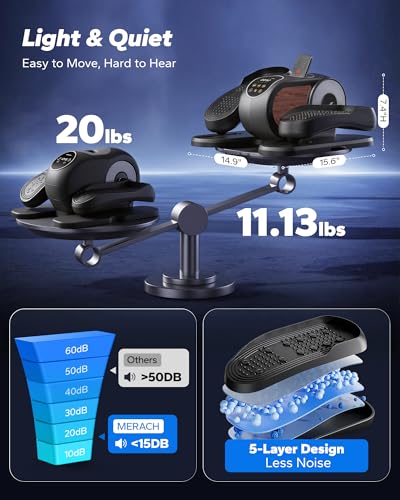
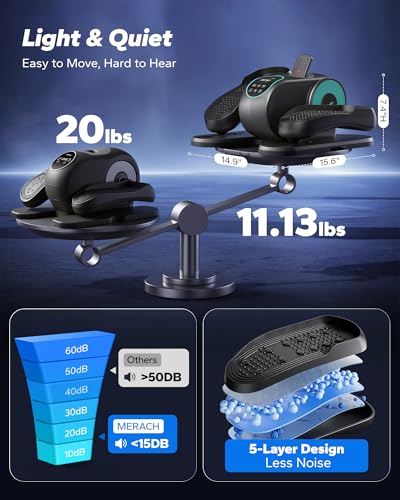
Choose a model known for smooth, quiet operation because many seniors will use it during TV, phone calls, reading, or shared living spaces; avoid squeaky, grinding, or pulsing units that may discourage regular use or signal poor alignment. Noise also matters for caregivers or partners in the same room, and a machine that stays quiet is more likely to be used for longer, gentler sessions. Owners consistently mention quietness as a strength, saying these machines can be used during TV, desk work, music, meetings, calls, and everyday indoor routines without much distraction.
Portability
An elliptical’s portability determines whether it will realistically fit your space and routine, not just whether it looks good on paper. Check the machine’s weight, footprint, transport wheels, and whether it can be folded or moved easily through doorways, and watch out for heavier full-size models that may be stable during workouts but difficult to reposition or store.
Be realistic about who will move the elliptical: compact size is helpful, but seniors should look for a carry handle, transport wheels, and a manageable lift weight, especially if it must be stored after each use or moved between rooms. Avoid units that are technically portable but too heavy to pick up safely, and plan a dedicated use spot if the user has back problems, stairs, thick rugs, or limited grip strength. Owner sentiment is mixed in the expected way: some buyers find compact, lightweight designs easy to move and store, and handle-and-wheel setups more portable than expected, while others warn that heavier units are awkward to assemble or move, particularly for people with back issues or challenging floors.
1,000,000+ shoppers use Buyer's Guide every week to find the best products and services online.

Helping millions of users make smarter purchases online.


