


- Pool Size: Up to 40,000 gallons
- Pool Type: In-ground or above-ground
- Cable Length: 13.5'
- Compatible Systems: Pentair IntelliChlor IC40
- Compatible Controls: Pentair IntelliChlor IC40





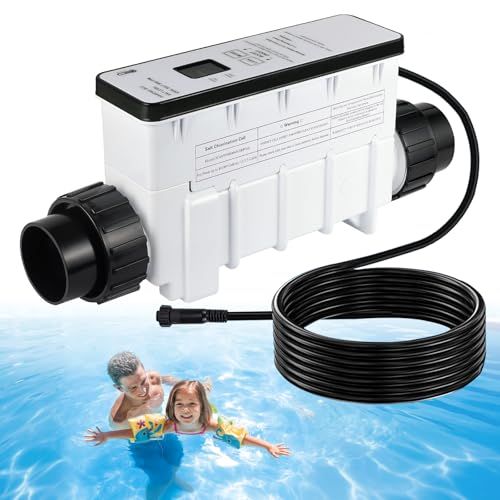
Kolasina Salt Cell Chlorine Generator
Overall Performance and User Experience

The Kolasina Salt Cell Chlorine Generator is designed to simplify pool care by producing chlorine from dissolved salt, reducing the need to handle traditional chlorine tablets or liquid shock as often. In day-to-day use, the main appeal is consistency: when correctly sized and paired with balanced water chemistry, a salt system can maintain a steadier free chlorine level than manual dosing, which often swings between “too low” and “too high.” The Kolasina unit aims to deliver that steady output with a straightforward control approach and a salt cell that does the heavy lifting inside the plumbing line.
What most owners notice first is how the water feels. Salt pools are not “ocean salty” when properly maintained; they’re typically around 2,500–3,500 ppm salinity, which can feel softer and less drying for many swimmers. If your current routine involves frequent chemical additions, the Kolasina generator can be a quality-of-life improvement by turning sanitation into an automated, dialed-in process. You still need to test and balance water, but you may spend less time reacting to problems and more time preventing them.
Noise and footprint are other practical elements of the experience. Salt systems generally operate quietly, and the main audible component is often your pump rather than the generator. As with most units in this category, reliability depends heavily on good installation, stable water chemistry, and adequate flow. When those are in place, performance tends to be “set it and monitor it” rather than a constant tinkering project.
Maintenance is not eliminated, but it becomes more predictable. The salt cell can scale up over time, especially in pools with high calcium hardness or chronically high pH. That scaling reduces efficiency and can shorten cell life if ignored. If you already struggle with keeping pH stable, you’ll want to factor in the likelihood of periodic cleaning and the discipline required to keep balance in range. On the other hand, if your water source is moderate and you keep up with routine testing, cell upkeep can be minimal and manageable across the season.
Key Purchase Factors and What Matters Most
Before buying the Kolasina Salt Cell Chlorine Generator, the most important consideration is sizing. A generator that is undersized for your pool volume and climate will run at high output for longer periods, which can shorten cell life and still fail to keep up during peak heat or heavy swimmer load. A practical rule many pool owners follow is to choose a system rated for more than your actual pool volume so the unit can operate at a lower percentage output. This reduces strain and gives you headroom during algae-prone months. If you are between sizes, choosing the higher capacity is typically the safer long-term decision.
The next critical factor is compatibility with your existing equipment and plumbing. You’ll want to confirm the pipe diameter, available straight-run space for the cell, and whether your pad layout can accommodate the control unit. Electrical requirements matter as well: make sure you have a safe, code-compliant power source and that you understand whether the generator must be interlocked with the pump so it cannot produce chlorine without water flow. Flow and circulation are central to how well any salt system works; if your pump runtime is very short, you may need to adjust schedules to ensure enough daily production.
Water chemistry realities should influence your decision as much as the hardware. Salt systems often cause pH to drift upward over time, and that can increase scaling risk in the cell. If your fill water is high in calcium or your pool already tends to scale, you should plan for more frequent monitoring and occasional cleaning. This is not a dealbreaker, but it does mean ownership is easiest for people who are comfortable testing pH, total alkalinity, and calcium hardness regularly. In that sense, the most important “hidden feature” is not an app or a display, but whether the system matches your willingness to maintain balanced water.
Operating cost is another factor buyers sometimes underestimate. While salt is inexpensive and chlorine handling decreases, the cell is a consumable part. Eventually it will need replacement, and replacement cost varies widely by model and availability. When evaluating the Kolasina generator, look beyond the initial price and consider expected cell lifespan under your conditions, the cost and accessibility of replacement cells, and whether warranty coverage is straightforward. Also consider energy cost: if you increase pump runtime to generate enough chlorine, your electricity bill may rise, though variable-speed pumps can reduce that impact significantly.
Finally, consider usability and support. A generator is only as helpful as it is easy to set correctly. Clear controls, intelligible status indicators, and stable sensors can make the difference between quick adjustments and ongoing frustration. If you are buying online, it’s worth checking whether documentation is clear, whether customer support is responsive, and whether replacement parts are readily available in your region. These factors often matter more over three seasons than any single headline feature on day one.
Common Questions
Will the Kolasina Salt Cell Chlorine Generator make my pool taste like salt water?
In a properly maintained salt pool, the salinity is far below seawater. Most swimmers notice the water feels smoother rather than tasting noticeably salty. The effect is usually subtle, especially compared with ocean water.
Do I still need to add chlorine shock or other chemicals?
The generator’s goal is to supply your everyday chlorine needs, but you may still shock occasionally after heavy use, storms, or an algae event. You will also still manage pH, alkalinity, stabilizer (CYA), and calcium hardness, because salt generation does not replace overall water balance.
How long does the salt cell last?
Cell life depends on output level, water balance, scaling, and runtime. A properly sized system running at moderate output and kept free of scale will generally last longer than an undersized system running near maximum most of the time. Keeping pH and calcium hardness in range is one of the biggest contributors to longevity.
Is installation something I can do myself?
Some experienced pool owners handle the plumbing portion, but electrical wiring should be done according to local codes and often is best handled by a qualified professional. Correct placement, bonding/grounding considerations, and pump interlock requirements are important for safety and for preventing damage to the equipment.
In summary, the Kolasina Salt Cell Chlorine Generator can be a strong upgrade for pool owners who want steadier sanitation and less day-to-day chemical handling, provided it is sized correctly and matched to a commitment to basic water testing. The most important buying decision is capacity relative to your pool and climate, followed closely by equipment compatibility and the realities of your water chemistry. If those fundamentals align, the payoff is typically a more consistent swimming experience and a simpler maintenance routine over the long run.