









We also considered 10 others:


Our Top Choice
Compare Features


The order above is not editorial opinion, and it is not paid placement. It comes from what shoppers across our network actually do - which paddle board pumps they compare, and which they ultimately buy. We re-rank as new data comes in, so the long-term favorites have to keep earning their spot against new entrants. The full method, including how we make money.
Paddle Board Pumps Buyer's Guide
Paddle board pumps have to move a lot of air quickly, then finish at relatively high SUP pressures without overheating or misreading the gauge. The key tradeoff is convenience versus trust: a cordless, auto-shutoff pump is only useful if it matches your board’s valve, reaches the required PSI accurately, and has enough power for the number of boards you actually launch.
Build
A paddle board pump gets pulled, pressed, and packed repeatedly, so build quality affects how long it keeps working smoothly and whether it feels reliable at higher pressures. Look for a sturdy hose connection, solid handle and foot base, durable seals, and a body that does not flex, rattle, or leak under load. Be wary of flimsy plastic parts, loose fittings, or pumps that feel unstable, since small weaknesses can become frustrating failures over repeated use.
For paddle boards, prioritize a pump built around heat management, hose integrity, and valve sealing—not just a small plastic blower for pool toys. Look for a reinforced hose that will not soften or pop off near 12–20 PSI, secure Halkey-Roberts-style SUP adapters with spare gaskets, a stable base that will not tip on sand or gravel, and a casing with enough ventilation to survive back-to-back board inflations. Avoid flimsy hose collars, loose adapters, or designs with vents positioned where sand and splash are likely to enter. Owner feedback supports this focus: buyers often describe good pumps as solid, compact, robust, trip-ready, and dependable for repeated inflatable use, with readable displays, auto-off controls, and adapters adding confidence.
Performance
You want a paddle board pump that can reliably inflate your board to the recommended PSI without stalling, overheating, or giving inconsistent pressure readings. Look for strong inflation performance, accurate pressure control, and dependable auto-shutoff if included, plus deflation support if you want faster pack-down. Be wary of pumps that struggle near higher PSI ranges or require constant monitoring to work as intended.
Choose a pump that can both bulk-fill the board and finish at your board’s specified pressure; many inflatables inflate fast at low pressure but struggle during the final high-PSI stage that actually stiffens a SUP. Check the maximum PSI against your board’s manual, confirm it has automatic shutoff at the target pressure, and favor two-stage behavior or clear SUP-specific pressure capability over vague “high airflow” claims. This matters especially for longer touring boards, tandem boards, or thick boards that need more air volume and pressure. Owners commonly report that the better electric SUP pumps are a major upgrade from hand pumping, with set-and-wait pressure control, automatic shutoff, and strong inflation for paddle boards as well as lake toys and large floats.
Usability
A pump that’s easy to use saves you time and frustration before you get on the water, especially when you’re dealing with high-pressure inflation or setting up in a busy launch area. Look for straightforward controls, clear pressure readings, secure hose connections, and a stable design that doesn’t tip or require constant adjustment. Watch out for confusing settings, awkward attachments, or pumps that demand too much effort to monitor while your board inflates.
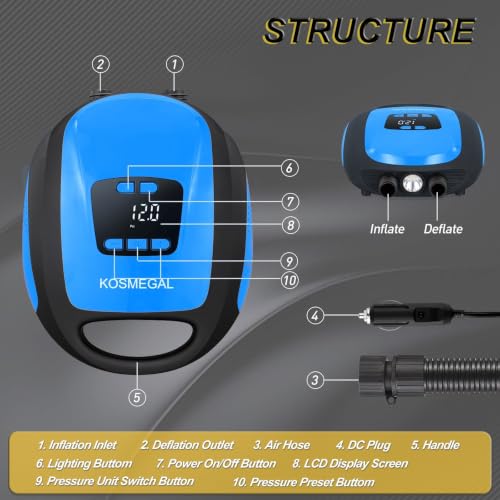
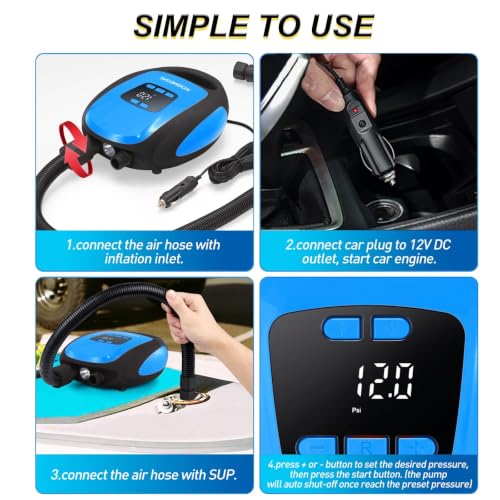
For real launch-site use, look for controls you can operate while unloading gear: a clear PSI display, simple target-pressure buttons, auto shutoff, a hose that reaches the valve without twisting, and adapters that lock in without needing one hand to hold them. Make sure the display uses the pressure unit you use, that the pump resumes or stops predictably if interrupted, and that it includes deflation if you want faster packing at the end of the day. Avoid pumps that require constant monitoring, guessing by feel, or repeated adapter fiddling, because those erase the advantage over a hand pump. Owner sentiment lines up with this: buyers value being able to set a target PSI, walk away to prep paddles or fins, and avoid over-inflating or guessing thanks to digital displays and auto-off features.
Speed
Inflation speed matters because it determines how quickly you can get from the parking lot to the water, especially with larger boards or multiple boards to fill. Look for a pump that can move a high volume of air early and still reach the required PSI without slowing to a crawl, and be wary of speed claims that don’t account for board size, target pressure, or the effort and cooldown time involved.
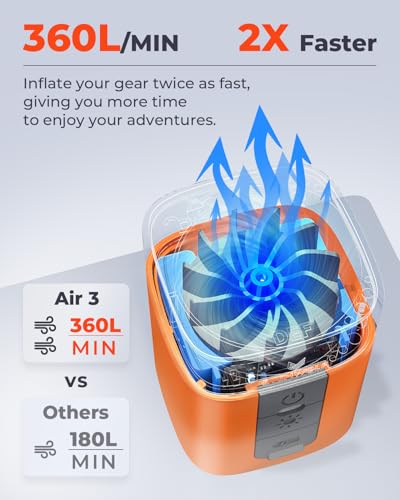
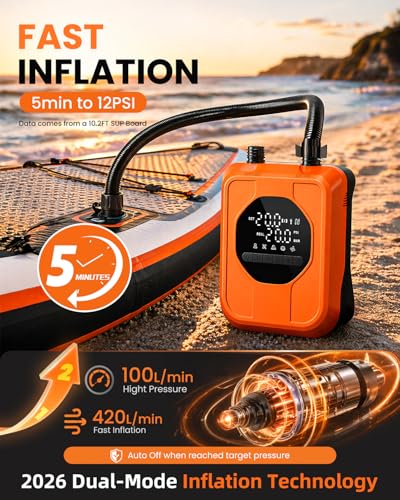
Judge speed by time to your actual board’s target PSI, not by how fast the pump fills a float or mattress at low pressure. A good SUP pump should move quickly through the soft-fill stage and still maintain progress during the high-pressure finish; larger boards, higher PSI targets, cold temperatures, and multiple boards will all stretch inflation time. If you regularly launch with a group, look for a pump rated for repeated inflations without long cooldowns rather than one optimized for a single small board. Owners often describe good models as cutting inflation to roughly 5–10 minutes for many boards, with some reports around seven minutes, and consistently note that electric pumping is much faster and less tiring than manual pumping.
Reliability
Reliability matters because a pump that overheats, shuts off, gives inconsistent readings, or fails mid-inflation can leave you with an underinflated board before you even get on the water. Look for pumps with sturdy connectors, consistent pressure performance, automatic shutoff that works predictably, and a track record of handling repeated inflations without frequent errors or breakdowns.
The main reliability risks for paddle board pumps are gauge drift, auto-shutoff failure, overheating during consecutive inflations, worn valve gaskets, and weak power connections. Look for a pump with dependable pressure selection, thermal protection, a proven seal at the SUP valve, replaceable adapters or washers, and a backup power option if you travel far from the car. Because over- or under-inflation affects board stiffness and safety, it is smart to cross-check a new pump against a known gauge before relying on it for trips. Owner feedback is mostly positive on dependable setup, solid build, battery strength, and automatic shutoff, but it also flags a real failure mode: some buyers report PSI readings becoming inaccurate or failing after use.
Battery
Battery life matters because a cordless paddle board pump is only useful if it can inflate your board and still have enough charge for the rest of your outing. Look for realistic run-time or inflation-count estimates for boards similar to yours, and watch out for pumps that drain quickly under high pressure or lose capacity in cold conditions. If you often inflate multiple boards, choose a battery with extra margin or a pump that can also run from a vehicle outlet.
For cordless paddle board pumping, size battery expectations around complete boards at target PSI, not just minutes of runtime or low-pressure inflatables. Check how many full SUP inflations the pump can realistically handle, whether that includes deflation, how long it takes to recharge, and whether it has a 12V car option as a backup for multi-board days. If you paddle at remote launches, campsites, or beaches without vehicle access, a removable or high-capacity battery is useful; if you launch near the car, a reliable 12V mode may matter more than cordless convenience. Owners strongly appreciate rechargeable pumps for beaches, lakes, camping, and multiple-board outings, with many reporting enough charge left after more than one board, but battery life is also mixed: some users question capacity claims and experience shorter runtimes than expected.
1,000,000+ shoppers use Buyer's Guide every week to find the best products and services online.

Helping millions of users make smarter purchases online.


