
The Enhulk pool vacuum is widely received as an effective, quick-cleaning upgrade for keeping the pool bottom clear.
The cordless design makes it easy to handle and maneuver without dealing with hoses or hookups.
Strong suction is a standout, especially for picking up everyday leaves, dirt, sand, algae, and other debris.
The Enhulk pool vacuum is widely received as an effective, quick-cleaning upgrade for keeping the pool bottom clear.
The cordless design makes it easy to handle and maneuver without dealing with hoses or hookups.
Strong suction is a standout, especially for picking up everyday leaves, dirt, sand, algae, and other debris.


The Enhulk pool vacuum is widely received as an effective, quick-cleaning upgrade for keeping the pool bottom clear.
The cordless design makes it easy to handle and maneuver without dealing with hoses or hookups.
Strong suction is a standout, especially for picking up everyday leaves, dirt, sand, algae, and other debris.
The InoKraft pool vacuum is widely liked as an effective hands-on cleaner for spots robots and hose vacuums miss, including spas, stairs, tanning decks, and above-ground pools.
Suction and debris pickup are strong for a cordless unit, with buyers describing it as able to pull in everything from fine sand and dirt to twigs and tree debris.
Battery life is acceptable for many normal cleanups, but longer jobs can have caveats because the unit may need charging time or repeated pauses when the bag fills.
The InoKraft pool vacuum is widely liked as an effective hands-on cleaner for spots robots and hose vacuums miss, including spas, stairs, tanning decks, and above-ground pools.
Suction and debris pickup are strong for a cordless unit, with buyers describing it as able to pull in everything from fine sand and dirt to twigs and tree debris.
Battery life is acceptable for many normal cleanups, but longer jobs can have caveats because the unit may need charging time or repeated pauses when the bag fills.

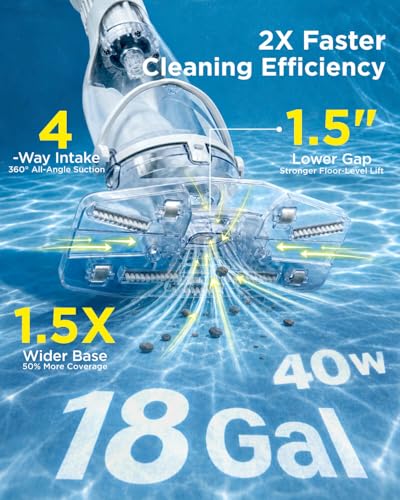
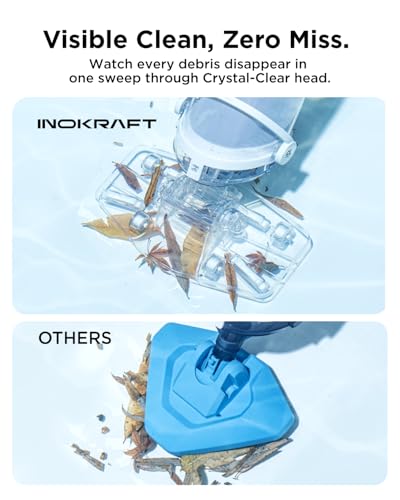


The InoKraft pool vacuum is widely liked as an effective hands-on cleaner for spots robots and hose vacuums miss, including spas, stairs, tanning decks, and above-ground pools.
Suction and debris pickup are strong for a cordless unit, with buyers describing it as able to pull in everything from fine sand and dirt to twigs and tree debris.
Battery life is acceptable for many normal cleanups, but longer jobs can have caveats because the unit may need charging time or repeated pauses when the bag fills.
The Enhulk pool vacuum is received as a dependable shortcut for routine pool maintenance, working well enough to save people from dragging out hoses and extra vacuum setup.
Setup and handling are consistently described as straightforward, with the lightweight design and extendable pole making quick cleanups easier.
Battery life is the one more variable area overall, though satisfied owners often get enough runtime to clean a full above-ground pool on one charge.
The Enhulk pool vacuum is received as a dependable shortcut for routine pool maintenance, working well enough to save people from dragging out hoses and extra vacuum setup.
Setup and handling are consistently described as straightforward, with the lightweight design and extendable pole making quick cleanups easier.
Battery life is the one more variable area overall, though satisfied owners often get enough runtime to clean a full above-ground pool on one charge.


The Enhulk pool vacuum is received as a dependable shortcut for routine pool maintenance, working well enough to save people from dragging out hoses and extra vacuum setup.
Setup and handling are consistently described as straightforward, with the lightweight design and extendable pole making quick cleanups easier.
Battery life is the one more variable area overall, though satisfied owners often get enough runtime to clean a full above-ground pool on one charge.
Setup, maneuvering, and cleanup are consistently described as simple, making routine spot cleaning feel much less time-consuming.
Its compact size and suction are best suited to smaller pools and spot cleaning, while sand, fine dirt, or the smaller head can make performance feel less consistent.
The vacuum comes across as a good value because it is affordable, cordless, and still holds up well for many buyers after repeated use.
Setup, maneuvering, and cleanup are consistently described as simple, making routine spot cleaning feel much less time-consuming.
Its compact size and suction are best suited to smaller pools and spot cleaning, while sand, fine dirt, or the smaller head can make performance feel less consistent.
The vacuum comes across as a good value because it is affordable, cordless, and still holds up well for many buyers after repeated use.


Setup, maneuvering, and cleanup are consistently described as simple, making routine spot cleaning feel much less time-consuming.
Its compact size and suction are best suited to smaller pools and spot cleaning, while sand, fine dirt, or the smaller head can make performance feel less consistent.
The vacuum comes across as a good value because it is affordable, cordless, and still holds up well for many buyers after repeated use.
The Teguy cordless pool vacuum is widely praised for strong overall performance, handling dirt, leaves, sand, insects, and small debris quickly without the hassle of a traditional setup.
The cordless, lightweight design and telescopic pole make it easy to maneuver around above-ground and in-ground pools and reach deeper or middle areas without struggling.
Battery life is viewed as reliable for typical cleaning sessions, with several buyers saying they can clean the whole pool on one charge and appreciate the fast charging.
The Teguy cordless pool vacuum is widely praised for strong overall performance, handling dirt, leaves, sand, insects, and small debris quickly without the hassle of a traditional setup.
The cordless, lightweight design and telescopic pole make it easy to maneuver around above-ground and in-ground pools and reach deeper or middle areas without struggling.
Battery life is viewed as reliable for typical cleaning sessions, with several buyers saying they can clean the whole pool on one charge and appreciate the fast charging.


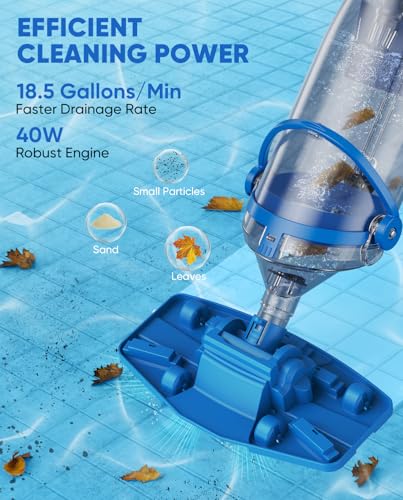


The Teguy cordless pool vacuum is widely praised for strong overall performance, handling dirt, leaves, sand, insects, and small debris quickly without the hassle of a traditional setup.
The cordless, lightweight design and telescopic pole make it easy to maneuver around above-ground and in-ground pools and reach deeper or middle areas without struggling.
Battery life is viewed as reliable for typical cleaning sessions, with several buyers saying they can clean the whole pool on one charge and appreciate the fast charging.
The U.S. Pool Supply vacuum head is widely liked for doing the basic job well, especially vacuuming debris from the pool bottom.
Suction strength is a mixed experience: some get strong pickup, while others find it suction-cups to the floor and becomes hard to move.
It comes across as a good value purchase, with buyers describing it as a quality product at a reasonable price.
The U.S. Pool Supply vacuum head is widely liked for doing the basic job well, especially vacuuming debris from the pool bottom.
Suction strength is a mixed experience: some get strong pickup, while others find it suction-cups to the floor and becomes hard to move.
It comes across as a good value purchase, with buyers describing it as a quality product at a reasonable price.


The U.S. Pool Supply vacuum head is widely liked for doing the basic job well, especially vacuuming debris from the pool bottom.
Suction strength is a mixed experience: some get strong pickup, while others find it suction-cups to the floor and becomes hard to move.
It comes across as a good value purchase, with buyers describing it as a quality product at a reasonable price.


The Bielmeier handheld pool vacuum is seen as very effective for quick pool cleanups, especially picking up dirt and debris from the bottom.
The reusable filter bags and telescoping pole add convenience, helping it handle different debris while reaching across the pool more easily.
The Bielmeier handheld pool vacuum is seen as very effective for quick pool cleanups, especially picking up dirt and debris from the bottom.
The reusable filter bags and telescoping pole add convenience, helping it handle different debris while reaching across the pool more easily.
The Bielmeier handheld pool vacuum is seen as very effective for quick pool cleanups, especially picking up dirt and debris from the bottom.
The reusable filter bags and telescoping pole add convenience, helping it handle different debris while reaching across the pool more easily.
The U.S. Pool Supply vacuum head is widely liked for straightforward pool cleaning that works well right away.
The build and brush setup come across as good quality, making spring cleanup feel easier and less labor-intensive.
The price feels worthwhile for buyers who just need an effective basic vacuum head.
The U.S. Pool Supply vacuum head is widely liked for straightforward pool cleaning that works well right away.
The build and brush setup come across as good quality, making spring cleanup feel easier and less labor-intensive.
The price feels worthwhile for buyers who just need an effective basic vacuum head.


The U.S. Pool Supply vacuum head is widely liked for straightforward pool cleaning that works well right away.
The build and brush setup come across as good quality, making spring cleanup feel easier and less labor-intensive.
The price feels worthwhile for buyers who just need an effective basic vacuum head.
The TidyMister vacuum head is seen as highly effective at cleaning, with dirt disappearing quickly as it glides across the pool floor.
The extra-wide head and direction-control swivel make vacuuming faster and easier, especially on larger pools and sloped areas.
Stability is mostly good but not perfect, since the head can occasionally stick to the liner or have attachment-fit issues for some setups.
The TidyMister vacuum head is seen as highly effective at cleaning, with dirt disappearing quickly as it glides across the pool floor.
The extra-wide head and direction-control swivel make vacuuming faster and easier, especially on larger pools and sloped areas.
Stability is mostly good but not perfect, since the head can occasionally stick to the liner or have attachment-fit issues for some setups.


The TidyMister vacuum head is seen as highly effective at cleaning, with dirt disappearing quickly as it glides across the pool floor.
The extra-wide head and direction-control swivel make vacuuming faster and easier, especially on larger pools and sloped areas.
Stability is mostly good but not perfect, since the head can occasionally stick to the liner or have attachment-fit issues for some setups.
The U.S. Pool Supply vacuum head is widely liked for straightforward pool cleaning that works well right away.
The build and brush setup come across as good quality, making spring cleanup feel easier and less labor-intensive.
The price feels worthwhile for buyers who just need an effective basic vacuum head.
The U.S. Pool Supply vacuum head is widely liked for straightforward pool cleaning that works well right away.
The build and brush setup come across as good quality, making spring cleanup feel easier and less labor-intensive.
The price feels worthwhile for buyers who just need an effective basic vacuum head.


The U.S. Pool Supply vacuum head is widely liked for straightforward pool cleaning that works well right away.
The build and brush setup come across as good quality, making spring cleanup feel easier and less labor-intensive.
The price feels worthwhile for buyers who just need an effective basic vacuum head.
We also considered 10 others:


Our Top Choice
The Enhulk pool vacuum is widely received as an effective, quick-cleaning upgrade for keeping the pool bottom clear.
The cordless design makes it easy to handle and maneuver without dealing with hoses or hookups.
Strong suction is a standout, especially for picking up everyday leaves, dirt, sand, algae, and other debris.
The Enhulk pool vacuum is widely received as an effective, quick-cleaning upgrade for keeping the pool bottom clear.
The cordless design makes it easy to handle and maneuver without dealing with hoses or hookups.
Strong suction is a standout, especially for picking up everyday leaves, dirt, sand, algae, and other debris.
The Enhulk pool vacuum is widely received as an effective, quick-cleaning upgrade for keeping the pool bottom clear.
The cordless design makes it easy to handle and maneuver without dealing with hoses or hookups.
Strong suction is a standout, especially for picking up everyday leaves, dirt, sand, algae, and other debris.
Compare Features


The order above is not editorial opinion, and it is not paid placement. It comes from what shoppers across our network actually do - which manual pool vacuums they compare, and which they ultimately buy. We re-rank as new data comes in, so the long-term favorites have to keep earning their spot against new entrants. The full method, including how we make money.
Manual Pool Vacuums Buyer's Guide
Manual pool vacuums are about trading automation for control: they shine when you need to grab leaves, sand, algae dust, or grit from steps, ledges, spas, and pool bottoms without setting up a hose or waiting on a robot. The sharpest buying concerns are whether the head, filter, pole, and battery match your pool surface, debris type, and cleanup length—because the wrong combination can scatter fine sediment, fill too quickly, or be awkward to control.
Cleaning
You want a pool cleaner that consistently removes the debris your pool actually gets—leaves, sand, dirt, algae-prone buildup, or fine dust—so the water looks clearer and requires less manual brushing or skimming. Look for strong cleaning performance across the floor, walls, waterline, and tight corners if those areas matter for your pool shape, and watch out for models that only pick up large debris while leaving fine sediment behind or stirring it back into the water.
Choose a manual pool vacuum around the exact surfaces you actually spot-clean: a compact head or handheld body for spas, stairs, tanning ledges, coves, and above-ground pool bottoms; a wider weighted head for open floor passes; and soft brushes or non-scratch wheels for vinyl liners and fiberglass. Avoid assuming any “pool vacuum” will replace a robot or suction-side system for full-wall cleaning—this category is strongest when used for targeted debris removal and quick bottom cleanups. Owner feedback supports that use case: shoppers consistently like manual vacuums for getting spots that robots and hose setups miss, with strong reports on stairs, spas, shallow areas, above-ground pools, and everyday pool-bottom cleaning.
Ease
A pool cleaner should save you effort, not create another chore, so look for one that’s straightforward to set up, start, empty, and rinse after each cycle. Pay attention to how easily you can access the debris basket or bag, whether controls are intuitive, and whether routine maintenance requires tools or awkward disassembly. If a cleaner is cumbersome to lift, untangle, or clean out, its time-saving benefits can disappear quickly.
Prioritize a setup that matches how often you will realistically use it: cordless handheld units are best when you want grab-and-go cleanup without hoses or pump hookups, while pole-mounted heads should have secure, standard pole connections and controls you can operate while standing at the pool edge. For shallow ledges, spas, and tight corners, look for small-head attachments and adjustable pole sections; for deeper pools, confirm the pole length reaches the middle and deep end without forcing you to lean over the water. Owners repeatedly describe the better options as simple to set up, maneuver, empty, and clean, especially compared with dragging out a hose vacuum, and they praise lightweight cordless designs with telescopic poles for quick cleanup.
Debris
Debris pickup matters because it determines whether your pool cleaner can handle the actual mess in your pool, from fine sand and dirt to leaves, twigs, and heavier debris. Look for strong, consistent suction and a debris system that matches your pool’s needs, since some cleaners do well with large leaves but struggle with fine particles, while others can lose effectiveness when the basket or filter starts to fill.
Match the intake, filter, and bag style to your debris, because this is where manual pool vacuums most often disappoint: large leaves and twigs need a wide mouth and roomy basket, while sand, silt, algae dust, and fine sediment need a fine filter that will not blow debris back into the water. If your pool sits under trees, avoid tiny debris chambers that fill quickly; if you fight fine grit on the floor, avoid coarse mesh-only designs. Owner reports are strongest when the vacuum is paired to the right debris load, with buyers citing effective pickup of leaves, dirt, sand, sediment, algae, twigs, tree debris, grit, and fine dust during routine cleanups.
Battery
If you choose a cordless or solar-powered pool cleaner, battery life determines whether it can finish a full cleaning cycle without stopping short. Look for a runtime that matches your pool’s size, shape, and debris load, and consider recharge time as well as whether the cleaner maintains suction and navigation as power drops. For solar-powered options, watch how dependent performance is on steady sunlight, especially if your pool is shaded or you need predictable cleaning on cloudy days.
For cordless manual vacuums, size the battery to your actual cleaning pattern, not the advertised maximum: a spa or small above-ground pool can often be handled with short runtime, but a larger pool with leaf loads may require enough charge for repeated passes plus time lost to emptying the bag or filter. Check charging time, whether the battery is sealed against water intrusion, and whether the unit can hold standby charge between weekly cleanings; avoid models that force long recharge breaks if you routinely clean after storms. Owner sentiment is generally positive—many users get a full pool or multiple short cleanings on one charge and appreciate fast recharging—but longer jobs can still be limited by recharge pauses or debris bags filling mid-session.
Value
A pool cleaner should justify its cost by saving you time and keeping your pool consistently clean without constant fixes or supervision. Look for the right balance of cleaning coverage, reliability, ease of maintenance, and included features for your pool type, and be wary of paying extra for capabilities you won’t use or a low upfront price that leads to frequent repairs, replacement parts, or poor performance.
Judge value by what the vacuum prevents you from doing: if it saves frequent hose setup, reduces pump-based vacuuming, or handles spa and step cleanup that a robot misses, it is more valuable than a cheaper tool that stays in storage. For large pools with heavy debris, factor in filter capacity, pole quality, and replacement filters or bags, because a low upfront cost can be offset by slow cleanup or consumables. Owners tend to see good value when the vacuum is lightweight, cordless, easy to clean out, useful for routine maintenance, and a less expensive alternative to robot or pump-based options for everyday debris and smaller pool jobs.
Build
A well-built pool cleaner is more likely to handle repeated cycles, debris, chemicals, and sun exposure without constant breakdowns or parts wearing out early. Look for sturdy wheels or tracks, solid hoses or cables, secure seals, and easily available replacement parts; watch out for flimsy plastics, weak connectors, or designs that make routine maintenance harder than it should be.
Inspect the parts that determine control and longevity: a weighted head should stay planted on the floor instead of floating, the pole connector should lock firmly without wobble, wheels and brushes should be appropriate for your pool surface, and filter housings, seals, and latches should feel secure enough for repeated wet use. For handheld cordless units, pay close attention to the water-sealed motor area, debris-chamber latch, handle rigidity, and whether filters are easy to remove without cracking tabs. Owner feedback backs up these priorities: buyers praise weighted heads that track the pool bottom, lightweight cordless bodies that are easy to maneuver, telescopic poles that help reach deeper or middle areas, and builds that feel well made with filters capable of handling outdoor pool debris.
1,000,000+ shoppers use Buyer's Guide every week to find the best products and services online.

Helping millions of users make smarter purchases online.