


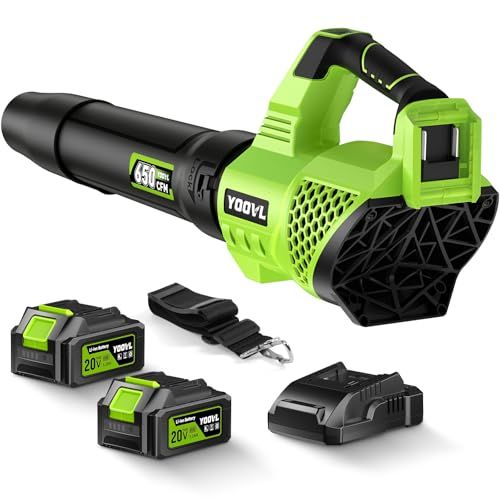
- Type: Handheld
- Power: Cordless 5.2Ah 20V battery
- Air Speed: 280 mph
- Airflow Volume: 650 CFM
- Weight: 8.6 lbs





YOOVL Leaf Blower
Review Overview and Real-World Performance

The YOOVL Leaf Blower is aimed at homeowners who want a practical tool for routine yard cleanup without the fuss of heavy equipment or constant maintenance. In day-to-day use, it’s best thought of as a convenience-first blower designed to handle the typical debris you’ll find on patios, driveways, decks, and small-to-medium lawns. For tasks like clearing dry leaves, grass clippings after mowing, and dust or grit from hard surfaces, it can be a satisfying time-saver, especially when you want quick results without dragging out a rake and tarp.
What most users notice first is the overall handling. A leaf blower can have impressive specs on paper but still feel awkward in the hand, and that’s often what separates a tool you use weekly from one that gathers dust in the garage. The YOOVL’s usability is its strongest day-to-day trait: it’s the kind of blower you’re likely to grab for short cleanups and spot maintenance. For many households, that frequency of use ends up mattering more than peak power, because a slightly less aggressive blower that’s comfortable and quick to deploy can beat a stronger one that feels cumbersome.
In performance terms, the YOOVL does best when debris is dry and surfaces are relatively open. It’s well suited to pushing leaves into lines for easy pickup, clearing corners of a patio, and moving light accumulations out of a garage or workshop. Like most blowers in its class, it will work harder when leaves are wet, when debris is embedded in thick grass, or when you’re dealing with heavier material like damp piles, small twigs, or compacted litter. If your property frequently has wet leaf mats, you may find yourself doing a first pass to loosen debris or relying on a rake for the stubborn areas.
Noise and vibration are also part of the experience with any blower. Many shoppers care as much about neighbor-friendly operation as they do about raw airflow. The YOOVL is generally positioned as a more approachable, household-friendly option rather than a commercial-grade, high-decibel yard cannon. If you expect to use it early in the morning, in a densely packed neighborhood, or around people who are sensitive to loud tools, prioritizing manageable noise levels can be as important as the highest possible output.
What to Consider Before Buying (and What Matters Most)
Before buying the YOOVL Leaf Blower, the first factor to consider is the kind of debris you deal with most often. If your routine cleanup is primarily dry leaves on hard surfaces, light grass clippings, and general dust, a blower like this can be a very practical match. If you commonly face wet leaves, pine needles packed into turf, or frequent storm debris, you’ll want to pay extra attention to power delivery and whether the blower is designed for heavier-duty clearing. Matching the tool to your yard conditions is the most important step, because it determines whether you’ll feel satisfied or limited after the first few weekends.
The second factor is run time and power system expectations. Many shoppers underestimate how much battery capacity or continuous run time they actually need, then feel frustrated when a tool slows down or needs a recharge mid-job. Think about the square footage you’ll clear and how you prefer to work. If you like doing one complete pass around the yard in a single session, prioritize strong sustained output and enough capacity to finish without interruption. If you’re comfortable doing shorter bursts of cleanup, slightly less runtime may be perfectly fine. This consideration is among the most important because it impacts your workflow more than almost any other spec.
Ergonomics comes next, and it’s often the hidden deal-maker. Consider the balance, grip comfort, and how easy it is to direct the nozzle where you want. A tool that feels light enough at first lift can still cause fatigue if it’s front-heavy or forces your wrist into an awkward angle. If multiple people in the household will use the blower, comfort becomes even more crucial, since different users may have different strength and height preferences. In practice, comfort and control can be nearly as important as power, because they influence whether you can use the blower for ten minutes versus thirty.
Speed control and usability features are also worth thinking about. A blower that’s always at maximum can be less versatile around mulch beds, gravel paths, or garden borders where you want to avoid scattering material. Having the ability to dial in airflow for delicate areas helps keep cleanup efficient and reduces the time spent “fixing the fix.” For many users, adjustability matters more than a top-end number because it expands what the blower can do without collateral mess.
Finally, consider storage and maintenance. Leaf blowers tend to live in garages, sheds, or closets, and ease of storage can affect how often you use them. A tool that stores neatly and doesn’t require special fuel mixing or frequent servicing usually sees more real use. If you value low-maintenance ownership, prioritizing a system that’s simple to maintain and quick to set up can be a deciding factor.
Common Questions
Q: Is the YOOVL Leaf Blower powerful enough for a typical suburban yard?
A: For routine debris like dry leaves, light grass clippings, and dust on driveways, patios, and decks, it should feel capable and convenient. If your yard regularly collects wet leaves or heavy debris after storms, you may want to compare models that emphasize higher sustained airflow for tougher conditions.
Q: Will it work on wet leaves?
A: It can move some wet leaves, but wet debris usually requires more force and multiple passes. If wet leaf removal is a frequent need, prioritize models known for stronger output and consider pairing any blower with a rake for the most stubborn patches.
Q: Is it easy to control around flower beds or gravel?
A: Control depends on how adjustable the airflow is and how comfortable the tool feels in your hands. In general, being able to use a lower setting for delicate areas is helpful to avoid blowing mulch or scattering stones, so it’s worth choosing a setup that allows more nuanced control for mixed landscaping.
Q: What should I look for to avoid arm fatigue?
A: Pay attention to weight distribution, handle comfort, and how naturally the nozzle points where you need it. A balanced tool with a comfortable grip can feel significantly lighter in extended use than a heavier or poorly balanced alternative.
Overall, the YOOVL Leaf Blower is a solid choice for everyday yard and driveway cleanup when your priorities are convenience, ease of handling, and reliable performance on common debris. The most important purchase factors are matching the blower’s strength to your typical yard conditions and making sure runtime and ergonomics fit how you actually work, because those two elements will determine whether the tool feels effortless or limiting over time.