
Join the millions that have trusted BuyersGuide.org to help them make smarter buying decisions. Let our independent expert reviews and data-driven shopping recommendations help you find the one that's right for you.






We also considered 10 others:


Our Top Choice
Compare Features


Why These Features Matter:
A juicer is one of those kitchen purchases that sounds aspirational (“I will be a person who drinks celery at 8 a.m.”) and then immediately becomes logistical (“Where does this enormous object live, and why is it judging my tiny counter?”). The best juicer isn’t the one with the most impressive list of features — it’s the one you’ll actually pull out on a Tuesday, use without waking up everyone in the apartment, and clean without bargaining with yourself.
After reading an unreasonable number of owner reviews and talking to the kinds of people who truly have opinions about ginger yield, a few make-or-break realities show up again and again:
- Noise: Some juicers sound like a shop vac eating gravel. Others are “I can do this while my kid watches cartoons” quiet.
- Cleanup: Most people don’t stop juicing because they hate juice. They stop because they hate the brush.
- Counter behavior: If it vibrates, creeps forward, or requires a full arm workout to assemble, it’ll be used twice and then become modern sculpture.
- Real-life throughput: The difference between “one orange” and “a week of carrots” is the difference between charming and exhausting.
- Storage and mess: Pulp finds a way. Also: cords are always too short, and drip-stoppers are only as good as your patience.
The Big Fork in the Road: Fast-and-Loud vs. Slow-and-Steady
Most juicers fall into two personality types:
- Centrifugal (fast): They shred produce at high speed. Great for “I need juice now,” less great for “I enjoy peace and quiet.” Expect more foam and a little less yield, especially with greens.
- Masticating / cold-press (slow): They crush and press. They’re typically quieter and better with leafy greens, and the juice tends to feel “rounder” and less airy. They also tend to be heavier, slower, and more parts-y (translation: more to wash).
If you’re mostly a citrus-and-apple person who wants a glass in 90 seconds, you can live happily in the fast camp. If you’re juicing kale, wheatgrass, beets, ginger — or you’re trying to justify the purchase with “health” — slow is usually where people end up after they rage-quit the loud one.
Notable Strengths to Look For
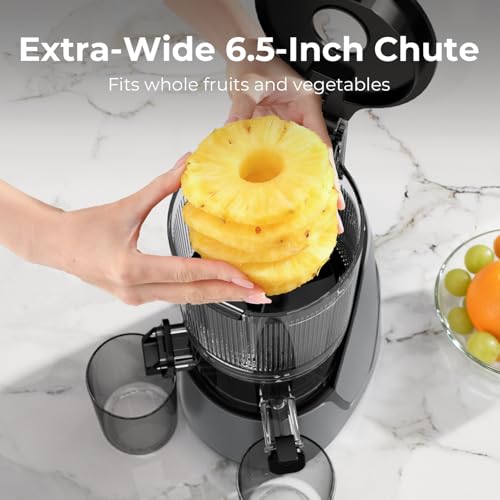
- A feed chute that matches your lifestyle: Wider chutes mean less chopping. This matters more than you think when you’re standing there holding a wet carrot like it’s a prop in a sad cooking show.
- Stable base + grippy feet: A juicer that migrates across the counter is funny exactly once.
- Smart pulp handling: Pulp containers that are easy to remove and don’t require you to perform a small excavation with a spoon.
- Reasonable assembly: If lining up the parts feels like cracking a safe, you won’t do it daily. Look for intuitive click-and-lock pieces.
- A genuinely useful drip-stop: This is less about “no drips ever” (mythical) and more about “I’m not wiping the counter again.”
- Easy-to-rinse surfaces: Mesh filters and tiny teeth are where joy goes to die. Anything that reduces scrubbing is a quiet blessing.
Things That Make People Quit Juicing (Ask Me How I Know)
- Cleaning that takes longer than drinking: If it can’t be cleaned in a quick rinse + one brush moment, you’ll start negotiating with yourself. (“I’ll juice tomorrow.” You won’t.)
- Too many fiddly parts: The more components, the more likely one is living a lonely life in the back of a drawer, making the entire machine unusable.
- Staining and smells: Turmeric and carrot will tint plastic like a beige kitchen in 1997. Some pulp bins hold onto odors if they aren’t washed immediately.
- Counter footprint and height: A tall juicer that doesn’t fit under upper cabinets becomes a permanent resident of exactly the spot you need for everything else.
- “Dishwasher-safe” (with an asterisk): Some parts technically survive the dishwasher but warp, cloud, or come out looking like they’ve been through a rough breakup. Hand-washing is still the norm.
How to Choose Based on How You Actually Live
If you’re in a small apartment: prioritize a smaller footprint, fewer parts, and something you can lift with one hand without feeling like you’re doing a farmer’s carry. Bonus points if it’s not so loud your neighbor learns your wellness routine.
If you have kids (or chaos): you want stability, easy cleanup, and a juicer that tolerates distractions. Machines that require constant pushing/monitoring feel like a bad idea when someone is yelling about a missing shoe.
If you’re a “greens and ginger” person: lean toward slow-press styles. They tend to handle fibrous stuff better and don’t turn leafy greens into a sad, damp bird’s nest.
If you’re mostly citrus: honestly, consider whether you need a full juicer at all. A dedicated citrus press is smaller, easier to clean, and won’t make your kitchen feel like a lab. Full-size juicers shine when you’re doing more than oranges.

What Good Juice Looks (and Feels) Like
Good juice isn’t just “liquid came out.” It has a texture you notice: less froth, fewer gritty bits, and a brightness that tastes like you meant to do this, not like you panic-produced it because your coworker said “gut health” too confidently.
- Foam: Some foam is normal, but if you’re spooning off a cappuccino layer every time, that’s a sign of higher-speed extraction.
- Separation: Juice separates naturally; it’s not a moral failure. But excessive separation in minutes can feel less pleasant, especially if you’re sipping slowly.
- Pulp in the glass: A little is charming. A lot is “this is basically salad dressing.” Filters and strainers vary widely in how annoying they are to clean.
Honest Caveats (Because This Is a Juicer, Not a Miracle)
- Juicing is inherently messy: Even the neatest machines leave you with pulp, drips, and the faint sense you should own more dish towels.
- Some produce is just… rude: Beets stain. Pineapple strings. Celery somehow gets everywhere. No product completely changes that.
- Weight is a trade-off: Heavier machines feel stable and premium, but you’ll resent them if you have to haul them out of a lower cabinet daily.
- Budget models can be totally fine — until they aren’t: If you’re juicing occasionally, you may never hit the annoying edge cases. Daily juicers notice motor strain, clogging, and small plastic failures faster.
The Features to Pay For:
Worth it:
- A design that’s easy to assemble correctly without looking at the manual like it’s a tax form
- A brush/filter setup that doesn’t require a 10-minute scrub session
- Quiet operation (or at least a less angry sound)
- Parts that rinse clean before pulp dries into cement
Not:
- Extra speed settings you’ll never use
- A giant accessory kit destined for a drawer you can’t close
- Anything that promises “no mess” with a straight face
Quick Guidance: Finding “Your” Best Juicer
- Be honest about frequency: If you’ll juice once a week, optimize for easy storage and quick cleanup. If you’ll juice daily, prioritize durability and low annoyance over “looks sleek.”
- Match the machine to your produce: Soft fruits, hard roots, leafy greens — not every juicer handles them with the same grace.
- Read the complaints, not just the praise: People will forgive almost anything except cleaning misery and clogging. Those are the deal-breakers.
- Plan your cleanup ritual: The happiest juicer owners rinse parts immediately. The most miserable ones “let it soak” and then meet their nemesis three hours later.
The Bottom Line
The “best juicer” is the one that fits your kitchen like a real object, not an idea: it doesn’t bully your counter space, doesn’t punish you with cleanup, and doesn’t sound like a jet engine. Aim for a machine that respects your mornings — slightly sleepy, mildly chaotic, and fully uninterested in washing seven parts before coffee.
2,600+ shoppers have used Buyer's Guide in the last week to help find the best Juicers.

Helping millions of users make smarter purchases online.

