











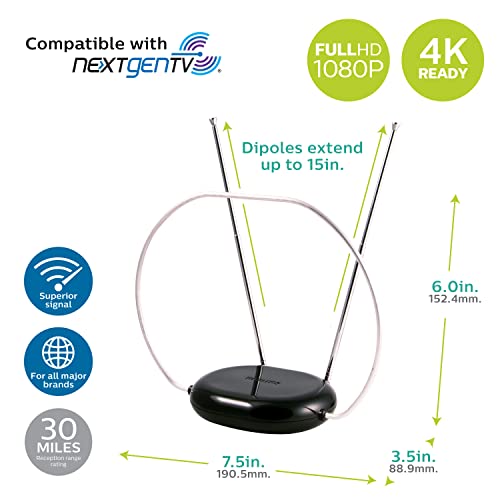


We also considered 10 others:


Our Top Choice
Compare Features


The order above is not editorial opinion, and it is not paid placement. It comes from what shoppers across our network actually do - which indoor antennas they compare, and which they ultimately buy. We re-rank as new data comes in, so the long-term favorites have to keep earning their spot against new entrants. The full method, including how we make money.
Indoor Antennas Buyer's Guide
Indoor antennas are a tradeoff between convenience and signal physics: they are easy to hide and install, but walls, window coatings, tower direction, and UHF/VHF band differences can decide whether they work. The sharpest checks are your local transmitter map and your room placement options, because advertised range and channel counts often matter less than whether the antenna can see the stations you actually want.
Quality
You want an antenna that feels well made because flimsy housings, weak connectors, or thin cables can shorten its life and make reception less consistent over time. Look for sturdy materials, secure coaxial connections, and weather-resistant construction if it will be mounted outdoors, and be wary of designs that feel overly delicate or depend on fragile adhesive mounting.
Prioritize an indoor antenna that matches your actual signal environment, not the biggest advertised range: check whether your target stations are UHF, high-VHF, or low-VHF, and avoid flimsy flat designs if you need VHF reception through walls or from a non-window side of the home. Build quality matters most in the coax connector, cable strain relief, amplifier housing, and mounting pads, because indoor antennas are often moved repeatedly during placement tests; owner feedback supports this, with many buyers describing dependable cord-cutting performance, clear HD picture once positioned well, and better-than-expected build quality for basic indoor use.
Reception
Reception determines how many channels you can actually watch and how reliably they stay clear, so you should match the antenna’s range and design to your distance from broadcast towers, nearby obstacles, and whether you need indoor or outdoor placement. Look for consistent signal stability and useful amplification if you’re far from towers or dealing with weak signals, but watch out for exaggerated range claims or overpowered amplifiers that can distort strong local stations.
Before buying, look up your local broadcast towers and choose an antenna style suited to distance, direction, and obstructions: a window-facing flat antenna can work well for nearby UHF towers, while harder VHF stations, terrain, metal siding, low-E glass, brick, or apartments surrounded by buildings may require a larger element, better placement, or an attic/outdoor option instead. Be cautious with built-in amplifiers; they can help with long cable runs or weak signals but can also overload the tuner when towers are close. Owners commonly report stable signal, clear HD picture, and few interruptions when placement and conditions are favorable, but those positives depend heavily on window placement, aiming, and rescanning after each move.
Performance
You want an antenna that reliably pulls in the channels available in your area and keeps them stable across your actual setup, not just under ideal conditions. Look for compatibility with your TV or tuner, placement flexibility, and easy rotation or repositioning if signals come from different directions. Be cautious of antennas that promise unrealistic range or seem to require frequent adjustment or replacement to maintain basic functionality.
For reliable day-to-day performance, buy for stable lock-on rather than maximum channel claims: look for enough coax length to reach a high window, a removable or optional amplifier, and a design you can rotate or reposition to reduce multipath reflections from walls, appliances, vehicles, and neighboring buildings. If you plan to feed more than one TV or use a splitter, account for signal loss because an antenna that works on one short cable may fail when split. Owner sentiment backs the importance of aiming and scanning, with many users saying signals come in strong and clear after proper positioning and that setup usually works with a simple connection followed by the TV’s auto-scan.
Channels
Channel count matters because an antenna is only useful if it can reliably pull in the stations you actually want, including major networks, public broadcasting, and local subchannels. Look at expected local channel coverage for your address rather than a generic range claim, and remember that terrain, building materials, antenna placement, and broadcast tower direction can all affect which channels come in clearly.
Judge channel potential by the specific stations you want, not by total scan count: verify whether the major networks in your area broadcast from the same direction, whether any are on VHF, and whether low-power subchannels are realistic from inside your home. A high channel count can include duplicates, shopping, religious, foreign-language, or low-value subchannels, while the one station you care about may be blocked or broadcast from a different tower cluster. Owner reports are encouraging—many buyers receive dozens of local stations, major networks, and more channels than expected with good locations—but feedback is also mixed because some homes still miss desired stations or receive only a limited set.
Installation
A TV antenna that’s easy to set up saves you trial-and-error time and helps you get a stronger signal sooner. Look for clear instructions, simple assembly, flexible mounting or placement options, and enough cable length to position it near a window, wall, attic, or roof where reception is best. Watch out for antennas that require extra hardware, awkward aiming, or frequent repositioning if you want a low-frustration installation.
Choose an antenna you can test in several spots without damaging walls: long coax, reversible adhesive, a stand or top-of-TV mount, and a low-profile shape matter more indoors than they would for a fixed roof antenna. Plan to connect it directly to the TV first, place it high and near a window if possible, run a full channel scan, then move it and rescan; many TVs will not show newly available channels until another scan is completed. Owners frequently describe installation as quick—plug in, place near a window or TV, scan, and watch—and some appreciate compact mounts that avoid the clutter of sheet-style window antennas and extra cords.
Value
You want an antenna that delivers reliable channels and clear reception without paying for features that don’t improve performance in your location. Look for strong value for money by weighing reception consistency, build quality, included accessories, and ease of setup against the cost. Be cautious of antennas that promise extreme range or premium features if reviews suggest spotty reception or little real-world benefit.
The best value comes from buying the least complicated antenna that reliably receives your must-have local stations; paying for exaggerated range numbers, unnecessary amplification, or a design unsuited to your tower bands wastes money even if the antenna is inexpensive. Factor in possible extras such as longer coax, a stand, an LTE/5G filter, or an amplifier only if your signal report suggests they are needed. Owner sentiment consistently supports the value case for cord-cutters, with many buyers seeing indoor antennas as a worthwhile way to get free local TV, strong local channel pickup, and a practical alternative to another monthly live-TV bill.
1,000,000+ shoppers use Buyer's Guide every week to find the best products and services online.

Helping millions of users make smarter purchases online.


