





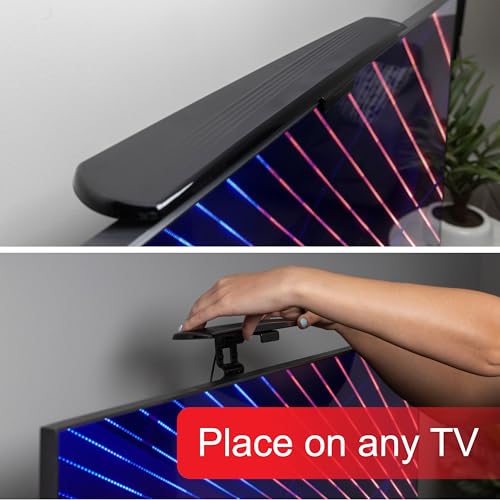


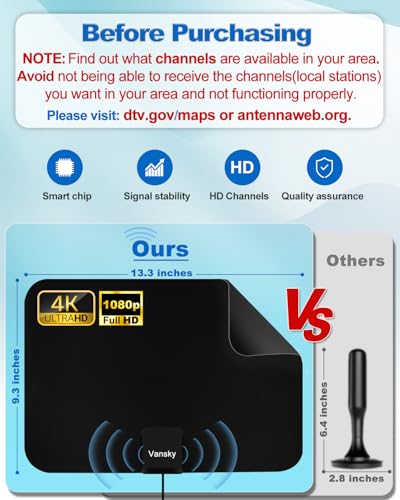


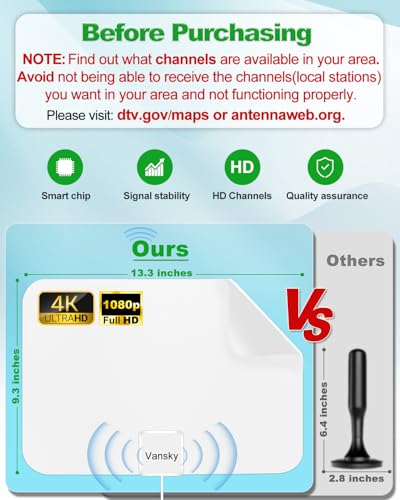


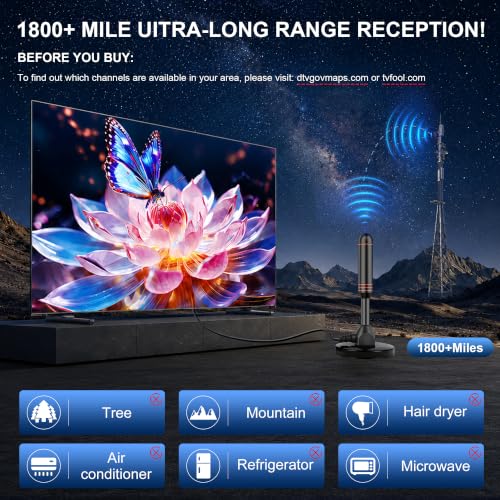
We also considered 10 others:


Our Top Choice
Compare Features


The order above is not editorial opinion, and it is not paid placement. It comes from what shoppers across our network actually do - which indoor antennas for local channels they compare, and which they ultimately buy. We re-rank as new data comes in, so the long-term favorites have to keep earning their spot against new entrants. The full method, including how we make money.
Indoor Antennas for Local Channels Buyer's Guide
Indoor antennas are a location-dependent cord-cutting tool: the same model can be excellent in one apartment and weak across town because tower direction, distance, walls, and interference matter more than packaging claims. The sharpest checks are whether your must-have stations are UHF or VHF, whether nearby strong towers might overload an amplifier, and whether you can place the antenna high, near a window, and pointed toward the broadcast cluster.
Reception
Reception determines how many channels you can actually watch and how reliably they stay clear, so you should match the antenna’s range and design to your distance from broadcast towers, nearby obstacles, and whether you need indoor or outdoor placement. Look for consistent signal stability and useful amplification if you’re far from towers or dealing with weak signals, but watch out for exaggerated range claims or overpowered amplifiers that can distort strong local stations.
Start by checking your address against local broadcast towers before buying: look for the distance and compass direction to each must-have station, and confirm whether those stations broadcast on UHF, VHF-Hi, or VHF-Low. Many thin flat indoor antennas do better with UHF than VHF, so do not assume “HD” or long-range marketing means reliable reception for every local channel. If you live close to towers, be cautious with amplified models because amplification can worsen reception by overloading the tuner; if you are farther out or blocked by masonry, metal siding, low-E windows, or hills, prioritize placement flexibility, a longer coax lead, and easy repositioning. Owner feedback supports this location-first approach: buyers often report clear HD picture, stable signal, and few dropouts once the antenna is well placed and scanned, while strong results are most common when local conditions are favorable.
Channels
Channel count matters because an antenna is only useful if it can reliably pull in the stations you actually want, including major networks, public broadcasting, and local subchannels. Look at expected local channel coverage for your address rather than a generic range claim, and remember that terrain, building materials, antenna placement, and broadcast tower direction can all affect which channels come in clearly.
Buy for the exact channels you need, not the largest advertised channel count. Before choosing an indoor antenna, list your must-have local stations—major networks, local news, public TV, sports affiliates—and verify whether they transmit from the same direction; if key stations are scattered across different tower groups, a fixed flat antenna may require compromises or frequent repositioning. Also remember that a “channel” count includes subchannels, so more channels may not mean more of the networks you actually watch. Owner sentiment backs this: many buyers are pleased by a strong lineup of local channels and are sometimes surprised by how many stations appear after a scan, especially when their location cooperates and they mainly want local news, sports, and favorite broadcast shows.
Quality
You want an antenna that feels well made because flimsy housings, weak connectors, or thin cables can shorten its life and make reception less consistent over time. Look for sturdy materials, secure coaxial connections, and weather-resistant construction if it will be mounted outdoors, and be wary of designs that feel overly delicate or depend on fragile adhesive mounting.
Judge quality by the antenna’s practical RF design and hardware, not just how slim it looks. For this category, useful quality signs include a sturdy coax connector that will not loosen after repeated repositioning, enough cable length to reach a window or higher wall position, a reversible or paintable surface if it must sit visibly, and a design that matches your signal needs—passive for strong-signal urban areas, amplified only when distance or obstacles justify it. Avoid flimsy connectors, permanently attached short cables, and designs that force you to keep the antenna behind a TV if your towers are in another direction. Owner feedback is consistent with this: when placed well, indoor antennas are often seen as dependable cord-cutting options that deliver clean HD picture quality and stable local-channel reception.
Performance
You want an antenna that reliably pulls in the channels available in your area and keeps them stable across your actual setup, not just under ideal conditions. Look for compatibility with your TV or tuner, placement flexibility, and easy rotation or repositioning if signals come from different directions. Be cautious of antennas that promise unrealistic range or seem to require frequent adjustment or replacement to maintain basic functionality.
Performance depends on the whole reception chain: antenna position, amplifier choice, coax run, TV tuner, and rescanning procedure. Look for a model that lets you test multiple placements—high on a wall, in a window, away from routers, LED lamps, power bricks, and large metal objects—and rescan the TV after every meaningful move because TVs store only what they detect during that scan. If the antenna includes an amplifier, make sure it can be removed or turned off; amplified setups can help weak distant signals but can also create dropouts in dense urban areas with strong transmitters. Owner reports support this trial-and-adjust pattern: shoppers frequently describe plug-in-and-scan setup, reliable free local TV under favorable conditions, and cases where one indoor antenna worked where another flat design struggled.
Installation
A TV antenna that’s easy to set up saves you trial-and-error time and helps you get a stronger signal sooner. Look for clear instructions, simple assembly, flexible mounting or placement options, and enough cable length to position it near a window, wall, attic, or roof where reception is best. Watch out for antennas that require extra hardware, awkward aiming, or frequent repositioning if you want a low-frustration installation.
Choose an installation style that fits where the signal is strongest, not merely where the antenna is least visible. A top-of-TV mount may look tidy, but it can underperform if the TV sits low, inside a cabinet, against a brick wall, or on the wrong side of the room; a window/wall-mount design with a longer cable gives more placement options. Check whether mounting pads, stands, or clips are included, whether the coax connector orientation fits tight spaces, and whether the cable can reach without sharp bends or strain on the TV port. Owner sentiment reinforces the ease side: buyers commonly describe installation as quick—connect the wire, place the antenna near the TV or window, run the TV’s auto-scan, and start watching within minutes—while low-profile mounting is appreciated when it avoids a cluttered window-sheet look.
Value
You want an antenna that delivers reliable channels and clear reception without paying for features that don’t improve performance in your location. Look for strong value for money by weighing reception consistency, build quality, included accessories, and ease of setup against the cost. Be cautious of antennas that promise extreme range or premium features if reviews suggest spotty reception or little real-world benefit.
The best value is the antenna that reliably gets your must-have free local broadcasts in your specific home, not the one with the biggest range claim or the most bundled accessories. Before spending more for amplification, filters, or exaggerated distance ratings, check your tower map and try to determine whether your problem is weak signal, blocked signal, multipath reflections, or VHF compatibility; the wrong “upgrade” can add cost without adding usable channels. Also factor in return flexibility, because indoor antenna success is hard to guarantee until tested in the actual room and rescanned. Owner feedback supports the value case: many buyers see indoor antennas as worthwhile cord-cutting tools for replacing paid TV access to local news, sports, public channels, and major broadcast stations without an ongoing cable bill.
1,000,000+ shoppers use Buyer's Guide every week to find the best products and services online.

Helping millions of users make smarter purchases online.


