












We also considered 10 others:


Our Top Choice
Compare Features


The order above is not editorial opinion, and it is not paid placement. It comes from what shoppers across our network actually do - which dehydrators they compare, and which they ultimately buy. We re-rank as new data comes in, so the long-term favorites have to keep earning their spot against new entrants. The full method, including how we make money.
Dehydrators Buyer's Guide
Dehydrators live or die on a narrow tradeoff: they must move enough warm air to dry food thoroughly without cooking delicate herbs, case-hardening fruit, or leaving unsafe moisture in jerky. The sharpest buying concerns are even airflow under a full load and real temperature control, because those determine both food quality and whether long unattended drying sessions are trustworthy.
Drying
Even drying is what separates a useful dehydrator from one that leaves you with leathery edges, sticky centers, or unsafe under-dried jerky. Look for strong, consistent airflow and dependable temperature control, especially if you plan to dry thicker fruit slices, herbs, or meat. Watch for units that require frequent tray rotation or produce uneven results across racks, since that can add hassle and make drying times harder to predict.
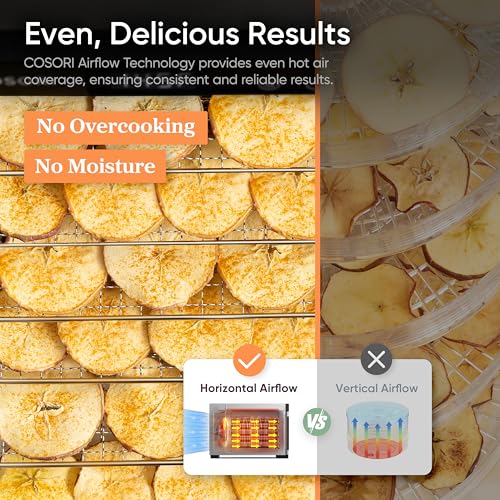
Prioritize airflow design before tray count: a dehydrator for real food preservation should move warm air evenly across loaded trays so edge pieces, center pieces, and back-corner pieces finish at similar times. If you plan on jerky, tomatoes, fruit slices, herbs, or mushrooms, look for a fan layout that reduces tray rotation, enough wattage for wet foods, and tray spacing that lets air pass around pieces instead of stacking them into damp zones. Owner reports support this focus: buyers consistently value models that dry jerky, fruit, herbs, vegetables, tomatoes, mushrooms, and even specialty materials reliably, evenly, and without constant babysitting.
Build
A well-built dehydrator matters because long drying runs can expose weak hinges, flimsy trays, poor seals, and noisy or inconsistent fans. Look for sturdy materials, trays that slide smoothly without warping, a door that closes securely, and controls that feel durable; be cautious of units that flex, rattle, or seem likely to wear out with frequent use.
Choose materials based on heat, weight, and repeated washing: stainless-steel trays and a solid cabinet are preferable for heavy jerky batches, sticky fruit, and frequent harvest processing, while plastic trays should at minimum feel rigid, food-safe, and resistant to warping. Avoid flimsy trays that sag under wet produce, brittle stack sections, loose doors, or housings that make it easy for drips to reach the fan or heater. Owner sentiment backs this up, with sturdier stainless racks and screens often described as a durable step up, while simple no-frills builds are praised when they work reliably through repeated use.
Usability
A dehydrator that’s easy to use is more likely to become part of your routine instead of ending up stored away. Look for straightforward controls, clear temperature and timer settings, trays that slide in and out smoothly, and a layout that makes loading, checking, and cleaning simple. Watch out for cramped trays, confusing buttons, or designs that require a lot of rearranging during drying.
For a machine that may run overnight or all day, insist on simple time-and-temperature controls, a clear display, and auto shutoff; dehydration is not a cooking task you want to babysit every hour. Door-style units can make it easier to check one tray without disturbing the whole stack, while stackable units should be easy to reorder if rotation is needed. Owners repeatedly appreciate set-and-forget operation, beginner-friendly setup, quiet running, timers, and controls simple enough for long drying sessions.
Cleaning
Cleaning matters because dehydrated foods can leave sticky sugars, crumbs, oils, and spice residue on trays, liners, and the interior, and a hard-to-clean machine may discourage regular use. Look for trays and liners that remove easily, fit in your sink or dishwasher if that’s important to you, and have minimal seams or tight corners where food can get trapped. Watch out for interiors that are awkward to reach or fan/heating areas that are exposed to drips, since those can make cleanup slower and more frustrating.
Plan for sticky sugars, oily marinades, herb crumbs, and jerky drips: removable trays, fine mesh screens, fruit-leather sheets, and drip protection matter as much as drying power. Stainless trays, dishwasher-safe accessories, and nonstick silicone sheets can save major effort, but check whether every insert is actually dishwasher-safe and whether small mesh openings trap seeds or meat fibers. Buyers commonly highlight easy cleanup as a major convenience, especially with removable stainless trays, simple designs, and nonstick sheets that release food cleanly.
Size
Size determines both how much counter or storage space a dehydrator will take up and how much food you can dry in one batch. Look for enough tray area for your typical use—small snacks, garden harvests, jerky, or meal prep—and watch for models that seem compact but have limited usable spacing between trays. If you plan to dry bulky foods or large batches, capacity matters as much as footprint.
Judge size by usable drying area, not just the number of trays: round trays with center holes, tight spacing, or narrow shelves can hold far less sliced fruit or jerky than expected. Small households may prefer a compact countertop unit, but gardeners, hunters, mushroom foragers, and batch jerky makers should look for enough tray area and vertical clearance to process a full load without overcrowding, because overcrowding slows drying and can leave moist spots. Owner feedback reflects this tradeoff: compact units are liked for counters, storage, RVs, and small kitchens, while larger multi-tray machines are valued for harvest-sized batches, though some buyers find the actual cooking space smaller than expected.
Temperature
Good temperature control helps you dry different foods safely and evenly, since herbs, fruit, meat, and jerky often need different heat levels. Look for a dehydrator with clear, adjustable settings and reliable accuracy, and watch out for models with vague low/medium/high controls or hot spots that can overdry the outside while leaving moisture inside.
Temperature control is critical: look for an adjustable range low enough for herbs and delicate foods, around midrange for fruit and vegetables, and high enough for jerky safety workflows. Avoid fixed-temperature or preset-only units if you plan to dry varied foods, because herbs, fruit leather, vegetables, pet treats, and meat do not all benefit from the same heat; for jerky, verify the unit can reach and hold the needed high setting and follow food-safety guidance for heating meat appropriately. Owner reports support adjustable controls as a key advantage, with timers and temperature ranges viewed as useful and precise, while fixed controls, limited presets, and jerky batches needing longer maximum-heat runs are recurring watch-outs.
1,000,000+ shoppers use Buyer's Guide every week to find the best products and services online.

Helping millions of users make smarter purchases online.


