





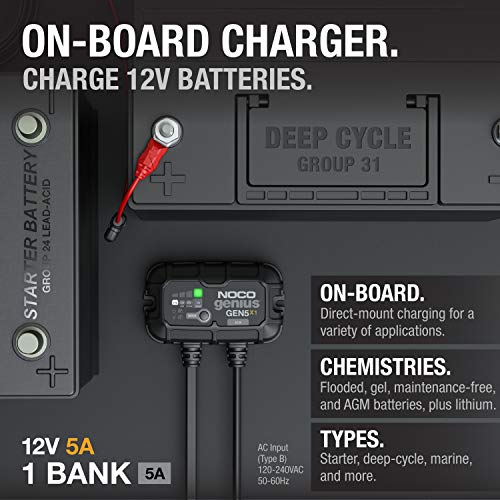


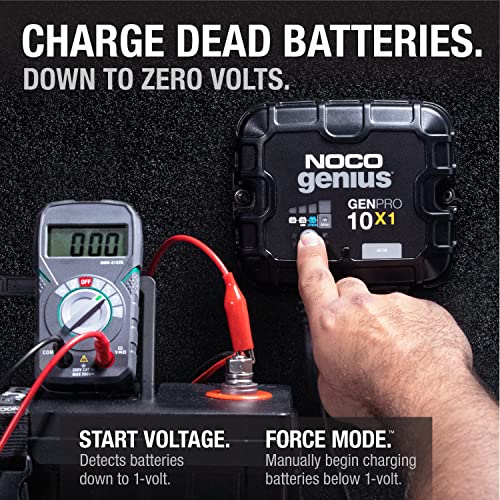


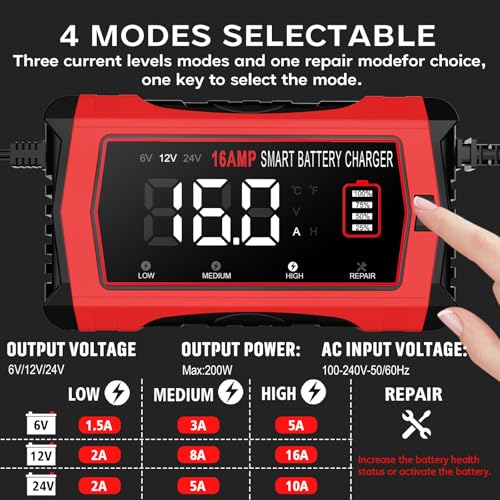


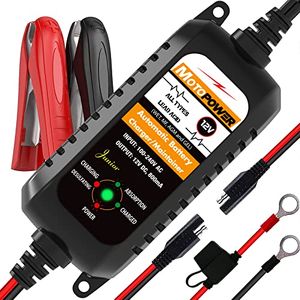


We also considered 10 others:




Our Top Choice
Compare Features


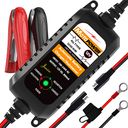
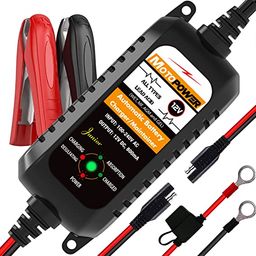


The order above is not editorial opinion, and it is not paid placement. It comes from what shoppers across our network actually do - which deep cycle battery chargers they compare, and which they ultimately buy. We re-rank as new data comes in, so the long-term favorites have to keep earning their spot against new entrants. The full method, including how we make money.
Deep Cycle Battery Chargers Buyer's Guide
Deep-cycle battery chargers have to balance fast recovery with battery-preserving charge control, because the wrong profile can shorten the life of an expensive marine, RV, trolling-motor, or off-grid battery bank. The sharpest checks are chemistry compatibility, bank/voltage matching, and whether the charger can safely maintain batteries that sit for long periods without overcharging them.
Charging
You want a charger that matches your battery type and size, delivers enough output for the way you’ll use it, and charges reliably without overheating or cutting out too soon. Pay attention to charging speed, boost or jump-start capability if you need it, and whether the charger can maintain, recover, or condition batteries safely rather than simply pushing maximum power.
For deep-cycle batteries, prioritize a true multi-stage charger with the right profile for your chemistry: bulk, absorption, and float for lead-acid; a LiFePO4-specific constant-current/constant-voltage profile with no inappropriate float/equalize behavior for lithium; and a low-voltage recovery or BMS wake-up mode if batteries may be deeply discharged. Size output current to the battery bank, not just the vehicle: roughly 10–20% of amp-hour capacity is a practical target for many lead-acid banks, while lithium banks may accept higher rates only if the battery maker allows it. Owner feedback supports looking for this kind of capable charging behavior, with shoppers praising chargers that revive weak or deeply discharged batteries, charge faster than small maintainers, offer lower-amp maintenance modes, and handle multiple boat batteries effectively.
Battery
A good charger should protect battery life as much as it restores charge, so look for smart maintenance features like automatic shutoff, float or trickle modes, and safeguards against overcharging or overheating. If you need to revive weak or neglected batteries, recovery or repair modes can help, but they cannot fix every battery, so be wary of chargers that overpromise dramatic capacity restoration.
Match the charger to how your deep-cycle battery is actually used: a trolling-motor, RV house, solar-storage, or marine starting/deep-cycle battery needs full recharge cycles and safe long-term maintenance, not just a quick automotive top-off. Look for selectable or automatic modes for flooded, AGM, gel, and LiFePO4 batteries, and avoid chargers that apply desulfation or equalization to sealed AGM, gel, or lithium unless the battery manufacturer explicitly permits it. Owners often credit good maintainers with keeping seldom-used batteries healthy, extending battery life, and preventing premature replacement, which is especially important when deep-cycle banks sit through off-seasons.
Compatibility
Make sure the charger supports the battery types and sizes you actually use, since the wrong compatibility can mean slow charging, poor fit, or unsafe operation. Look for clear support for your battery chemistry, voltage, and physical format, plus the right ports or clamps for your charging situation. If you charge different devices or vehicles, prioritize versatile charging options, but avoid assuming “universal” means it works with every battery.
Before buying, verify voltage, chemistry, capacity range, and bank count: a 12V charger will not properly charge a 24V or 36V trolling-motor bank unless it is designed for that system, and a multi-bank charger should provide isolated outputs so each battery is charged independently. If you run LiFePO4, confirm explicit lithium support, BMS wake-up capability, and the correct charge voltage; if you use marine AGM or flooded batteries, confirm the right absorption and float settings plus temperature compensation. Owner reports reinforce the value of broad but specific compatibility, with successful use across lithium, lead-acid, AGM, 12V, 24V, high-capacity lithium, powersports, vehicle, and deep-cycle marine setups.
Reliability
You want a charger that works consistently every time you connect a battery, because unreliable charging can leave you stranded or force you to keep troubleshooting instead of getting the job done. Look for models known for stable operation, accurate status indicators, and dependable automatic shutoff or maintenance modes, and watch out for complaints about error codes, failed starts, overheating, or chargers that stop recognizing batteries.
A deep-cycle charger may be left connected for days or months, so reliability means stable voltage regulation, safe float/maintenance behavior, reverse-polarity and short-circuit protection, over-temperature protection, and automatic restart after power interruptions. For boat, RV, or shed installations, also look for memory of the selected mode so the charger does not revert to the wrong chemistry after an outage. Owner sentiment backs the importance of dependable long-term operation: buyers praise units that keep seasonal batteries charged, continue working for years, feel durable, and can be trusted to maintain multiple batteries without constant supervision.
Usability
A battery charger should be easy to set up, read, and control so you can connect it correctly and start charging without guesswork. Look for clear clamps or connectors, straightforward mode selection, and a display that shows charging status, errors, and battery condition at a glance. Watch out for chargers with confusing buttons, vague indicator lights, or instructions that make common tasks feel harder than they should.
Choose controls that reduce chemistry and voltage mistakes: clear mode labels, visible charging-stage indicators, error lights, charge-percentage or status display, and clamps or ring terminals appropriate for your installation. For deep-cycle use, the best setup is often semi-permanent ring leads on each battery bank, with enough cable length and strain relief to avoid pulling on terminals; avoid chargers that make it too easy to accidentally select a lithium mode for lead-acid or an equalize mode for sealed batteries. Owners consistently value simple, automatic operation, clear indicators, plug-and-go setup, included clamps and cables, and the ability to leave the charger connected after charging is complete.
Build
You want a charger that feels solid enough to handle regular use, storage, and the occasional bump without cracked housings, loose ports, or flimsy clamps. Look for durable cables with enough length to reach comfortably, secure connectors that grip well, and a design that manages heat without getting excessively hot during longer charging sessions.
For marine, RV, and garage deep-cycle use, build quality is not cosmetic: look for rugged cables, corrosion-resistant connectors, secure mounting points, adequate cooling, and a weather-resistant or marine-rated enclosure if it will live near bilge moisture, salt air, or outdoor storage. Boat-mounted chargers should fit the compartment cleanly, resist vibration, and have cable routing that reaches each bank without unsafe extensions; portable garage chargers should still have sturdy clamps and insulation that tolerate repeated use. Owner feedback supports paying attention to construction, with buyers calling out solid materials, durable feel, useful cable length, compact rugged marine installations, and long service life rather than flimsy trickle-charger build.
1,000,000+ shoppers use Buyer's Guide every week to find the best products and services online.

Helping millions of users make smarter purchases online.


