

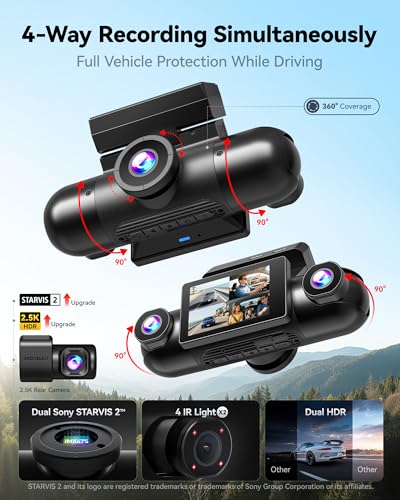
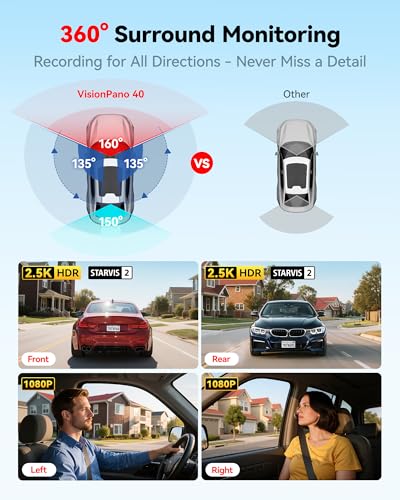


- Resolution: 2.5K front & rear, 1080p left & right
- Field of View: 160° front, 150° rear, 135° left & right
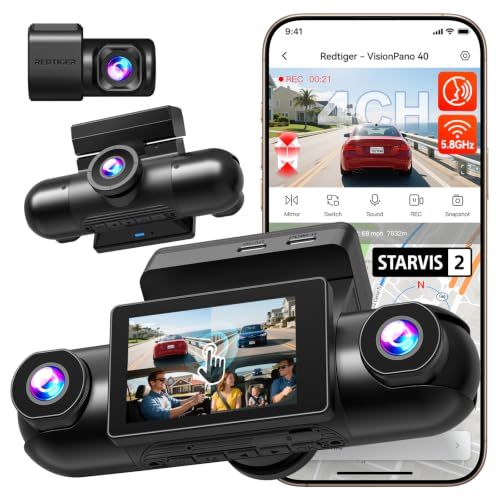
- Screen: 3" LCD touchscreen
- Monitoring: Parking
- Recording: Timelapse, G sensor, loop
- Installation: Adhesive





REDTIGER 4 Channel Dash Cam
Overall performance and real-world use

The REDTIGER 4 Channel Dash Cam is designed for drivers who want more than a single forward-facing view. With four channels capturing multiple angles around and inside the vehicle, it aims to deliver a fuller record of what happened before, during, and after an incident. In day-to-day driving, that extra coverage is the headline feature: it can help document side impacts, rear-end collisions, parking lot dings, and interior activity that a traditional one- or two-channel setup might miss.
In practice, the value of a four-channel system depends on how consistently it records and how usable the footage is when you need it. A good multi-camera dash cam should balance coverage with clarity, ensuring that critical details such as license plates, traffic signals, lane markings, and the movement of surrounding cars remain legible. The REDTIGER approach is typically about giving you more context, even if one angle is partially blocked by glare, weather, or a tall vehicle in front. When multiple cameras overlap in coverage, you’re more likely to capture the complete sequence of events, including what led up to a collision and what happened immediately afterward.
Another strong practical advantage is the way multi-channel recording can reduce uncertainty during insurance claims and disputes. If a vehicle merges into you from the side or an incident occurs just outside the forward camera’s field of view, a broader set of angles can help establish position, timing, and right of way. For professional drivers, rideshare operators, and fleet use, multi-camera coverage can also be useful for documenting passenger behavior, deliveries, or interactions at pickup and drop-off locations. That said, interior recording raises privacy considerations, and users should be mindful of local laws and passenger consent rules where applicable.
Reliability matters as much as image quality. A dash cam that produces great footage but randomly stops recording is not doing its job. The REDTIGER 4 Channel Dash Cam’s appeal is in the promise of continuous, automated recording with loop functionality and incident locking so that important clips aren’t overwritten. The best experience comes when the system feels invisible: you start the car, it records, and you only think about it when you actually need the footage. If the device includes parking monitoring, it becomes even more valuable for people who street park or leave their vehicle in busy lots, since damage often happens when the car is unattended.
Key factors to consider before buying
Before choosing a four-channel dash cam, the first factor to consider is whether you truly need four angles. More channels can mean more complete coverage, but it also means more setup complexity, more wiring, and more storage demand. If you mostly want evidence in traffic incidents, a front and rear system might be enough. If you frequently deal with side impacts, vandalism, or you want an interior view for rideshare or security reasons, a four-channel setup like this becomes far more compelling.
The most important purchase consideration for most buyers is footage usability. It’s not just about resolution on a box; it’s about whether the camera can capture identifying details in typical conditions such as night driving, rain, glare, and fast movement. Look for stable exposure control at night, balanced contrast, and a field of view that is wide enough to capture context without distorting the image so much that details smear at the edges. If a dash cam offers multiple channels, it’s also worth thinking about how the system allocates quality across those channels. Some multi-camera systems deliver excellent front video but compromise on the auxiliary angles. When evaluating the REDTIGER 4 Channel Dash Cam, users should treat the “worst” camera as important, because the side or cabin camera is often the one you need in a tricky claim.
Storage and file management are another major factor, and arguably the second most important after video clarity. Four channels produce a lot of data. That means you’ll want support for a sufficiently large microSD card and a recording format that doesn’t make reviewing footage a chore. Consider how easy it is to pull clips off the device, whether the system supports Wi‑Fi transfer or requires physically removing the card, and whether the app or desktop playback tools are stable and straightforward. The more cameras you have, the more you benefit from a clean interface that lets you quickly jump to a time and view all angles in sync.
Parking mode and power delivery can be a deciding factor, especially if you’re buying a 4-channel unit for security rather than just driving. Parking recording typically requires either a hardwire kit or a dedicated power solution, and you’ll want low-voltage cutoff protection so the camera doesn’t drain your battery. The “most important” aspect here is not simply having parking mode, but having a parking mode you can trust. A good parking system should reliably wake on impact or motion, record the relevant window of time, and avoid false triggers that fill your card with meaningless clips. If you live in an apartment complex or park on the street, this feature can move from nice-to-have to essential.
Installation difficulty is often underestimated. Four channels usually require more cables and more thoughtful placement to avoid obstructing airbags, blocking the driver’s view, or creating messy cable runs. Buyers should consider whether they’re comfortable tucking wires under trim, routing to the rear, and securing interior or side-facing cameras. If not, professional installation may be worth budgeting for, and that cost should be part of the purchase decision. The best dash cam is the one that is installed cleanly and remains in the correct position over months of temperature swings and daily vibration.
Finally, consider support, warranty, and firmware updates. Multi-camera systems are more complex, and occasional bugs or app quirks can happen. A manufacturer that provides clear documentation, responsive customer support, and ongoing updates can make ownership smoother. In the long run, that can be just as meaningful as a slight difference in specs.
Common Questions
Does a 4-channel dash cam record all cameras at the same time? Yes, a true 4-channel dash cam is intended to record all connected angles simultaneously, creating a more complete timeline of events. This is one of the main reasons to choose a system like the REDTIGER 4 Channel Dash Cam over simpler setups.
Will a 4-channel system fill up the memory card quickly? Yes, it generally will. Recording four video streams uses significantly more storage than a single camera. Using a higher-capacity, high-endurance microSD card is important, and loop recording helps manage space by overwriting the oldest non-locked files.
Is parking mode worth it? If your vehicle is frequently left unattended in public areas, parking mode can be one of the most valuable features you can buy. The key is powering it correctly, usually with a hardwire kit and voltage protection, so it can record incidents without risking a dead battery.
Do I need to worry about privacy with an interior camera? Potentially, yes. Interior recording can be helpful for rideshare drivers and fleet operators, but local laws vary. It’s wise to disclose recording to passengers and to check any regulations that apply where you drive.
In summary, the REDTIGER 4 Channel Dash Cam targets drivers who want maximum coverage and stronger documentation than a basic front-only camera can provide. The most important factors to weigh are real-world footage clarity and reliability, followed closely by storage needs and how you plan to power and install the system. If you’re willing to handle the added setup in exchange for broader evidence and peace of mind, a four-channel dash cam can be a meaningful upgrade.