Choosing the Right Office Chair
Posted on Tuesday, March 24, 2026
To keep this site free for consumers, we receive compensation for customer referrals.
Choosing the Right Office Chair
An office chair plays a central role in how a workspace functions. From home offices to corporate environments, the right office chair helps support daily tasks such as computer work, meetings, and administrative responsibilities. Because people often remain seated for long periods, the structure and adjustability of an office chair can influence comfort, posture, and overall usability throughout the workday.
The office chair category includes a wide range of designs, materials, and adjustment systems. Understanding how these chairs are built and which features matter most can make it easier to evaluate different options before making a decision.
What to Understand Before Choosing an Office Chair
Office chairs are designed to support seated work while allowing the user to move, adjust, and reposition during the day. Unlike standard seating, these chairs typically include mechanisms that allow the seat height, backrest angle, and arm positions to change.
This flexibility helps users align their body position with desk height, monitor placement, and keyboard positioning. When these elements work together, the workspace can feel more natural and easier to use over long periods.
How Office Chairs Are Designed
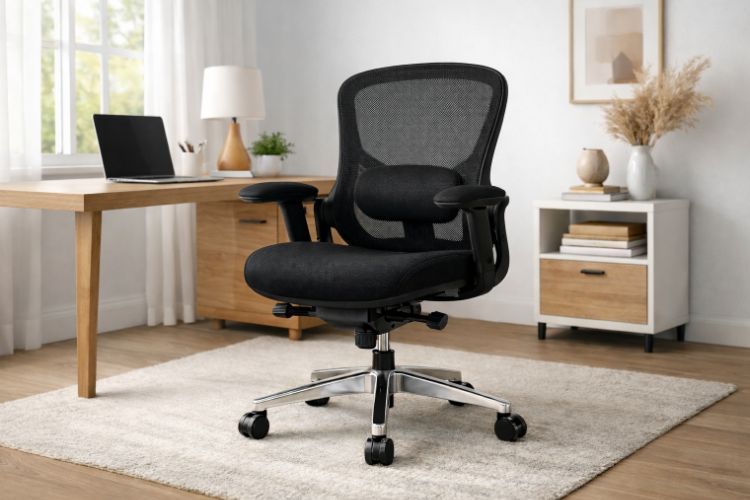
Most office chairs share several structural components that influence how they function. A wheeled base provides mobility across the floor, while a central column typically controls seat height adjustment.
The seat and backrest form the primary support areas, and many chairs also include armrests that can be adjusted to match desk height or typing position. Some models incorporate tilt or recline systems that allow the chair to shift slightly as the user leans back.
These features are intended to allow movement rather than forcing the user into a fixed position throughout the day.
Common Types of Office Chairs
Office chairs are available in several general formats. Each type reflects different design priorities and workspace needs.
Task chairs are commonly used for everyday desk work. They are typically compact and designed for straightforward functionality with a smaller footprint.
Executive-style chairs often feature a larger frame, thicker cushioning, and a taller backrest. These chairs may provide a more enclosed seating experience.
Ergonomic chairs focus on multiple adjustment points that allow users to fine-tune seating position. These designs often emphasize posture alignment and flexibility.
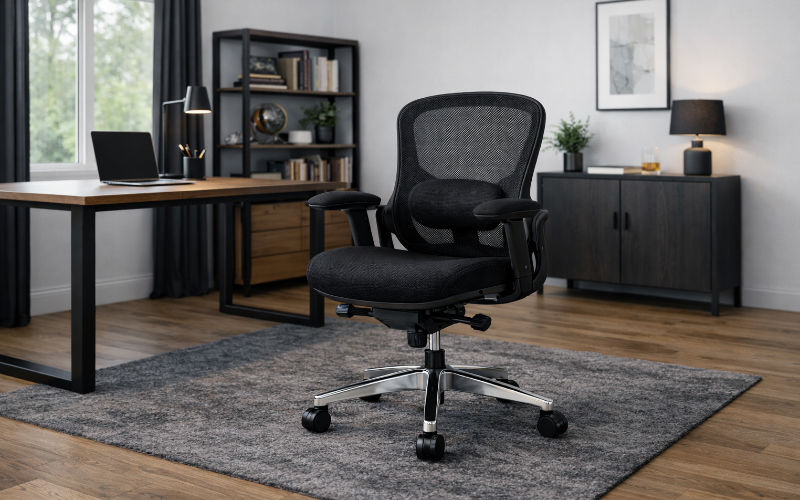
Mesh-back chairs replace traditional padded upholstery with a breathable material across the backrest, which can influence airflow and seating feel.
Key Features to Evaluate
Several design features influence how an office chair performs in everyday use. Understanding these elements can help clarify what matters most when reviewing different options.
- Seat height adjustment allows the chair to align with desk height and leg positioning.
- Backrest design affects how the chair supports the upper and mid-back.
- Lumbar support provides targeted reinforcement for the lower spine.
- Seat depth determines how the chair supports the thighs while seated.
- Armrest adjustment influences shoulder and arm positioning while typing.
- Tilt and recline mechanisms allow users to shift posture during extended sitting periods.
- Material selection impacts breathability, cushioning, and surface feel.
- Caster design affects how easily the chair moves across different flooring surfaces.
Evaluating these features together often provides a clearer understanding of how a chair may function during regular use.
Performance and Usability Considerations
Ease of adjustment is one of the most practical factors in everyday office chair use. Chairs that allow quick and intuitive adjustments make it easier to refine seating position throughout the day.
Mobility also plays a role in usability. Rolling casters allow users to move between areas of a workstation without lifting the chair, while a stable base helps maintain balance during movement.
Material choice can also affect the long-term experience. Breathable surfaces may influence airflow, while padded upholstery can create a different seating feel depending on the density and structure of the cushioning.
Trade-Offs to Keep in Mind
Office chair designs often involve trade-offs between adjustability, size, structure, and visual style. Some chairs emphasize simplicity with fewer controls, while others include multiple adjustment points that allow more precise customization.
Larger chairs may provide a more substantial seating presence but require additional space around the desk. More compact chairs can fit easily into smaller workspaces but may include fewer adjustable elements.
Understanding these trade-offs helps create realistic expectations when reviewing different chair designs.
Continuing Your Office Chair Research
Understanding how office chairs are designed, how their features function, and how different configurations fit into daily work environments can help make the evaluation process more manageable.
If you are exploring office chair options and want to review additional information about designs, features, and considerations, visit our site for more information and to compare office chairs. Seeing how different models approach support, adjustability, and materials can provide helpful context when evaluating what may work best for your workspace.

Related Blog Posts