












We also considered 10 others:


Our Top Choice
Compare Features


The order above is not editorial opinion, and it is not paid placement. It comes from what shoppers across our network actually do - which automatic pool cleaners they compare, and which they ultimately buy. We re-rank as new data comes in, so the long-term favorites have to keep earning their spot against new entrants. The full method, including how we make money.
Automatic Pool Cleaners Buyer's Guide
Automatic pool cleaners are not interchangeable: a surface skimmer, suction cleaner, pressure-side unit, cordless robot, and full floor/wall robot solve different messes. The sharpest buying decision is matching the cleaner to where your debris actually collects—surface, floor, walls, or waterline—while making sure the power source, basket, filters, and drivetrain can survive your pool size and debris load.
Cleaning
You want a pool cleaner that consistently removes the debris your pool actually gets—leaves, sand, dirt, algae-prone buildup, or fine dust—so the water looks clearer and requires less manual brushing or skimming. Look for strong cleaning performance across the floor, walls, waterline, and tight corners if those areas matter for your pool shape, and watch out for models that only pick up large debris while leaving fine sediment behind or stirring it back into the water.
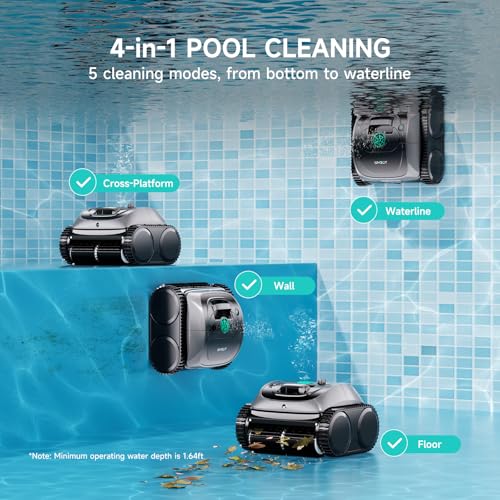
Prioritize coverage before convenience: confirm whether the cleaner handles only the floor, the surface, the walls, or the waterline, and do not assume a skimmer will replace a bottom vacuum or that a floor robot will keep floating leaves from sinking. For irregular pools, slopes, deep ends, main drains, steps, and tight corners, look for active navigation, wall-climbing ability, scrubbing brushes, and anti-stall behavior rather than a simple random path. Owner feedback supports this distinction: buyers strongly like hands-off everyday cleaning when the unit matches the job, with many reporting clear pools, reliable operation, and thorough pickup of leaves, dirt, fine sand, petals, and small debris.
Ease
A pool cleaner should save you effort, not create another chore, so look for one that’s straightforward to set up, start, empty, and rinse after each cycle. Pay attention to how easily you can access the debris basket or bag, whether controls are intuitive, and whether routine maintenance requires tools or awkward disassembly. If a cleaner is cumbersome to lift, untangle, or clean out, its time-saving benefits can disappear quickly.
Judge ease by the messy parts of ownership: how heavy it is when full of water, whether you can remove the basket from the top, how often it must be emptied, how easy it is to retrieve, and whether cords, hoses, or poles will tangle around ladders, drains, or steps. For suction and pressure-side cleaners, verify hose length, pump or booster-pump requirements, and fitting compatibility; for cordless robots, check charging access, carry handles, retrieval hooks, and whether controls are usable without a finicky app. Owners often praise simple setup, cordless drop-in use, quiet automatic operation, lightweight handling, extendable poles, and easy-empty baskets, which are exactly the features that make a cleaner practical instead of another pool chore.
Battery
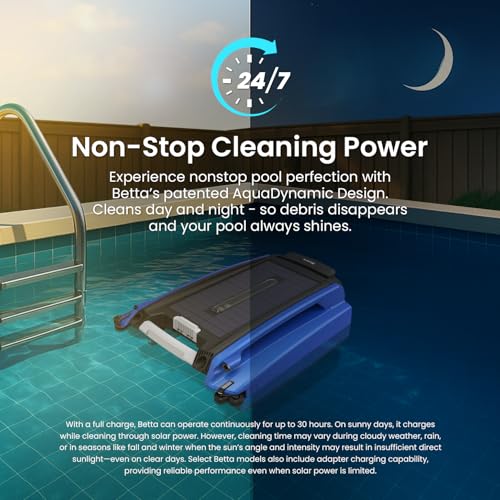
If you choose a cordless or solar-powered pool cleaner, battery life determines whether it can finish a full cleaning cycle without stopping short. Look for a runtime that matches your pool’s size, shape, and debris load, and consider recharge time as well as whether the cleaner maintains suction and navigation as power drops. For solar-powered options, watch how dependent performance is on steady sunlight, especially if your pool is shaded or you need predictable cleaning on cloudy days.
For cordless robotic cleaners, choose runtime with margin for your pool size, depth, and debris level, because batteries run shorter as they age and heavy debris can extend cleaning time. Check recharge time, charge-port sealing, low-battery behavior, and whether the unit can be retrieved easily if it stops in the deep end; for solar skimmers, make sure your pool gets enough sun and that shaded areas, night use, and cloudy stretches will not leave it stranded. Owner sentiment is favorable here: many report long cordless cleaning sessions, enough runtime for larger pools, full cycles without quitting partway through, and solar models that can run day and night or stay charged even with some shade.
Debris
Debris pickup matters because it determines whether your pool cleaner can handle the actual mess in your pool, from fine sand and dirt to leaves, twigs, and heavier debris. Look for strong, consistent suction and a debris system that matches your pool’s needs, since some cleaners do well with large leaves but struggle with fine particles, while others can lose effectiveness when the basket or filter starts to fill.
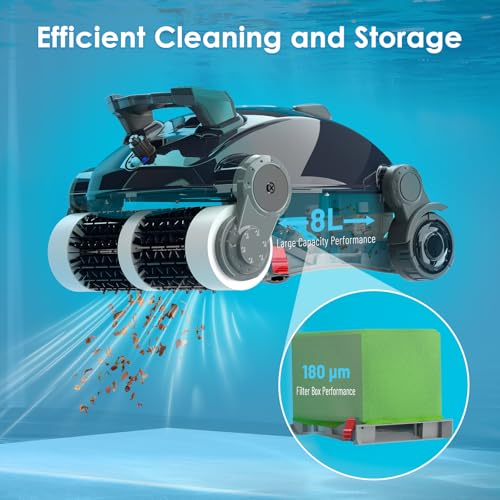
Match the debris system to your actual contaminants: large leaves and acorns need a wide intake and high-capacity basket, while pollen, silt, sand, dust, and algae residue require fine filtration that will not immediately clog. If trees drop debris daily, a surface skimmer can prevent leaves and bugs from sinking, but you may still need a floor cleaner for sediment; if your pool gets fine dust, look for fine filter panels or bags rather than only a coarse leaf basket. Owner reports reinforce the importance of this match, with strong praise for units that collect leaves, bugs, pollen, tiny particles, dirt, sediment, algae, sand, silt, dust, and larger bottom debris into easy-to-empty baskets.
Value
A pool cleaner should justify its cost by saving you time and keeping your pool consistently clean without constant fixes or supervision. Look for the right balance of cleaning coverage, reliability, ease of maintenance, and included features for your pool type, and be wary of paying extra for capabilities you won’t use or a low upfront price that leads to frequent repairs, replacement parts, or poor performance.
Evaluate value as total pool-maintenance cost, not just purchase price: include replacement filters, bags, tracks, brushes, hoses, batteries, drive parts, energy use, and any required pump or booster-pump run time. The best value is the cleaner that eliminates your most frequent paid or manual task—skimming under trees, vacuuming sand and silt, or brushing walls—not necessarily the most feature-packed model. Owners commonly frame these cleaners as worthwhile when they reduce manual brushing, vacuuming, skimming, hose setup, or paid cleaning service, and many feel the cost is justified when routine maintenance becomes faster and more reliable.
Build
A well-built pool cleaner is more likely to handle repeated cycles, debris, chemicals, and sun exposure without constant breakdowns or parts wearing out early. Look for sturdy wheels or tracks, solid hoses or cables, secure seals, and easily available replacement parts; watch out for flimsy plastics, weak connectors, or designs that make routine maintenance harder than it should be.
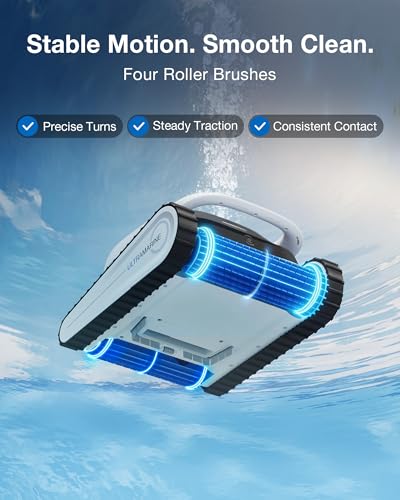
Because automatic cleaners live in chlorinated water, sun, grit, and moving debris, inspect durability-critical parts: drive tracks, wheels, gears, scrubber brushes, seals, hinges, basket latches, cable swivels, hose cuffs, and the availability of replacement parts. For vinyl, fiberglass, tile, pebble, or plaster pools, confirm brush and traction compatibility so the unit climbs effectively without scuffing the surface; also look for anti-stall design around drains and raised fittings. Owner feedback is mostly positive on reliable startup and time-saving routine use, but durability is the key watch-out: some buyers report worn tracks, stalled internal gears, major issues after a year or two, or the need for occasional repairs and extra attention.
1,000,000+ shoppers use Buyer's Guide every week to find the best products and services online.

Helping millions of users make smarter purchases online.


