

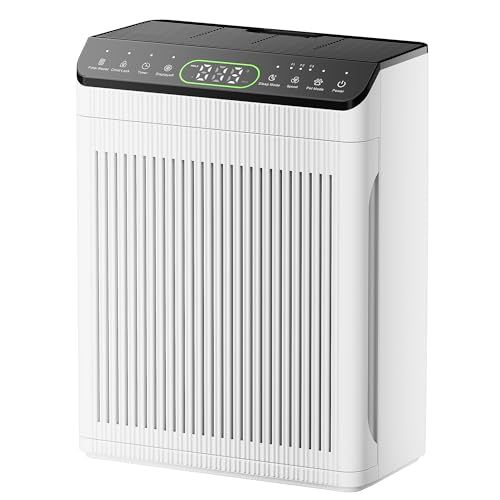
- Coverage: 2,200 sq ft in 1 hour
- Particle Removal: 99.97% down to 0.3 microns
- Filter Type: H13 True HEpA
- Dimensions: 13.4" wide x 7.5" deep x 17.1" tall
- Ideal For: Allergens, dust, pet dander, smoke, odors





Evalit Air Purifier
Overview and Everyday Performance

The Evalit Air Purifier is designed for people who want noticeably cleaner indoor air without turning their living space into a noisy, high-maintenance “appliance zone.” In day-to-day use, the best air purifiers fade into the background: they run quietly, respond sensibly to changing conditions, and make the air feel fresher over time. That’s the experience the Evalit aims to deliver, especially in common problem scenarios like seasonal allergies, pet dander, lingering cooking odors, and the general dust that accumulates in homes and apartments.
What most buyers will care about first is whether the purifier can actually move enough air to matter in the room where it will live. Strong airflow and efficient filtration tend to create that “cleaner air” feeling faster, especially after activities that kick up particles such as vacuuming, changing bedding, or having several people in one room. If you plan to run it in a bedroom, consistent performance at lower fan speeds becomes important because many units can purify well on high but become disruptive at night. The Evalit’s value proposition is best when it can maintain clean air steadily rather than requiring frequent, loud bursts of high power.
Another everyday factor is how the purifier behaves as a routine companion. Controls should be intuitive, with modes that make sense rather than gimmicky settings you never touch. Many users also appreciate indicators that communicate filter condition and air quality in a way that’s easy to understand at a glance. In practice, the most satisfying purifiers are the ones you can set and forget, only checking in periodically to confirm everything is operating as expected.
In terms of placement, it’s worth remembering that any air purifier performs best when air can circulate freely around it. Even a very capable purifier will struggle if it’s wedged behind furniture or pushed into a corner where intake and exhaust are blocked. If the Evalit is used in a high-traffic space like a living room, a slightly more open placement can improve perceived performance more than toggling settings constantly. Used thoughtfully, the purifier can contribute to a cleaner baseline for the whole household, particularly when run consistently rather than only during “bad air” moments.
What to Consider Before Buying (and What Matters Most)
Before purchasing the Evalit Air Purifier, the single most important consideration is room size and the purifier’s real-world capacity for that space. Marketing terms can be vague, so it helps to focus on whether the unit is intended for a small bedroom, a medium living room, or a larger open-plan area. If a purifier is undersized, you may end up running it at higher speeds to compensate, which can increase noise and reduce the sense of comfort. If it’s appropriately sized, you’ll get better air cleaning at gentler settings, which is usually the sweet spot for everyday use.
Filtration type is the next critical factor. A true HEPA-style approach is typically what allergy sufferers seek because it targets fine particulate matter such as pollen, dust mites, and pet dander. If odors, cooking smells, or smoke are major concerns, you’ll want meaningful odor control, which usually comes from activated carbon or similar media. Many buyers assume “any purifier removes smells,” but odor control varies dramatically by filter design and the amount of sorbent material used. If your primary issue is particles, prioritize particle filtration; if your main frustration is odors, make sure odor treatment is not an afterthought.
Ongoing cost and maintenance are also high-impact, even if they’re less exciting than initial features. Replacement filters and their replacement frequency can change the real cost of ownership significantly over a year. It’s wise to check how easy it is to obtain official filters, whether third-party options exist, and how often you’ll realistically need to replace them based on your environment. Homes with pets, heavy outdoor pollen, frequent cooking, or nearby traffic often go through filters faster. A purifier that is affordable upfront but expensive to maintain can be less satisfying than a slightly pricier model with more reasonable long-term costs.
Noise is often the deciding factor for bedroom and office use. Many purifiers can be loud on their highest setting, but the more meaningful question is whether the Evalit can keep air clean at a comfortable sound level. If you’re sensitive to noise or plan to sleep with the unit running, you’ll likely value a quiet low or sleep mode more than an aggressive turbo mode. The most important noise consideration is not “How loud is the maximum?” but “How livable is it at the speed I’ll use most?”
Energy use matters for people who plan to run a purifier continuously, which is exactly how you get the best results. A purifier that can run 24/7 without causing anxiety about the electric bill is easier to commit to long term. While any individual unit usually won’t be a major energy hog, the difference becomes noticeable when you run it year-round. Ease of cleaning around the unit also counts: prefilters that catch hair and larger dust can extend the main filter’s life, but only if they’re easy to access and simple to keep clean.
Finally, consider how the purifier fits your routine. If you want “hands off,” look for automatic behavior that doesn’t overreact and constantly ramp up and down. If you prefer control, make sure manual settings are straightforward. The best choice is the one you’ll actually use consistently, because consistency is what turns air purification from a gadget into a real quality-of-life upgrade.
Common Questions
Will the Evalit Air Purifier help with allergies? It can help if your allergy triggers are airborne particles such as pollen, dust, and pet dander and if the unit’s filtration is designed to capture fine particulates. For best results, run it daily and keep doors and windows management consistent so you’re not constantly reintroducing large amounts of outdoor allergens.
Does it remove odors from cooking or pets? Odor reduction depends heavily on whether the filter includes substantial odor-adsorbing media such as activated carbon. If odors are your primary issue, make sure the filter system is intended for smells, not only dust, and plan on timely filter changes because saturated odor media becomes less effective.
How do I choose the right size for my room? Match the purifier to the room where it will be used most, not the biggest room in the home unless that’s your target space. If you’re between sizes, sizing up can allow you to run at lower, quieter speeds while still getting good air cleaning.
How often will I need to replace the filters? Filter life varies based on pets, smoke exposure, outdoor air quality, and how many hours per day you run the unit. A cleaner environment and the use of a prefilter can extend life, while heavy dust or odors can shorten it. Treat the manufacturer’s timeline as a baseline and adjust based on performance and any filter indicators.
Where should I place the purifier for the best effect? Place it where airflow is not blocked, ideally with space around the intake and exhaust. Bedrooms often benefit from placement a few feet away from the bed rather than tucked under a desk. In living rooms, a central or semi-open spot typically performs better than a tight corner.
Overall, the Evalit Air Purifier is best evaluated through the lens of fit: the right capacity for your room, the right filtration for your specific problems, and a maintenance profile you won’t resent. If you prioritize room size matching, filtration type, and livable noise at your typical setting, you’ll make a smarter purchase and get the kind of consistent, low-friction air cleaning that actually improves day-to-day comfort.