

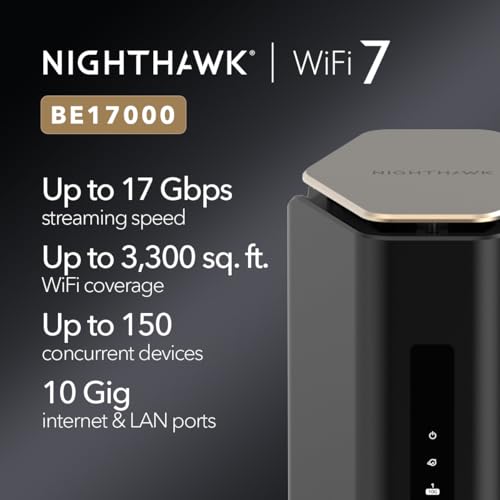


- Speed: Up to 17Gbps
- Coverage Area: Up to 3300 sq ft
- Bands: Tri (2.4GHz, 5GHz, & 6GHz)
- Processor: 2.0GHz 4-core
- Ports: 3 1-gigabit ethernet, 1 10-gigabit ethernet, USB





NETGEAR Nighthawk WiFi 7 Router
Overall Performance and Real-World Experience

The NETGEAR Nighthawk WiFi 7 Router is built for people who want their home network to feel effortless even under heavy demand. WiFi 7 (802.11be) is designed to push beyond the practical limits of WiFi 6/6E by improving throughput, reducing latency, and handling many simultaneous connections more gracefully. In day-to-day use, that translates into smoother 4K and 8K streaming, faster large file transfers across the home, and more consistent online gaming performance, especially when multiple users are active at once.
One of the most noticeable benefits of a high-end WiFi 7 router is how well it maintains responsiveness when the network is busy. If you’ve ever experienced the “everything slows down when someone starts a big download” problem, a premium router with stronger processing, better radios, and modern scheduling can make the entire household feel more stable. The Nighthawk line generally targets this kind of experience: strong wireless coverage, quick device handling, and the ability to push fast speeds to compatible clients at close range.
That said, the most dramatic WiFi 7 gains typically appear when you have WiFi 7 client devices (newer phones, laptops, and adapters) that can take advantage of the latest features. If most of your devices are WiFi 6 or WiFi 5, you can still benefit from better overall router capacity and range, but the headline speeds you might see in marketing won’t be fully realized. In other words, this router can be an excellent foundation for the next several years, but its peak performance depends on the rest of your hardware catching up.
Coverage is another major reason people look at Nighthawk-class routers. A single powerful router can work well in apartments and medium-sized homes, but building materials and layout matter. If you have dense walls, long hallways, a finished basement, or dead zones at the edges of the property, a mesh system or adding compatible extenders may still be necessary. Even a top-tier router can’t completely override physics, though better antennas and radios can reduce the pain.
What to Consider Before Buying (and What Matters Most)
Before purchasing the NETGEAR Nighthawk WiFi 7 Router, it’s worth stepping back and identifying what problem you’re solving. The most important factor for many buyers is whether their internet plan and devices can actually use the router’s capabilities. If your ISP speed is modest, upgrading to WiFi 7 won’t magically increase your internet bandwidth, but it can improve consistency, reduce congestion, and speed up local transfers inside your home network. If you pay for multi-gig internet, then the router’s ability to handle multi-gig WAN and LAN becomes far more important, because otherwise your wired and wireless network can bottleneck your service.
Client device compatibility is a close second in importance. WiFi 7 benefits are most obvious on WiFi 7 clients, particularly at short range. If you’re buying a router to support a new WiFi 7 laptop, a next-gen gaming PC with a WiFi 7 card, or a household that upgrades phones frequently, the investment makes more immediate sense. If you keep devices for a long time and most of your equipment is older, you should weigh whether a strong WiFi 6E router would meet your needs for less.
Home size and layout should guide your decision as much as raw specs. A large router can have impressive coverage, but if your home is spread out across multiple floors or has difficult construction materials, the “most important” choice might actually be topology rather than standard. In those cases, a mesh system may provide a better experience than a single powerful router, even if the single router is technically more advanced.
Another factor to consider is wired connectivity. Many households now have more devices that benefit from Ethernet than they realize: desktop PCs, game consoles, smart TVs, NAS boxes for backups, and work-from-home docking stations. If you need multiple wired connections in one room, you may want to plan for a network switch. If you want the fastest possible backbone for a NAS or a high-end workstation, multi-gig Ethernet ports and the ability to route traffic at those speeds becomes more important than peak wireless numbers. For power users, the best setup is often a combination of fast wired links for stationary devices and WiFi 7 for mobile devices.
Software features and ongoing costs can be decisive. Router apps have improved, but not all are equally clear or consistent. Consider whether you care about advanced controls such as VLANs, guest networks, traffic prioritization, VPN support, and detailed device management. Also consider whether any security features, parental controls, or network protection services require a subscription after an initial trial. Some buyers are happy to pay for a polished security suite; others prefer a one-time purchase with no recurring costs. This is especially important because a router is not a short-term purchase for most people, and the “total cost of ownership” can matter as much as the upfront price.
Finally, reliability and update cadence matter more than many shoppers expect. A router is infrastructure; when it’s unstable, it affects everything. Look for a model that is known to receive regular firmware updates, security patches, and feature refinements. If you work from home, game competitively, or run a smart home with many devices, stability may be the single most important requirement, even above maximum throughput.
Common Questions
Do I need WiFi 7 devices to benefit from a WiFi 7 router?
You don’t strictly need WiFi 7 clients to see improvements, because a newer router can deliver better range, processing, and congestion handling. However, the biggest speed and latency benefits come when both the router and the client support WiFi 7 features.
Will this router make my internet faster?
It can remove bottlenecks inside your home network, which may help you reach the full speed you already pay for, especially over WiFi. But it cannot exceed the speed your ISP delivers to your modem. If your current router is limiting your connection, upgrading can feel like a major speed boost.
Is a single high-end router better than mesh?
In smaller or more open spaces, a single powerful router can be simpler and very effective. In larger homes or layouts with tough signal paths, mesh often provides more consistent coverage and fewer dead zones. The “better” option depends on your floor plan and where your devices are located.
Should I prioritize multi-gig ports or wireless specs?
If you have multi-gig internet, a NAS, or a desktop setup that transfers large files, multi-gig Ethernet becomes extremely important. If your priority is mobile devices and you mostly browse, stream, and use video calls, wireless consistency and coverage will matter more than peak wired throughput.
As a premium upgrade, the NETGEAR Nighthawk WiFi 7 Router is best viewed as a long-term foundation for fast, responsive networking, particularly for households adding newer WiFi 7 devices and juggling many simultaneous connections. The most important purchase considerations are whether your internet plan and devices can take advantage of it, whether your home layout calls for a single router or mesh, and whether the software features and any subscriptions match your expectations. If those align with your needs, it’s a strong choice that can keep your network feeling modern for years.