


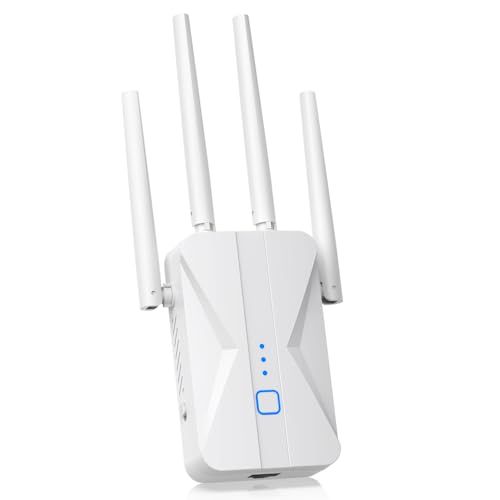
- Type: Extender
- Speed: Up to 1.2Gbps
- Coverage Area: Up to 1000 sq ft
- Bands: Dual (2.4GHz & 5GHz)
- Ports: 1 gigabit ethernet




ROQRL Wi-Fi Extender
Overall Performance and Everyday Experience

The ROQRL Wi-Fi Extender is designed for people who like their current internet service but struggle with weak or inconsistent Wi-Fi in certain areas of the home. In practice, it aims to solve common “dead zone” problems in upstairs bedrooms, basements, garages, or rooms separated by thick walls. As with most extenders, the best results come when it is placed strategically, roughly halfway between the router and the area where you need stronger coverage. When positioned well, the ROQRL can make everyday tasks like streaming video, joining video calls, browsing, and downloading files feel noticeably more reliable in previously troublesome spots.
Range extension is the main promise here, and the ROQRL generally meets expectations for a typical consumer extender: it can improve signal strength and stabilize connections where a router alone struggles. That does not mean it magically turns a slow internet plan into a fast one, or that it can overcome extreme structural obstacles. Instead, it works best as a practical, cost-effective boost to your existing network, helping devices stay connected and maintain usable speeds at the edges of coverage. If your issue is less about coverage and more about your internet service being slow at the source, no extender can fully fix that; it can only repeat what it receives.
Day-to-day usability also comes down to consistency. A good extender should reduce dropouts and make roaming around the home less irritating. With the ROQRL, many users will find that the biggest quality-of-life improvement is not the top speed number, but the steadiness of the connection in rooms that used to fluctuate. That stability is especially valuable for work-from-home scenarios, smart TVs, and smart home devices that often fail when signal strength is marginal.
Key Purchase Factors and What Matters Most
Before buying any Wi-Fi extender, it helps to be clear about what problem you’re trying to solve. Coverage issues are the best match for an extender, while network congestion or very high-speed needs may point toward a mesh system or a router upgrade instead. For the ROQRL, the most important factor is compatibility with your existing router and Wi-Fi setup. Most extenders support common standards and will work with the majority of home routers, but you should still confirm that it matches your Wi-Fi type and security settings. If your household relies heavily on newer features or you have many modern devices, ensuring the extender aligns with those capabilities can make setup smoother and performance more predictable.
Placement is the next major consideration and, for many people, it becomes the deciding factor in satisfaction. Extenders need a good signal from the router to repeat it effectively. If the only available outlet is too far from the router, the extender may end up repeating a weak signal and provide only modest gains. If you can place the ROQRL where the router’s signal is still reasonably strong, you’re much more likely to see meaningful improvement in the target room. Think about the layout of your home, where you actually need better Wi-Fi, and whether an outlet exists in a sensible intermediate location.
Another factor to consider is speed expectations and how extenders work. Many extenders can reduce effective throughput because they retransmit data, especially if they use the same band for communicating with both the router and your devices. This doesn’t mean the ROQRL cannot improve your experience; it often can, because a strong repeated signal at a moderate speed is better than a weak, unstable signal at a theoretical higher speed. Still, if you’re trying to maximize performance for bandwidth-heavy tasks like 4K streaming in multiple rooms, large file transfers, competitive gaming, or a busy household with lots of simultaneous users, you should be realistic about what an extender can deliver compared to a mesh system with dedicated backhaul or a stronger router placed more centrally.
Device count and usage patterns also matter. If your home has many devices connected at once, including cameras, speakers, and smart appliances, you’ll want an extender that can remain stable under load. Even if your internet plan is fast, a crowded Wi-Fi environment can cause slowdowns. In such situations, the ROQRL can help by providing a closer access point for distant devices, but it will not fully eliminate interference from neighboring networks or the limitations of an older router. If you live in an apartment building or dense neighborhood, interference is an important hidden variable, and you may benefit from adjusting channels or router placement alongside using the extender.
Finally, ease of setup and ongoing management should not be underestimated. An extender is supposed to reduce frustration, not add to it. Buyers should look for a straightforward pairing process, clear indicator lights or status feedback, and a sensible way to confirm where the device should be placed. This is particularly important if the extender is being purchased for a less technical family member. The ROQRL is best suited to users who want a practical coverage boost without a full network overhaul, and who can spend a few minutes experimenting with placement to get the best results.
If you have to prioritize the most important factors, focus first on placement feasibility in your home, then on your performance expectations relative to an extender’s limitations, and then on compatibility with your current router and devices. Those three elements will determine satisfaction more than minor feature differences between extenders.
Common Questions
Will the ROQRL Wi-Fi Extender make my internet speed faster everywhere?
It can make your Wi-Fi feel faster in weak-signal areas by improving signal strength and reducing retransmissions caused by a struggling connection, but it cannot exceed the speed your router receives from your internet service. Think of it as improving reach and reliability rather than increasing the internet plan’s speed.
Where should I place the ROQRL Wi-Fi Extender for the best results?
Place it roughly halfway between your router and the dead zone, in a spot where the router’s Wi-Fi is still strong and stable. If you put it too close to the dead zone, it may only receive a weak signal and won’t have much quality bandwidth to extend.
Is an extender like the ROQRL better than a mesh Wi-Fi system?
It depends on your goal and budget. An extender is typically more affordable and can solve a specific coverage gap, especially in smaller homes or targeted areas. A mesh system is often better for larger homes or when you want more seamless roaming and consistent performance across many rooms.
Will the extender create a separate network name?
Many extenders can either create a separate Wi-Fi network name or mirror your existing one, depending on how they are configured. If it creates a new name, you may need to choose the extended network on your devices. If it mirrors the name, roaming may feel simpler, though device switching behavior still varies by device.
Can it help with video calls and streaming in a back bedroom?
Yes, that’s one of the most common and best use cases. If the back bedroom currently has a weak signal, extending coverage can reduce buffering, improve stability, and lower the chance of dropped calls, provided the extender is placed where it can receive a strong signal from the router.
Conclusion: The ROQRL Wi-Fi Extender is a sensible choice for households that need stronger coverage in a few specific areas without replacing their router or investing in a full mesh system. The purchase decision should hinge on whether you can place it in an effective location, whether your expectations align with what extenders can realistically deliver, and whether it integrates cleanly with your existing network. Set up thoughtfully, it can turn frustrating dead zones into dependable, usable spaces for work, entertainment, and everyday connectivity.