





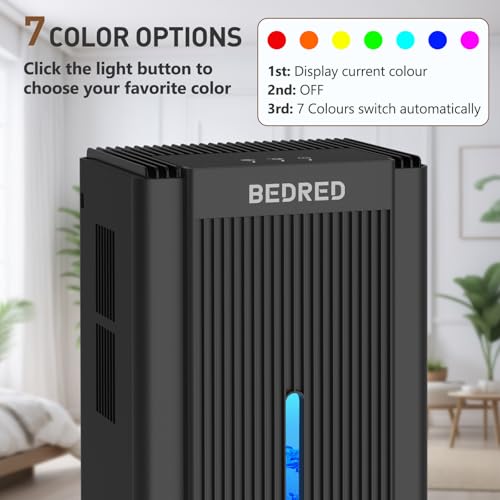






We also considered 10 others:


Our Top Choice
Compare Features


The order above is not editorial opinion, and it is not paid placement. It comes from what shoppers across our network actually do - which whole basement dehumidifiers they compare, and which they ultimately buy. We re-rank as new data comes in, so the long-term favorites have to keep earning their spot against new entrants. The full method, including how we make money.
Whole Basement Dehumidifiers Buyer's Guide
Whole-basement dehumidifiers have to do more than dry one room: they must pull moisture from cool concrete, stored belongings, crawlspace air, and sometimes laundry or seepage while running unattended for long stretches. The sharpest buying concerns are real moisture-removal capacity at basement temperatures and a drainage setup that will not leave the unit stopped on a full bucket or leaking near finished space.
Performance
You want a dehumidifier that can pull enough moisture from the air to bring your room to a comfortable humidity level and keep it there, not just collect water occasionally. Look for capacity that matches your space size and dampness level, steady humidity control with an adjustable humidistat, and performance in the temperatures where you’ll use it. Watch out for undersized units, vague moisture-removal claims, or models that run constantly without noticeably reducing humidity.
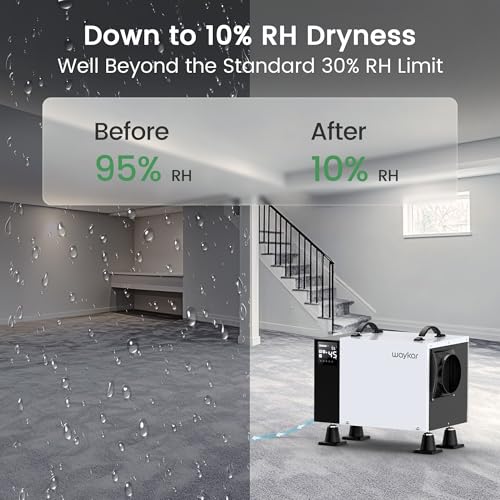
For a whole basement, judge performance by real moisture load, not just advertised square footage: look for enough pint capacity to hold 45–50% RH in cool basement temperatures, continuous-duty operation, auto humidistat control, and low-temperature defrost if the space drops near the 50s. Avoid undersized units if you have seepage, laundry, unsealed concrete, crawlspace connection, or humidity that sits in the 60–70% range, because they may run constantly without catching up. Owner feedback supports prioritizing strong removal capacity: buyers often report obvious water collection, large damp basements and crawlspaces coming under control, and humidity dropping from the mid-60s into the mid-40s after extended operation or even sharply overnight.
Build
You want a dehumidifier that feels sturdy and can handle regular vibration, moisture exposure, and frequent bucket removal without cracking, leaking, or becoming noisy over time. Look for solid housing, smooth-fitting water buckets, durable wheels or handles, and owner feedback that points to long-term reliability rather than early failures or rattling parts.
For basement use, build matters because the unit may run for months in dusty, cool, damp air: favor a heavier-duty cabinet, washable or replaceable filter access, corrosion-resistant coils, robust casters or handles, clear humidity readout, and controls that survive unattended operation. Check that the housing, hose fittings, bucket switch, pump connection, and power cord strain relief feel sturdy; avoid flimsy residential-style designs if the unit will serve as whole-basement moisture control rather than occasional room drying. Owner sentiment backs this up, with many describing stronger units as solid, commercial-grade-feeling, dependable season after season, easy to set up, and capable of keeping larger spaces near target instead of drifting back into the 60–70% range.
Ease
You’ll live with a dehumidifier day to day, so ease of use matters as much as moisture removal: look for simple setup, clear controls, an easy-to-read display, and settings that are intuitive enough to adjust without fuss. Pay attention to maintenance, too—features like a removable water tank with a comfortable handle, accessible filter, clear full-tank alerts, and an option for continuous drainage can make the difference between a unit you use consistently and one that becomes a chore.
For a whole basement, ease of use mostly means how well it can be left alone: prioritize a reliable humidistat, auto restart after power outages, continuous-drain or pump mode, readable controls from a standing position, filter-clean reminders, and an accessible bucket only as a backup. If the basement is not visited daily, avoid models that depend on frequent manual emptying or have confusing pump/timer settings, because a full bucket can stop dehumidification right when humidity is highest. Owners commonly praise simple setup, digital displays, timers, auto shut-off, removable tanks, app monitoring, included drain hoses, and built-in pumps that make operation feel close to set-and-forget.
Noise
Noise matters because a dehumidifier may run for hours at a time, especially in bedrooms, living rooms, basements, or home offices where a constant hum can become distracting. Look for quiet operation at the fan speeds you’ll actually use, and watch out for units that are tolerable on low but noticeably loud or rattly on high, especially if you plan to place one near where you sleep, work, or relax.
For a basement below living areas, do not look only for “quiet”; check whether the sound profile is low fan hum versus compressor rattle, whether there are multiple fan speeds, and whether vibration can transfer through joists or a concrete slab. If the unit will run under bedrooms, offices, or a finished basement media room, plan for rubber feet, level placement, and a model known for low vibration during compressor cycling. Owner feedback is encouraging here: many buyers say quieter units are suitable for basements, bedrooms, offices, and living areas, especially compared with older dehumidifiers that could be heard elsewhere in the home.
Drainage
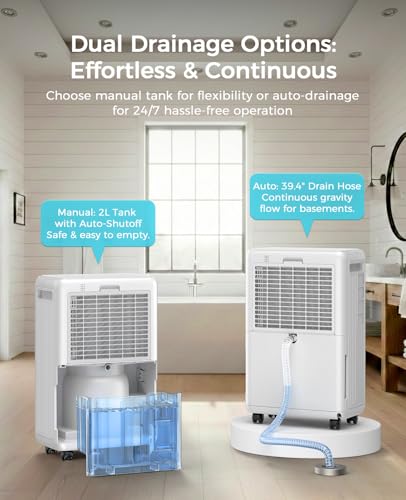
Drainage determines how often you have to empty the dehumidifier and how safely it can run unattended. Look for a bucket capacity that fits the room’s moisture level, an easy-to-remove tank with overflow shutoff, and a hose connection or built-in pump if you want continuous draining to a floor drain, sink, or higher outlet. Watch for poor sealing or awkward buckets, which can lead to spills, leakage, or frequent interruptions.
Drainage is the make-or-break feature for whole-basement dehumidification: choose continuous gravity drain if you can slope to a floor drain or sump, and choose a built-in pump only if you must lift water to a sink, standpipe, or higher discharge point. Verify hose diameter, included hose length, lift height, backflow protection, leak shutoff behavior, and whether the pump restarts reliably after outages; avoid relying on a small bucket in a wet basement because it can fill quickly and shut the unit off. Owners strongly appreciate pump and continuous-drain options because they avoid repeated emptying, but sentiment is more mixed around pump reliability, leakage, tank size, and hose fit, so this is a feature to inspect carefully rather than assume will work in every layout.
Size
You need a dehumidifier that fits where moisture actually builds up, whether that’s a basement corner, laundry room, closet, or bedroom. Look at the unit’s footprint, height, and clearance needs so it won’t block walkways, doors, vents, or shelves; a compact size can be easier to place, but watch that it still has enough capacity for the space you need to dry.
For whole-basement coverage, size should balance placement flexibility with air movement and reservoir capacity: a compact unit is easier to tuck near a drain, under stairs, or beside mechanical equipment, but it still needs enough clearance around intake/exhaust and enough capacity for the basement’s dampest season. Avoid choosing the smallest footprint if it means a smaller tank, weaker fan throw, or more frequent attention in a large or divided basement; in partitioned spaces, placement and airflow paths may matter as much as the unit’s footprint. Owner feedback reflects this tradeoff: compact models with wheels are liked for easy placement and moving, but smaller designs can bring compromises such as less power or tanks that need daily emptying in very wet conditions.
1,000,000+ shoppers use Buyer's Guide every week to find the best products and services online.

Helping millions of users make smarter purchases online.


