



- Battery Life: Up to 24 hours
- Case: 42mm or 46mm aluminum
- Compatibility: iPhone smart phones
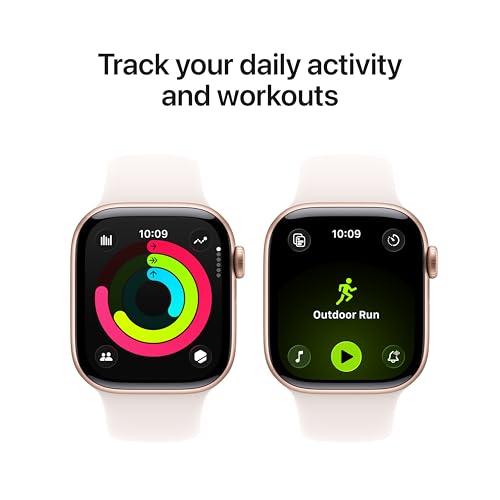
- Activity Tracking: Workouts, steps, calories
- Health Monitoring: Heart rate, sleep, SpO2, ECG, women's health, fall detection, crash detection





Apple Watch Series 11 GPS Smartwatch
Design, display, and everyday comfort

The Apple Watch Series 11 GPS Smartwatch continues Apple’s steady refinement of a product that’s as much a daily companion as it is a piece of tech. From the moment you put it on, the most important thing to assess is whether it feels like something you’ll happily wear from morning to night. Apple’s familiar design language remains clean and premium, with a case and finish that look at home in the gym, the office, and at dinner. The real story, however, is how the watch disappears into your routine: it needs to be comfortable, readable, and quick to interact with, because the best smartwatch is the one you don’t have to think about.
The display is central to that experience. A bright, sharp screen matters for glanceable information such as messages, timers, workout stats, and navigation cues. If you spend time outdoors, screen brightness and clarity in direct sunlight become purchase-defining factors, especially when you’re checking pace mid-run or reading a notification while walking. An always-on display, if included and enabled, can also change how “watch-like” the device feels; you can quickly see the time and complications without a wrist raise, which makes the smartwatch feel more natural. The tradeoff is battery consumption, so it’s worth considering how you value convenience versus runtime.
Comfort is not just about weight. Band choice can determine whether you love or loathe wearing a smartwatch all day. People with sensitive skin may want to think about material and breathability, while athletes may prioritize a band that stays secure when sweating. Sizing is equally important; the case size should suit your wrist, and the band should fasten without pressure points. Since many people wear their Apple Watch to sleep for recovery metrics and sleep tracking, comfort at night becomes a practical concern rather than a luxury.
Before buying, one of the most important factors is how you intend to use it day-to-day. If you mainly want something elegant for notifications and quick checks, you’ll care most about display quality, responsiveness, comfort, and how easily the watch integrates with your iPhone. If you plan to lean heavily into workouts and health features, then fit, sensor reliability, and durability will dominate your decision. The Series 11 GPS model is meant to be capable across both worlds, but your personal emphasis will determine whether it feels like a worthwhile upgrade or simply a nice-to-have.
Health, fitness, and GPS performance
Apple has built its smartwatch reputation on health and fitness, and the Apple Watch Series 11 GPS Smartwatch aims to remain one of the most approachable, motivating options available. The strength of Apple’s approach isn’t only the presence of sensors, but the way the watch turns them into habits. Activity rings, trends, workout reminders, and well-designed summaries encourage consistency without feeling overly technical. For many users, that “gentle push” is the difference between a tracker that gets ignored and a device that actually influences behavior.
When evaluating this watch, accuracy and usefulness are more important than simply having a long list of features. Heart rate tracking needs to be stable during both steady-state cardio and higher-intensity intervals. If you do a lot of strength training, you’ll want the watch to be responsive when starting and stopping sets, and you’ll want workout logging that feels quick rather than fiddly. For runners and walkers, GPS quality is crucial. A GPS watch should deliver reliable distance and pace, acquire a signal without drama, and remain consistent in challenging areas such as tree cover or dense neighborhoods. The GPS-only model relies on the watch’s internal GPS for outdoor tracking and typically depends on the iPhone for certain connectivity tasks, which is perfectly fine if you usually carry your phone anyway.
Another factor that matters is how much you want your watch to replace other gear. If you want to leave your phone behind often, you may end up wishing for a cellular model instead of GPS-only, especially for music streaming, calls, or emergency communication away from your phone. On the other hand, if your phone is almost always nearby, the GPS version can be the smarter purchase because it keeps costs down while still delivering the core Apple Watch experience.
Health features are also a major draw, but prospective buyers should focus on what will truly change their routine. Sleep tracking can be valuable if you’re willing to wear the watch overnight and keep up with charging habits. Safety features and alerts may be especially meaningful for older users, people with medical concerns, or anyone who exercises alone. If you’re buying the watch for a family member, these capabilities can be more important than any fitness metric. The key is to consider not only what the watch can measure, but what you will actually act on. A watch that nudges you to move more, sleep better, and pay attention to warning signs can have a real impact, but only if it’s easy enough to use that you stick with it.
Finally, software is part of performance. Apple’s workout app, fitness metrics, and health summaries tend to be polished, and the broader Apple ecosystem support is a major advantage. The watch becomes more useful when it’s paired with Apple Fitness+, Apple Health, and third-party apps that take advantage of the sensors. If you’ve never used an Apple Watch before, this cohesive ecosystem can feel like the “secret feature” that makes everything more intuitive than competing platforms.
Buying considerations, value, and Common Questions
Before purchasing the Apple Watch Series 11 GPS Smartwatch, the most important practical consideration is compatibility. You’ll need an iPhone to set it up and get the full experience, and the watch is at its best when tightly integrated with Apple services. If you’re not already in the iPhone ecosystem, this alone may be the deciding factor. Next, think about battery life and charging behavior. Even a great smartwatch can feel inconvenient if you regularly run out of charge halfway through a day or forget to top it up before sleep tracking. Consider when you can reliably charge: during a morning shower, while working at a desk, or during an evening wind-down. A predictable charging routine matters more than theoretical battery numbers.
Price and longevity should also guide your decision. Smartwatches are not purely timeless accessories; they’re personal electronics with an expected upgrade cycle. Value, then, is partly about how many years you plan to keep it and how quickly you tend to adopt new features. If you’re upgrading from a much older Apple Watch, Series 11 will likely feel like a significant leap in speed, display quality, and sensor sophistication. If you already own a recent model, the upgrade may hinge on whether the newest health features or performance tweaks address a specific need you have right now. Apple’s trade-in programs and seasonal discounts can also shift the equation considerably.
Durability and intended environment are worth weighing. If you’re tough on gadgets, prioritize a case finish and band that match your habits, and consider how you’ll use the watch during travel, workouts, and outdoor activities. Water resistance is useful, but it’s still wise to treat the watch as a piece of electronics and follow Apple’s care guidance, especially around exposure to soaps, lotions, and impacts. If you’re buying for someone who wants a “set it and forget it” device, ease of use and reliable notifications may be more valuable than niche sports metrics.
Common Questions
Will the GPS model work without my iPhone nearby? The watch can track workouts with GPS, tell time, run many apps, and handle offline tasks on its own, but it relies on the iPhone for full connectivity features when Wi‑Fi isn’t available. If you want calls and data everywhere without your phone, you should consider the cellular version instead.
Is it worth upgrading if I already have an older Apple Watch? If your current watch feels slow, has weak battery life, or lacks the health and fitness features you care about, an upgrade can be very satisfying. If your existing watch is recent and meets your needs, the value of upgrading depends on whether the new features solve a specific problem for you.
How important is battery life compared to features? Battery life is foundational because it affects whether you can use sleep tracking, long workouts, and always-on display features without stress. If you dislike charging daily, prioritize battery behavior and your charging routine over extra features you may rarely use.
In the end, the Apple Watch Series 11 GPS Smartwatch is best judged by how seamlessly it fits into your life. If you want a polished smartwatch with strong fitness and health tools, excellent ecosystem integration, and a comfortable design you’ll actually wear, it remains one of the most compelling options. The smartest purchase comes from matching the model and configuration to your real habits, especially around iPhone proximity, charging routine, and the health features you’ll genuinely use.