







We also considered 10 others:


Our Top Choice
The order above is not editorial opinion, and it is not paid placement. It comes from what shoppers across our network actually do - which scooters for elderly they compare, and which they ultimately buy. We re-rank as new data comes in, so the long-term favorites have to keep earning their spot against new entrants. The full method, including how we make money.
Scooters for Elderly Buyer's Guide
Buying a scooter for an elderly rider is a tradeoff between independence, safety, and practical handling by the rider or caregiver. The sharpest concerns are whether it can be controlled confidently in real environments and whether its range, comfort, and transport weight match the user’s actual daily routine.
Range
Range determines whether the scooter supports a full errand, medical visit, or outdoor outing without causing charge anxiety. For elderly riders, predictable charging matters as much as the headline distance because being stranded can become a safety and caregiving problem.
Prioritize a scooter with enough rated range for the longest realistic outing plus a reserve, because range drops with rider weight, hills, grass, frequent starts, cold weather, and aging batteries. Look for an easy-to-read battery gauge, a charger that is simple to plug in without bending awkwardly, and clear guidance on whether the battery can be removed for indoor charging. Owner sentiment strongly supports making this a top filter: buyers repeatedly described long rides and outings where the charge still had plenty left, and they also tied good battery life to practical longer-use mobility.
Safe Control
Elderly riders often need smooth starts, confident stops, and low-speed control more than raw speed. A scooter that feels stable outdoors but still turns cleanly indoors reduces both fall risk and caregiver intervention.
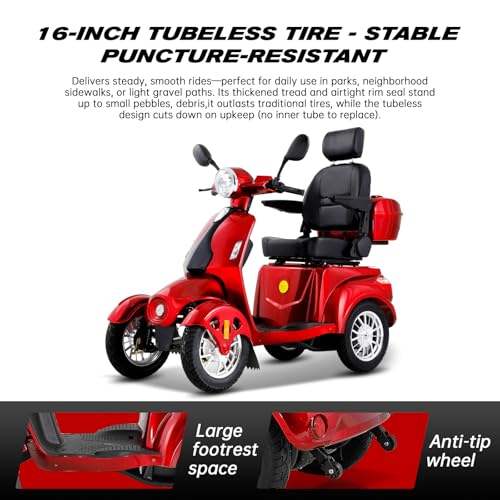
Choose stable, controllable handling over maximum speed: adjustable speed control, predictable throttle response, automatic or electromagnetic braking, anti-tip wheels, and a turning radius suited to hallways, store aisles, and sidewalks are key. For outdoor use, check tire size, ground clearance, and whether the scooter is intended for grass, uneven pavement, curb cuts, and slopes; small travel scooters can feel convenient but may be less forgiving on rough surfaces. Owner reports back up the importance of this dimension, with positive notes for outdoor handling on grass, turns, and adjustable speed for different situations, along with generally well-received speed in practical use.
Rider Fit
A mobility scooter is only helpful if the rider can sit down, steer, reach the controls, and get off safely without strain. Comfort features become safety features when the user has weak knees, reduced balance, arthritis, or recovery-related movement limits.
Fit the scooter to the rider’s body and mobility limits: look for a swiveling seat, adjustable armrests, adjustable tiller, supportive backrest, easy step-through clearance, and controls that can be used with limited hand strength. Seat height and foot space matter because many users are transferring from a chair, walker, car seat, or post-surgery recovery position, not simply hopping on like a recreational rider. Owner sentiment points to this directly: buyers described scooters as making limited-mobility or post-surgery movement feel easier, and practical features like a swiveling seat were called out as everyday conveniences.
Transport Fit
The best-riding scooter can become a poor choice if it cannot be lifted, stored, or transported by the rider or caregiver. Weight distribution and folded size are especially important for appointments, travel, and homes with tight entryways.
Do not treat “foldable” or “portable” as automatically car-friendly; confirm the total weight, the heaviest lifted piece, folded dimensions, and whether the battery or seat removes to reduce lifting load. Measure the trunk, doorway, storage corner, ramp, or hitch carrier before buying, and consider who will actually lift or load it on a bad day. Owner feedback is mixed here: some buyers liked the manageable size and weight, while others found the design less convenient, and one reported needing a hitch-style carrying solution for vehicle transport.
Setup Build
A mobility scooter should be dependable from the first setup through daily use. Clear assembly and durable construction reduce frustration, downtime, and unsafe improvisation by riders or caregivers.
Look for straightforward assembly, clearly labeled parts, protected wiring, solid frame construction, reliable seat/tiller locks, and easy access to routine maintenance items such as tires, brakes, charger port, and battery connections. For elderly users, setup should not require heavy lifting, confusing wiring, or repeated adjustments before the first safe ride. Owner sentiment is favorable on this point: buyers generally found scooters easy to assemble and get ready to use, and they described everyday models as well-made and reliable for senior mobility needs.
Ownership Value
Value in this category is not just about paying less; it is about dependable mobility for the rider’s actual routine. The right scooter prevents wasted effort, unnecessary caregiver burden, and replacement costs from a poor fit.
Judge value by the whole ownership experience: safe handling, real usable range, comfort, transportability, replacement battery availability, charger quality, warranty process, and whether common parts can be serviced. A low upfront cost is not a good value if the scooter is too heavy to load, uncomfortable to transfer onto, or unreliable for necessary trips. Owner sentiment supports value as a meaningful separator, with buyers describing strong overall satisfaction and good value when the scooter made everyday mobility feel easy and reliable.
1,000,000+ shoppers use Buyer's Guide every week to find the best products and services online.

Helping millions of users make smarter purchases online.


