







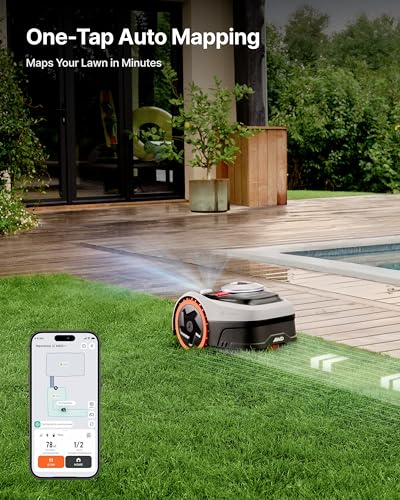


We also considered 10 others:


Our Top Choice
Compare Features


The order above is not editorial opinion, and it is not paid placement. It comes from what shoppers across our network actually do - which robotic lawn mowers they compare, and which they ultimately buy. We re-rank as new data comes in, so the long-term favorites have to keep earning their spot against new entrants. The full method, including how we make money.
Robotic Lawn Mowers Buyer's Guide
Robotic lawn mowers trade weekend labor for a system that only works well if its navigation, boundaries, slopes, and charging path match your yard. The sharpest buying concerns are whether the mower can reliably understand your lawn without escaping into beds, driveways, or play areas, and whether its mapping/software remains stable after the first setup.
Cutting
Cutting performance determines whether your robot mower actually keeps the lawn looking even, healthy, and consistently maintained rather than just moving around the yard. Look for clean, uniform cutting across your grass type and yard shape, plus the ability to handle slopes, thicker patches, uneven ground, and wet or fast-growing areas without leaving tufts or scalped spots. Pay close attention to edge trimming, since many robot mowers leave a border that may still need manual touch-up.
Choose a mower whose cutting capacity matches your actual mowable area, grass type, slope, and mowing frequency—not just the total lot size. For robotic mowing, a smaller cutting deck can still work well if the mower runs often, but you should check adjustable cutting height, rain/wet-grass behavior, slope rating, edge-cutting limitations, and whether it can handle narrow passages without leaving uncut strips. Avoid models that require infrequent “big cuts” if your grass grows fast, because robots perform best by trimming a little at a time. Owner feedback supports this: shoppers often praise robotic mowers that keep small yards consistently manageable, improve lawn appearance through frequent mowing, and control grass with little intervention, including on tougher yards and slopes.
Navigation
Good navigation determines whether your robot mower reliably covers the whole lawn instead of missing strips, repeating areas, or getting stuck. Look for a system that can map your yard accurately, follow efficient routes, handle narrow passages and complex layouts, and recognize obstacles like trees, furniture, toys, or garden edges. Be cautious if your lawn has lots of separate zones, slopes, overhanging cover, or weak signal areas, since these can expose weaknesses in mapping and route consistency.
Prioritize the navigation system that fits your yard’s complexity: simple fenced lawns may work with basic visual or boundary-based navigation, while open lawns, multiple zones, trees, slopes, and irregular edges usually need stronger mapping, obstacle detection, or RTK/LiDAR-style guidance. Check whether the mower needs clear sky view, a base station or antenna, a perimeter wire, app-drawn boundaries, or visual landmarks, and look for reliable recovery behavior when it loses signal or meets obstacles. This matters because navigation failures lead to missed patches, repeated rescues, lawn damage, or boundary escapes. Owner sentiment backs the importance of this dimension, with strong praise for models that stay on route, produce clean systematic mowing paths, handle obstacles and uneven ground, and allow wire-free or app-guided mapping.
Setup
Setup matters because a robot lawn mower only works well if it understands your yard, its charging station is placed correctly, and any boundaries are accurately installed or mapped. Look for clear installation steps, flexible boundary options, and guidance for handling slopes, narrow passages, flower beds, and separate lawn areas. Watch out for systems that require more digging, wiring, calibration, or troubleshooting than you’re willing to take on.
Before buying, map your installation burden: confirm whether you must bury or stake perimeter wire, place an RTK antenna, maintain Wi-Fi coverage, scan the yard, remote-drive boundaries, or create no-go zones in an app. For yards with flower beds, trampolines, pools, play areas, gravel, or steep drop-offs, make sure the setup process supports precise exclusion zones rather than only a broad lawn outline. Also check what happens if the phone app, QR code, account login, or connectivity fails, because some robotic mowers are hard to use without their setup ecosystem. Owners often report that newer wire-free systems are quicker and more approachable than older wire-based installs, especially when app controls, no-go zones, and remote boundary creation work smoothly.
Usability
A robot lawn mower should save you time, not make you manage another complicated gadget. Look for clear scheduling, intuitive app control, reliable connectivity, and simple onboard controls for quick adjustments without digging through menus. Watch out for mowers that make basic tasks like changing mowing times, checking status, or handling errors harder than they need to be.
Look for day-to-day usability features that reduce babysitting: automatic scheduling, quiet operation windows, weather handling, easy height adjustment, multi-zone control, theft lock/GPS alerts, clear error messages, and dependable return-to-dock behavior. If pets, children, toys, hoses, or garden tools are common in your yard, obstacle avoidance and pause/safety behavior are more than conveniences—they reduce the chance of damage or unsafe contact. Also check whether the mower can cross paths, pavement strips, or gates between zones without manual carrying. Owner feedback reinforces that the best experiences feel genuinely hands-off: buyers value automatic routine mowing, simple app mapping, no-wire boundaries, and mowers that return to the charger when the battery runs low.
Reliability
You want a robot lawn mower that can run week after week without constant resets, repairs, or fussy maintenance. Look for solid build quality, weather-resistant components, stable navigation and app behavior, and owner feedback that doesn’t point to recurring defects or random stoppages. Be cautious of mowers that seem capable on paper but have reports of poor quality control, frequent error codes, or parts that wear out quickly.
Treat reliability as a software-and-sensor issue, not just a motor or blade issue. Check for stable mapping retention, firmware update history, app quality, availability of replacement blades/batteries/wheels, water-resistance rating, dock durability, and how the mower behaves after power loss, heavy rain, signal drop, or a moved charging station. Be cautious if reports mention repeated error codes, lost maps, rejected maps, failed QR/app activation, or frequent “stuck” events, because those failures can turn an automatic mower into a constant troubleshooting project. Owner sentiment is mixed in exactly this way: many users find good models dependable and low-supervision, but negative reports highlight software maturity, navigation dropouts, defective setup components, and recurring error codes as major watch-outs.
Value
A robot lawn mower can be worth the investment if it reliably saves you mowing time while delivering the cut quality, coverage, and convenience your yard actually needs. Look for value for money in the balance between performance, smart features, installation needs, durability, and ongoing maintenance, rather than judging by upfront cost alone. Watch out for paying extra for features you won’t use or choosing a cheaper mower that struggles with your lawn size, slopes, obstacles, or boundary setup.
Judge value by avoided labor and total ownership cost, not by automation features alone. Include replacement blades, battery lifespan, possible subscriptions, boundary wire or antenna accessories, repair support, winter storage needs, and whether the mower can truly cover your whole yard without manual trimming or frequent rescues. A cheaper unit is poor value if it cannot handle your slopes, zones, or mapping conditions; a more capable unit can be worth it if it reliably replaces routine mowing or reduces lawn-service costs. Owner feedback supports this practical view: buyers tend to see value when robotic mowers automate small-lawn care, avoid buried wires or subscriptions, provide obstacle avoidance and adjustable cutting, run quietly, and reduce ongoing maintenance time.
1,000,000+ shoppers use Buyer's Guide every week to find the best products and services online.

Helping millions of users make smarter purchases online.


