


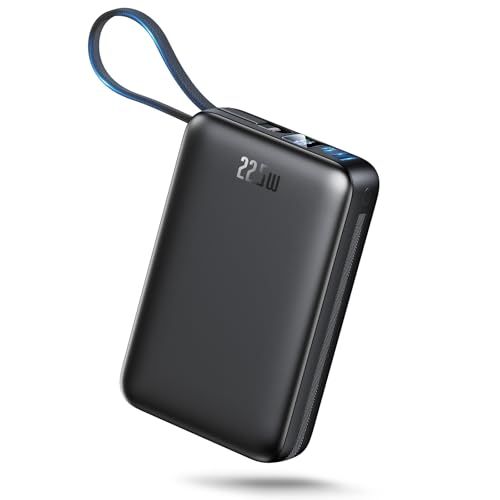
- Battery Capacity: 50,000mAh
- Max Output Power: 22.5W
- Output Ports: 1x USB-C, 1x USB-A
- Built-in Charging: USB-C & Lightning cables
- Extra Features: Digital display





Iggpbb 50000mAh Portable Charger Power Bank
Overview and Real-World Performance

The Iggpbb 50000mAh Portable Charger Power Bank is designed for people who want one thing above all else: a large reserve of backup power that can stretch across days instead of hours. A 50,000mAh class power bank is firmly in the “go bag” category, meaning it’s meant to keep multiple devices alive over a weekend trip, during power outages, or through heavy travel days when you’re far from an outlet. In that role, the Iggpbb aims to be a practical, high-capacity companion for phones, tablets, and other USB-powered gear.
In everyday use, the most noticeable benefit is psychological as much as practical: you stop thinking about battery anxiety. A typical modern smartphone battery is roughly 4,000 to 5,000mAh, so on paper a 50,000mAh bank looks like it could recharge a phone close to ten times. Real-world results will be lower because power banks store energy at a different voltage than your devices use, and some energy is lost as heat during conversion and charging. Even so, a power bank in this capacity range can still deliver multiple full charges for one phone, or a handful of charges spread across two or three devices, which is exactly why people buy them.
Performance also depends on charging speed, not just how much energy is on board. A large-capacity bank that only charges slowly can feel frustrating if you’re trying to top up quickly between meetings or during a short layover. When evaluating the Iggpbb, pay attention to whether your most important device can actually fast charge from it. If your phone supports USB-C Power Delivery, for example, you’ll want a USB-C output that can negotiate higher wattage so the phone charges at the speed you’re accustomed to from a wall charger. If you primarily use older phones or accessories that charge over standard USB-A, then stable 5V output and reliable multi-port sharing matter more than cutting-edge wattage.
Another real-world consideration is how a large bank behaves when charging several devices at once. Some models reduce output per port when multiple ports are used, which can slow charging to a crawl if you plug in a tablet and two phones simultaneously. The Iggpbb’s value rises if it can maintain useful speeds across ports, rather than advertising a peak output that only happens when a single port is used. For families, shared travel, or emergency kits, consistent performance under load is often more important than impressive specs on the box.
Finally, portability is an unavoidable tradeoff. A 50,000mAh power bank is not a pocket accessory, and most people will carry it in a backpack, work bag, or luggage. That said, the convenience of fewer recharges of the bank itself can outweigh the extra bulk. If you frequently forget to recharge smaller banks, a high-capacity option like this can feel more dependable because it remains ready for longer stretches. It’s also worth noting that the larger the capacity, the longer it typically takes to recharge the power bank itself, so input charging speed and the charger you use at home play a significant role in your day-to-day experience.
Key Purchase Factors and What Matters Most
Before buying the Iggpbb 50000mAh Portable Charger Power Bank, it helps to define your priority: maximum runtime, maximum charging speed, maximum portability, or maximum convenience for multiple devices. Capacity is the headline feature here, and for many buyers it will be the primary reason to choose this model. Still, capacity alone shouldn’t be the deciding factor, because a large number on paper can disappoint if the bank is slow, inconvenient to recharge, or incompatible with your devices’ fast-charging standards.
The most important factor for most users is output power and protocol compatibility. If you own a phone that fast charges via USB-C PD, the difference between basic 10–12W charging and higher-wattage PD charging is dramatic, especially when you’re topping up from 20% to 60% during a quick break. Similarly, some Android phones benefit from specific fast-charge standards, and some accessories expect stable, low-current “trickle” charging. The best choice is a bank that matches how you actually charge: fast for phones and tablets, and gentle for smaller items like earbuds or fitness trackers when needed.
The second factor to weigh is input charging speed, because a huge battery is only as convenient as your ability to refill it. A 50,000mAh bank can take a long time to recharge if it only accepts low-wattage input. If you want this power bank for emergency readiness, you might accept longer recharge times. But if it’s part of your daily routine, slow input becomes a pain point. Look for USB-C input support and consider whether you already own a capable wall charger; pairing a high-capacity bank with a weak charger undermines the whole experience.
Port selection and simultaneous charging are the next big considerations. Think about what you typically carry: a phone, maybe a tablet, perhaps a second phone for work, plus small accessories. Multiple outputs are useful, but only if they remain stable and reasonably fast when more than one device is connected. If you often travel with someone else or you run multiple devices for work, prioritize multi-port performance over single-port peak specs.
Safety and reliability should be treated as non-negotiable. A power bank is a dense energy storage device, and good internal protections against overcurrent, overheating, overvoltage, and short circuits are essential. While buyers can’t easily verify the full internal design, you can still make practical judgments: choose reputable sellers, look for clear documentation, and pay attention to signs of poor quality such as excessive heat during normal charging, unstable charging behavior, or inconsistent capacity performance over time.
Portability and travel rules are also crucial, and for some buyers they become the deciding factor. Many airlines impose limits on lithium battery capacity for carry-on luggage, and extremely high-capacity power banks may exceed common thresholds. If air travel is part of your life, this could be the single most important factor of all, even more important than the bank’s ability to recharge your phone for a week. The Iggpbb’s size and rating may make it better suited to road trips, camping, or home backup than frequent flying, depending on the exact watt-hour rating listed on the unit. Always check the printed Wh rating and your airline’s current policy before you rely on it for a flight.
Common Questions
Will the Iggpbb 50000mAh Portable Charger Power Bank really charge my phone ten times?
Not usually. The 50,000mAh figure is the internal battery capacity, and energy is lost during voltage conversion and charging. Many users should expect fewer full charges than the simple math suggests, though it can still provide multiple complete recharges and then some, depending on the phone’s battery size and charging efficiency.
Is a 50,000mAh power bank okay to bring on an airplane?
It depends on the watt-hour rating printed on the power bank and the airline’s rules. Many airlines have a common limit around 100Wh for batteries in carry-on, with some allowances up to 160Wh with approval. If the Iggpbb’s Wh rating exceeds what your airline allows, you may not be permitted to bring it. Always verify before flying.
How long will it take to recharge the power bank itself?
Recharge time depends heavily on the input wattage it supports and the charger you use. With a low-watt input and a basic charger, a large-capacity bank can take a very long time to refill. With higher-watt USB-C input and a suitable wall charger, recharge time improves significantly. Check the input specifications and plan around your typical charging setup.
Can I charge multiple devices at the same time without slowing everything down?
You can usually charge multiple devices simultaneously, but speeds may drop when more than one port is in use. The practical question is whether the combined output remains high enough to be useful for your devices. If you frequently charge a tablet and a phone together, prioritize models that maintain solid multi-port performance.
Overall, the Iggpbb 50000mAh Portable Charger Power Bank is a strong option for users who value endurance and want a serious energy reserve for multi-day use, shared charging, or emergency preparedness. The smartest buying decision comes from looking beyond capacity to the details that shape daily experience: output speed and compatibility, input recharge speed, multi-device performance, safety, and travel limitations. If those align with your needs, a high-capacity bank like this can be one of the most reassuring accessories you own.