











We also considered 10 others:


Our Top Choice
Compare Features


The order above is not editorial opinion, and it is not paid placement. It comes from what shoppers across our network actually do - which portable car jump starters they compare, and which they ultimately buy. We re-rank as new data comes in, so the long-term favorites have to keep earning their spot against new entrants. The full method, including how we make money.
Portable Car Jump Starters Buyer's Guide
Portable car jump starters sit at a tricky tradeoff: they need to be small enough to live in the vehicle, but powerful and safe enough to crank a weak or fully dead battery without another car nearby. The sharpest checks are whether the unit has enough real starting headroom for your engine and climate, and whether its clamps, protections, and battery storage behavior are trustworthy after months in a trunk.
Power
You need enough cranking strength to start your vehicle reliably, especially in cold weather, with an older battery, or when the engine is larger than average. Look for a jump starter rated for your vehicle type and engine size, and pay attention to real-world starting performance rather than just the biggest peak-amp number. Be wary of units that work only on lightly drained batteries or require repeated attempts before they can deliver a successful jump.
Match the starter to your actual engine and worst-case conditions, not just the biggest advertised peak number: check supported gas/diesel displacement, cold-temperature performance, and whether it has a manual boost/override mode for a battery that is too dead to be detected automatically. For trucks, large V8s, diesels, luxury vehicles with high electrical loads, or winter use, leave headroom rather than buying a unit rated exactly at your engine size; owners most strongly praise units that start dead vehicles quickly, including large V8s, light trucks, small SUVs, drained batteries, and cold-weather diesel situations, while still being compact enough to store in the vehicle.
Build
A jump starter needs to survive being stored in a trunk, dropped, and used in bad weather, so solid build quality directly affects whether it works when you need it. Look for a tough, well-sealed housing, secure ports and cables, and sturdy clamps with strong springs and clean, well-aligned jaws; flimsy plastic, loose connections, or weak clamps can make starts unreliable and less safe.
Prioritize clamp and protection quality because a jump starter fails at the point of contact as often as at the battery pack: look for sturdy, wide-opening clamps, thick cables, reverse-polarity protection, spark protection, short-circuit protection, over-current/over-temp safeguards, and a casing that can survive being kept in a trunk. Avoid flimsy clamps, vague safety claims, or units that feel like a generic power bank with jumper leads attached; owner feedback consistently favors models that feel rugged, have substantial clamps, simple instructions, and safety features that make the tool feel dependable rather than intimidating.
Ease
When your battery is dead, you want a jump starter that’s straightforward to connect and operate without guesswork. Look for clear clamps, simple controls, readable indicators, and safety prompts that make the process easy in poor lighting or bad weather. Watch out for designs with confusing menus, hard-to-read screens, awkward cables, or instructions that are only clear after you’ve already needed them.
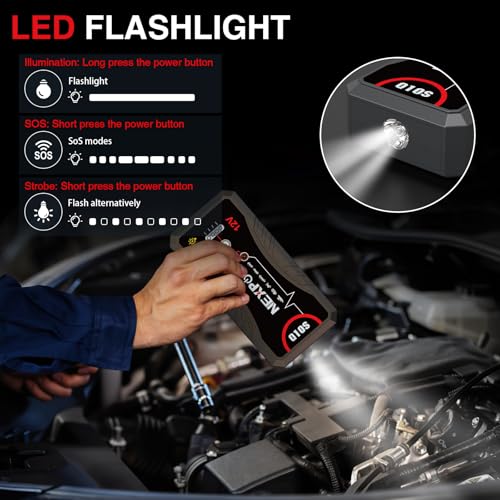
Choose controls you can use correctly in a stressful parking-lot situation: clear polarity indicators, loud/visible error warnings, a simple power/boost sequence, readable battery-status lights, and clamps that grip securely without needing perfect hand strength. If you may use it at night or in bad weather, favor obvious labels, a useful flashlight, and instructions printed on the unit or case; owners repeatedly say the best units feel much easier than jumper cables, especially for non-mechanical users, because setup is straightforward and safety features reduce fear of sparks or wrong connections.
Battery
A jump starter is only useful if it still has enough charge when your battery dies, so you should look for one with strong charge retention and clear battery-level indicators. Pay attention to how many starts it can deliver per charge, how long it takes to recharge, and whether it needs frequent top-offs, especially if you plan to leave it in a glove box or trunk between uses.
Check both jump reserve and shelf behavior: a good emergency pack should hold charge for months, show remaining charge accurately, support multiple starts per charge, and recharge conveniently before seasonal storage. Lithium packs should not be stored fully drained, so look for low self-discharge, clear recharge guidance, and input options you will actually use; owners commonly praise units that hold a charge for long stretches, deliver several jump starts before recharging, and add useful USB or flashlight functions, though battery life is the area where experiences can be more mixed.
Size
Size matters because you’ll usually keep a jump starter in your vehicle until you need it, so it should fit easily in a glove box, console, trunk cubby, or emergency kit without getting in the way. Look for a compact, lightweight unit that’s easy to carry and position near the battery, but watch out for designs that shrink too much and compromise cable reach, battery capacity, or ruggedness.
Buy the smallest unit that still has real headroom for your engine, but do not let pocket-size marketing override cable reach, clamp size, or cold-weather output. Measure where it will live—glove box, center console, under-seat bin, trunk kit—and make sure the case, clamps, and charging cable all fit together so the tool is actually in the car when needed; owners strongly value compact, handheld packs because they replace bulky jumper cables or booster packs while still having enough cranking power for typical cars, vans, light trucks, and stubborn batteries.
Value
You want a jump starter that feels worth its cost not just on the day you buy it, but when it actually saves you from being stranded. Look for value for money in the balance of reliable starting power, battery life, build quality, safety features, and useful extras—while watching out for cheap units that overpromise capacity or premium models that charge more for features you may never use.
Judge value by whether the unit can reliably prevent a tow, roadside wait, or dependence on another vehicle, not by extras alone: proven jump performance, safety protections, decent clamps, a case, charging accessories, and a usable warranty matter more than flashy lights or inflated ratings. Combination features can be worthwhile if you will actually use them, but avoid sacrificing starting reliability for add-ons; owners tend to feel these tools are a strong value when they start the vehicle quickly, come with the needed accessories, and serve as a practical alternative to jumper cables or roadside help.
1,000,000+ shoppers use Buyer's Guide every week to find the best products and services online.

Helping millions of users make smarter purchases online.


