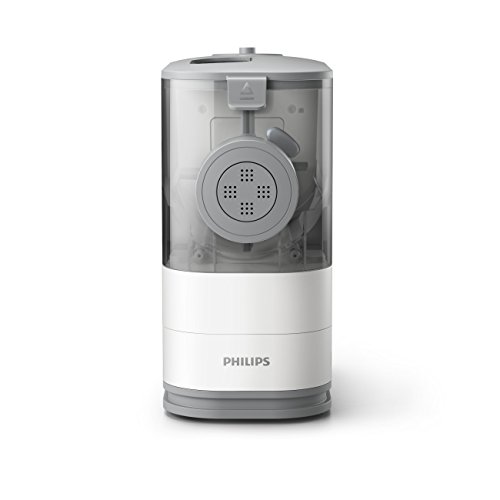
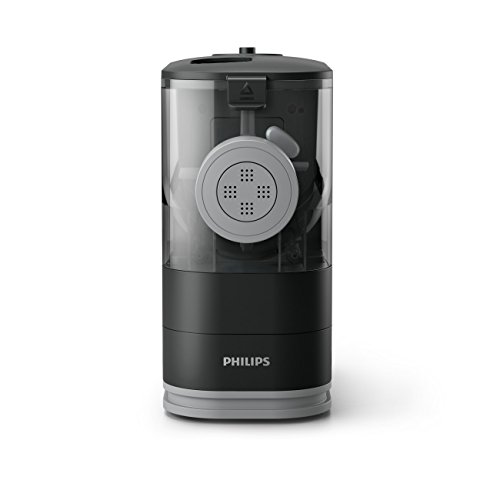
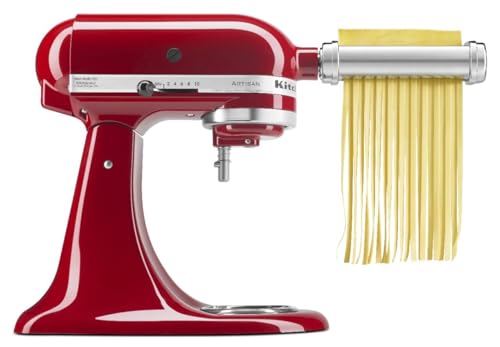
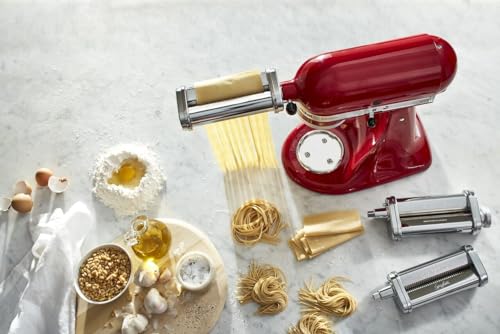
Our Top Choice
Why These Features Matter:
A pasta maker is one of those “this will be charming” purchases that can either become a weeknight ritual or a heavy metal guilt object living behind the Dutch oven. The difference usually isn’t ambition; it’s friction. How hard it is to clamp. How annoying it is to clean. Whether it walks itself off the counter. Whether the dough behaves like dough—or like a damp stress ball that refuses to cooperate.
The best pasta makers aren’t necessarily the fanciest. They’re the ones that make the process feel inevitable: mix, rest, roll, cut, cook—without turning the kitchen into a flour blizzard that lingers in the grout until spring.
Manual vs. Electric: Pick Your Kind of Effort
Manual rollers are quiet, durable, and weirdly soothing—right up until someone else needs to use the kitchen and there’s a hand-crank apparatus clamped to the counter like a Victorian medical device. They’re also the least fussy to store (assuming the drawer can handle a small cannonball of metal).
Electric rollers are for households where dinner happens while a child is asking a question every 14 seconds. They free up a hand for guiding dough, fending off pets, or stirring sauce. The trade-off: more parts, more cleaning, and one more appliance with a cord that will inevitably snake across the exact path between sink and stove.
- Go manual if: kitchen space is tight, noise matters, or pasta night is a weekend hobby.
- Go electric if: pasta is a “real dinner” plan, not a project, and multitasking is non-negotiable.
Weight and Stability: The “Walking Off the Counter” Test
A pasta maker should feel like it means business. Lightweight models have a charming price tag and an alarming tendency to shimmy as soon as the dough offers mild resistance. Heavier machines stay put, roll more evenly, and don’t require a second person to hold the whole operation together.
- Look for: a solid metal body; a clamp that tightens without feeling like it’s stripping the threads; rubber feet that actually grip.
- Watch out for: clamps that only work on thick butcher-block counters (and slide on thinner laminate). If the machine needs a “perfect” counter edge, it won’t be used.
Clamp Design: Small Detail, Huge Mood
The clamp is the make-or-break feature no one gets excited about until they’re re-tightening it mid-roll with floury hands. A good clamp tightens quickly, holds steady, and doesn’t chew up the counter edge. The best ones also work on the kind of counters real people have: slightly rounded, slightly worn, occasionally damp.
- Best-case scenario: quick twist to secure, no slipping, no gouging.
- Real-life annoyance: some clamps require a specific overhang depth. Without it, the machine perches awkwardly, like it’s thinking about leaving.
Roller Smoothness: The Difference Between “Silky Sheet” and “Ripped Patchwork”
Rolling pasta is basically a negotiation between gluten and gravity. The roller mechanism should glide, not grind. If the crank feels jerky or the rollers hesitate, the dough will snag—and then suddenly the sheet tears, and now there’s a sticky ribbon wrapped around a moving part.
- Look for: consistent resistance; rollers that don’t flex; adjustments that click into place rather than hover ambiguously between settings.
- A good sign: the dough comes out with a smooth, satiny finish instead of faintly ridged “corduroy” lines.
Adjustment Dial: Clicks Beat Guesswork
Thickness settings shouldn’t feel like tuning an old radio. Clear, stepped settings matter because pasta dough is moody: too thick and it eats like a jaw workout; too thin and it turns into a fragile sheet that tears on the way to the pot.
- Love: numbered settings with firm clicks.
- Not love: slippery dials that drift while rolling, producing surprise lasagna sheets that are more “handkerchief” than “pasta.”
Cutter Attachments: Nice to Have, Not Always Nice to Use
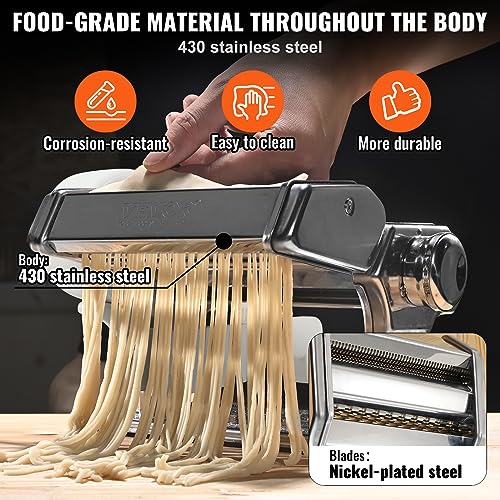
Built-in cutters (or attachable cutters) are convenient in theory: roll a sheet, feed it through, and out come neat strands. In practice, cutters are where budget machines show their seams. Dull cutters pinch. Misaligned cutters produce one long noodle and a pile of shaggy confetti. And if the cutter is a pain to remove, it will live on the machine permanently, collecting flour like an heirloom.
- Worth prioritizing: a cutter that produces clean edges without tugging; easy attachment that doesn’t require a pep talk.
- Reality check: for shapes beyond standard ribbons, a simple roller plus a knife often beats a fussy attachment set.
Cleaning: The Part No One Posts
Pasta makers are at their most photogenic right before the flour hits. Afterward, there’s dough dust in crevices and microscopic bits of dried paste waiting to turn into crunchy souvenirs in the next batch. The best designs acknowledge this and keep crevices minimal.
- Look for: smooth surfaces; fewer nooks; parts that separate without feeling delicate.
- Things that help: a small brush; the patience to let dough dry before brushing it off (counterintuitive, but true).
- Things to accept: most pasta makers are not friends with water. If “rinse it quickly” is the cleaning plan, pasta night becomes a lifestyle choice.
Noise Level: A Subtle Dealbreaker
Manual machines make a low, rhythmic crank sound that feels pleasantly old-world—until a cheap gear starts squeaking like an anxious hamster wheel. Electric models vary wildly: some hum politely; others sound like a small shop tool that’s about to ask for safety goggles.
- If quiet matters: prioritize smooth cranking and solid gears; avoid models with lots of rattly plastic.
- If kids are asleep nearby: manual tends to be kinder, but only if the machine doesn’t squeal.
Storage and Counter Reality: The “Will It Live Here?” Question
A pasta maker that requires a full teardown, careful re-boxing, and a storage space the size of a bread maker will be used twice a year. The best ones are simple enough to stash without resentment—or handsome enough to justify a semi-permanent spot on a shelf.
- Consider: weight (will it be carried with one hand?); footprint (does it actually fit in a cabinet?); and whether attachments have a home or just… roam.
- Small-apartment truth: corded electric models often demand the most awkward real estate: near an outlet, near a clear counter edge, away from the sink splash zone.
Dough Compatibility: Not Everything Is Built for “Healthy” Experiments
Classic egg dough behaves. Whole-wheat dough behaves differently. Gluten-free dough may behave like damp sand with opinions. Many machines can handle non-traditional doughs, but only if the rollers are sturdy and the adjustment dial is precise. Otherwise, it’s tearing, sticking, and a growing sense that dinner has become a science fair.
- For experimentation: prioritize roller strength and stability over extra attachments.
- For sanity: accept that some doughs simply prefer being rolled with a pin and cut by hand.
Things to Know Before Buying (So It Doesn’t Become a “Someday” Appliance)
- You’ll still need a drying plan. A rack is helpful, but so is the back of a chair, a floured sheet pan, or a clean dish towel over the banquette (crumbs and all).
- Flour gets everywhere. Not catastrophically, but enough that black countertops will tell on you.
- Two-person operation is real. Especially with manual machines: one feeds, one cranks, or one cranks while the other tries to keep the sheet from folding onto itself like a sleepy scarf.
- Expect a learning curve. The first batch is rarely the one served to guests with a serene smile. It’s the one eaten standing up, directly from the pot, because it’s fresh and still excellent.
Honest Caveats: Pasta Makers Aren’t Magic, Just Mechanical
Even great pasta makers have their quirks. Some clamps are divas. Some cutters need occasional coaxing. Some machines are heavy enough to feel indestructible, but annoying enough to move that they stay put and gather flour in a corner like a well-made monument.
But the right features—stable base, smooth rollers, clear settings, tolerable cleanup—turn fresh pasta into something that fits into real life: not an aspirational weekend project, but a repeatable, slightly messy, deeply satisfying dinner.
Quick Guidance: How to Choose Without Overthinking It
- Prioritize stability and smooth rolling over extra accessories. A great roller plus a knife beats a mediocre “everything” set.
- Pick the machine that matches the kitchen. Small counters want compact, sturdy manual models; busy households benefit from electric assistance.
- Choose the least annoying cleanup. The one that’s easiest to brush out is the one that gets used on a Tuesday.
- Be realistic about storage. If it can’t live somewhere accessible, it won’t become a habit.