

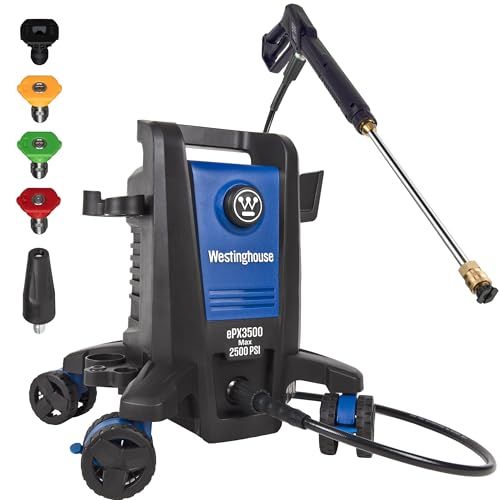
- Power Source: Electric
- Pressure: 2500 PSI & 1.76 GPM
- Nozzles: 0°, 15°, 25°, soap, turbo
- Hose Length: 25'
- Soap Tank: 20 oz built-in
Westinghouse ePX3500 Electric Power Washer Review
Introduction

The Westinghouse ePX3500 Electric Power Washer is a high-quality, versatile cleaning tool that offers exceptional performance for both residential and commercial use. With a maximum pressure of 3500 PSI and a flow rate of 2.6 GPM, this electric power washer can tackle even the toughest cleaning tasks with ease. In this review, we will delve into the various factors that potential buyers should consider before making a purchase and highlight the most important ones.
Factors to Consider
1. Pressure and Flow Rate: One of the most important factors to consider when purchasing a power washer is its pressure and flow rate. The higher the pressure and flow rate, the more effective the power washer will be at removing dirt, grime, and stains. The Westinghouse ePX3500 provides a maximum pressure of 3500 PSI and a flow rate of 2.6 GPM, making it a powerful tool for a wide range of cleaning tasks.
2. Versatility: It is crucial to consider the versatility of a power washer before making a purchase. In this regard, the Westinghouse ePX3500 offers multiple spray patterns, including 0-degree, 15-degree, 25-degree, and 40-degree nozzles, which allow for different levels of intensity depending on the cleaning task at hand. Additionally, it features a soap applicator nozzle, providing the convenience of applying detergent for deep cleaning.
3. Ease of Use: Another factor to consider is the ease of use of the power washer. The Westinghouse ePX3500 is designed with user-friendliness in mind, featuring a quick-connect nozzle system and a 25-foot high-pressure hose, which allows for easy setup and maneuverability. Moreover, it has built-in storage for accessories and a 35-foot power cord, providing ample reach and convenience during operation.
4. Durability: When investing in a power washer, durability is an important consideration. The Westinghouse ePX3500 is built with a rugged steel frame and large, sturdy wheels, ensuring its durability and stability during use. Additionally, the complete package includes a soap foam cannon, turbo nozzle, and surface scrubber, all of which are made with high-quality materials to withstand frequent use.
5. Noise Level: For those who value quieter operation, noise level can be a significant factor in choosing a power washer. While gas-powered washers tend to be noisier, electric power washers like the Westinghouse ePX3500 offer a quieter option. Though not completely silent, it provides a quieter operation compared to its gas-powered counterparts without compromising on performance.
Common Questions
Q: Can the Westinghouse ePX3500 be used on different surfaces?
A: Absolutely! The power washer features adjustable pressure settings and multiple spray patterns, making it suitable for various surfaces, including concrete, wood, vinyl siding, and more.
Q: Is the power washer easy to store?
A: Yes, the Westinghouse ePX3500 is designed with compact storage in mind. It has built-in storage for accessories and a collapsible handle, allowing for efficient storage in smaller spaces.
Q: Can the power washer be used with hot water?
A: No, the Westinghouse ePX3500 is designed for use with cold water only. Using hot water may damage the unit and void the warranty.
Q: Does the power washer require any maintenance?
A: Like any power tool, regular maintenance is recommended for optimal performance and longevity. It is advisable to clean the power washer after each use, inspect the hose and connections for leaks, and follow the manufacturer's instructions for maintenance.
Conclusion
The Westinghouse ePX3500 Electric Power Washer is a top-notch cleaning tool that provides exceptional pressure and flow rate, versatility, ease of use, durability, and a comparatively quieter operation. With its adjustable pressure settings, multiple spray patterns, and high-quality construction, it is a versatile and reliable option for a wide range of cleaning tasks. Additionally, the inclusion of accessories like a soap foam cannon, turbo nozzle, and surface scrubber adds further value to this power washer. Overall, the Westinghouse ePX3500 is a great investment for both residential and commercial users who seek a powerful and efficient cleaning solution.