












We also considered 10 others:





Our Top Choice
Compare Features


The order above is not editorial opinion, and it is not paid placement. It comes from what shoppers across our network actually do - which combination microwave air fryers they compare, and which they ultimately buy. We re-rank as new data comes in, so the long-term favorites have to keep earning their spot against new entrants. The full method, including how we make money.
Combination Microwave Air Fryers Buyer's Guide
Combination microwave air fryers promise one countertop appliance for reheating, defrosting, crisping, baking, and roasting, but the tradeoff is that microwave behavior and air-fryer behavior have very different space, accessory, and safety requirements. The sharpest checks are whether the controls prevent mode mistakes, whether the cavity actually supports crisping in a single layer, and whether the included racks or trays are clearly safe for the mode you are using.
Usability
You’ll use a microwave in quick, repetitive moments, so controls that are clear, responsive, and logically laid out can matter as much as power. Look for simple setup, readable buttons or displays, useful presets that don’t feel confusing, and a door or drawer action that opens smoothly and feels secure. Watch out for cramped keypads, overly complex menus, or drawer operation that requires awkward reach or extra force.
For a combination microwave air fryer, prioritize controls that make the cooking mode unmistakable: you should be able to tell at a glance whether you are using microwave, convection, air fry, or a combination cycle, because accessory safety and cooking results depend on it. Look for clear mode labels, direct time/temperature adjustment, pause/turn-food prompts, easy cancellation, and a readable display; avoid models that bury air-fry temperature, preheat, or microwave power levels behind confusing preset menus. Owner feedback supports this: shoppers often value straightforward dials, intuitive controls, useful presets, app or preheat notifications, smooth doors, and baskets or trays that are easy to clean, while still appreciating flexibility once they learn the modes.
Size
Size matters because your microwave needs to fit both your space and the dishes you use most. Check the exterior dimensions against your countertop, cabinet, or built-in opening, and make sure there’s enough clearance for ventilation and the door swing. Also compare interior capacity and turntable size, since a compact model may fit the spot but struggle with larger plates, bowls, or casserole dishes.
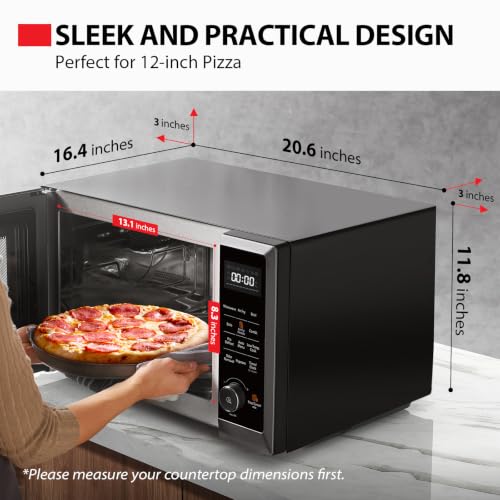
Do not judge these by exterior capacity alone: measure both your counter space and the usable cooking geometry inside. Check cabinet clearance for side/top ventilation, door swing, rear depth, turntable diameter, rack height, and whether the air-fry basket can hold food in a single layer; a cavity that fits soup bowls may still be too short or narrow for crisping fries, wings, pizza, or a whole chicken. Owner sentiment reflects this tradeoff: buyers like compact footprints that still handle toast, pizza, small baking, family meals, or backup-oven duty, but some find larger units take noticeable counter space while smaller ones can be limiting for larger households or bulky foods.
Features
You’ll want a microwave with functions that match how you actually cook, whether that means simple reheating, defrosting, sensor cooking, convection baking, air frying, or multi-stage programs. Look for presets that are genuinely useful and easy to adjust, and watch out for models loaded with modes you won’t use or controls that make basic tasks slower.
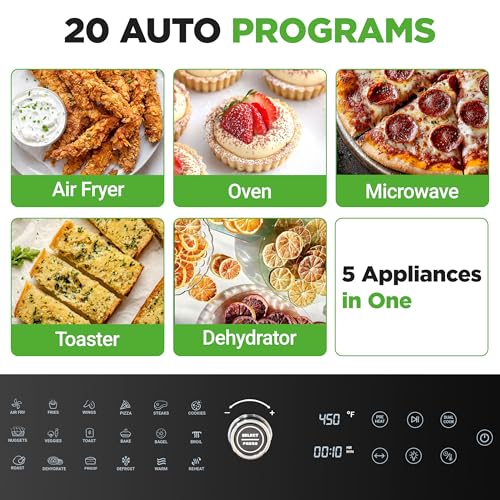
The most important features are the ones that make microwave and air-fry performance coexist safely and effectively: true convection airflow, a perforated crisper basket or tray, mode-specific accessory guidance, reliable preheating, adjustable temperature, microwave power-level control, and sensor reheat/defrost for foods where air frying is the wrong tool. Be cautious of long preset lists if they do not allow manual overrides, and confirm which included racks or pans are safe only in convection/air-fry modes, since metal use rules change by mode. Owner feedback backs the value of real versatility: shoppers often praise units that can air fry, bake, broil, roast, reheat, toast, dehydrate, proof, or slow cook, but they also note that faster cooking and many settings can require early time-and-temperature adjustments.
1,000,000+ shoppers use Buyer's Guide every week to find the best products and services online.

Helping millions of users make smarter purchases online.


