Rice Cooker Buying Guide
Posted on Sunday, March 01, 2026
To keep this site free for consumers, we receive compensation for customer referrals.

Rice Cooker Buying Guide: Features, Types, and Practical Considerations
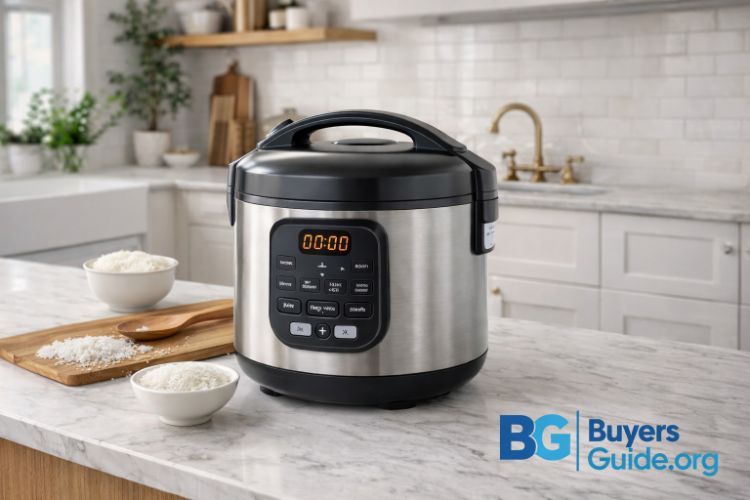
A rice cooker is a countertop appliance designed to automate the process of cooking rice and other grains with consistent heat and moisture control. While the concept is straightforward—combine grains and water, then apply heat—the internal technology and feature sets can vary significantly across models. Understanding how rice cookers function and which design elements matter most can make evaluating options far more manageable.
This rice cooker buying guide outlines how the category works, the different configurations available, and the performance factors that influence day-to-day use. Whether you prepare rice occasionally or rely on it as a staple, clarity around capacity, controls, and cooking logic helps align your selection with your actual needs.
How a Rice Cooker Works
At a basic level, a rice cooker heats water to boiling and maintains a controlled temperature until the liquid is absorbed or evaporated. Most units rely on temperature sensors to detect when water levels drop, automatically switching from active cooking mode to a lower-temperature setting.
More advanced models incorporate microprocessors to adjust cooking time and heat intensity based on the grain type and quantity. These systems aim to fine-tune moisture absorption and texture rather than relying solely on a fixed heating cycle.
Main Types of Rice Cookers
Rice cookers generally fall into three broad categories, each offering a different level of control and flexibility.
Basic On/Off Models
These units operate with a single cooking function and automatically transition to a warm setting once cooking is complete. They are straightforward to use and typically designed for standard white rice preparation.
Digital Programmable Models
Digital rice cookers include preset programs for various grain types such as brown rice, jasmine rice, or porridge. Timers, delay-start functions, and adjustable keep-warm settings are common features in this category.
Induction or Advanced Heating Systems
Some rice cookers use induction-based heating or multi-phase cooking algorithms to regulate temperature more precisely. These systems distribute heat evenly across the inner pot and may adjust cooking stages dynamically.
The choice among these formats depends largely on how frequently the appliance will be used and whether versatility beyond basic white rice is important.
Capacity and Size Considerations
Rice cooker capacity is typically measured in uncooked cups, which expand significantly after cooking. Smaller units are suitable for individuals or couples, while larger capacities may better accommodate families or meal preparation needs.
Countertop footprint and storage space should also be considered. Higher-capacity models often have a larger outer housing, which may affect placement in compact kitchens.
Key Features to Evaluate
- Cooking Programs: Presets for different rice varieties or grains allow for more tailored results without manual adjustments.
- Inner Pot Material: Pots may be aluminum, stainless steel, or multi-layered with nonstick coatings. Material thickness affects heat retention and durability.
- Keep-Warm Function: Automatic warming maintains serving temperature, but extended warming may gradually alter texture depending on design.
- Delay Timer: A programmable timer enables cooking to begin at a later time, which can support meal planning.
- Lid Design: Hinged lids, detachable lids, and pressure-sealed lids differ in ease of cleaning and steam management.
- Steam Venting System: Controlled venting reduces overflow and manages moisture release during cooking.
- Ease of Cleaning: Removable inner lids and dishwasher-safe components simplify maintenance.
Each feature contributes differently depending on cooking habits. For example, someone preparing multiple grain types may prioritize programmable settings, while occasional users may prefer simplicity.
Performance in Everyday Use
Consistency is one of the primary expectations of a rice cooker. Uniform texture, minimal scorching, and reliable shutoff mechanisms influence overall satisfaction. Thicker inner pots and even heat distribution can help reduce hot spots during cooking.
Noise levels, condensation management, and exterior heat retention may also affect daily experience. Some units collect excess moisture in detachable reservoirs, helping to keep countertops dry.
Energy consumption varies based on heating technology and warming duration. While cooking cycles are generally efficient, prolonged keep-warm settings can contribute to ongoing energy use.
Beyond Rice: Multi-Function Capabilities
Many rice cookers extend beyond plain rice preparation. Depending on design, they may handle quinoa, oats, mixed grains, steaming vegetables, or preparing soups and porridge.
However, multifunctionality can introduce complexity. Additional settings and accessories may increase the learning curve, so it is helpful to assess whether these features align with actual cooking patterns.
Trade-Offs and Design Constraints
Greater automation often means a higher reliance on electronic controls. While programmable systems offer precision, they can be more complex to operate and maintain. Simpler mechanical units may offer fewer customization options but are often more straightforward.
Nonstick inner pots support easier cleanup but may require careful utensil use to maintain coating integrity. Stainless steel alternatives can be more durable but may allow slightly more sticking depending on cooking method.
Long keep-warm cycles may gradually dry out rice, even in advanced models. Understanding realistic expectations around texture over time helps prevent overreliance on extended warming.
Who This Category Is Designed For
Rice cookers are practical for households that prepare rice regularly and value repeatable results with minimal oversight. They can also support meal planning by automating cooking while other tasks are underway.
For occasional rice preparation, a basic unit may provide sufficient functionality. Frequent grain preparation or interest in varied textures may justify exploring models with broader programming capabilities.
Making an Informed Evaluation
Selecting a rice cooker involves balancing capacity, control level, and material construction against actual cooking habits. Understanding how heating systems differ and how features affect maintenance can clarify which configuration aligns with your kitchen routine.
With a clear sense of priorities—whether simplicity, versatility, or automation—comparing options becomes more straightforward. For additional category research and guidance on kitchen appliances, visit our site to continue exploring informed buying considerations.

Related Blog Posts