



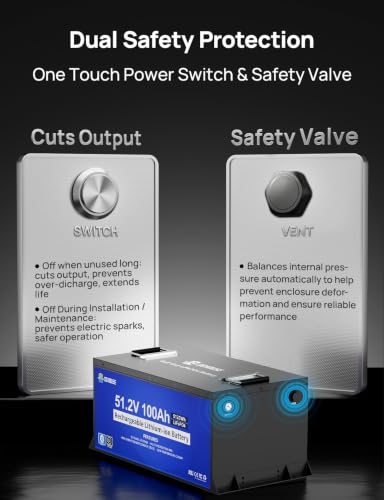


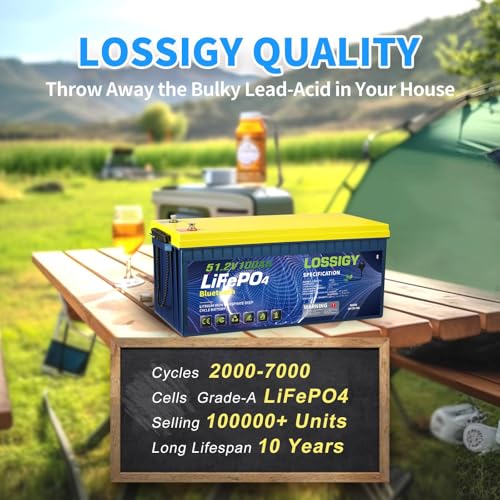

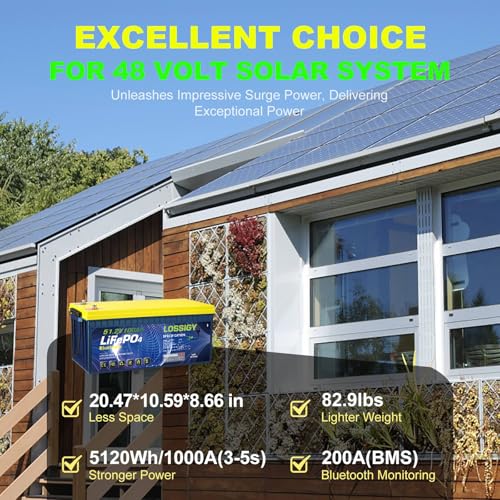


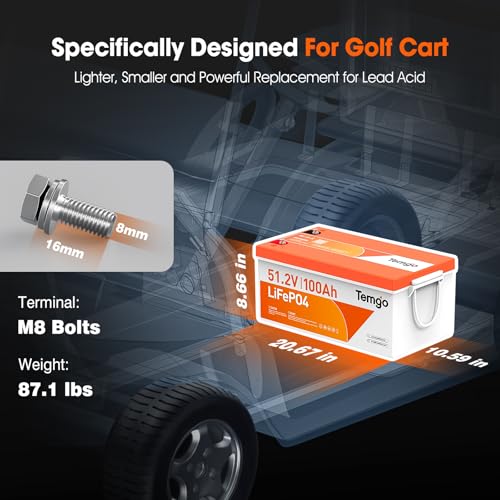







We also considered 10 others:


Our Top Choice
Compare Features


The order above is not editorial opinion, and it is not paid placement. It comes from what shoppers across our network actually do - which 48v lithium golf cart batteries they compare, and which they ultimately buy. We re-rank as new data comes in, so the long-term favorites have to keep earning their spot against new entrants. The full method, including how we make money.
48V Lithium Golf Cart Batteries Buyer's Guide
A 48V lithium golf cart battery is not just a lighter replacement for six 8V lead-acid batteries; it has to match the cart’s controller demand, charger behavior, accessory wiring, and physical battery bay. The sharpest checks are BMS current capacity for hills, passengers, and lifted carts, plus whether the kit truly includes the lithium charger, monitor, cables, mounting hardware, and any conversion parts your cart needs.
Power
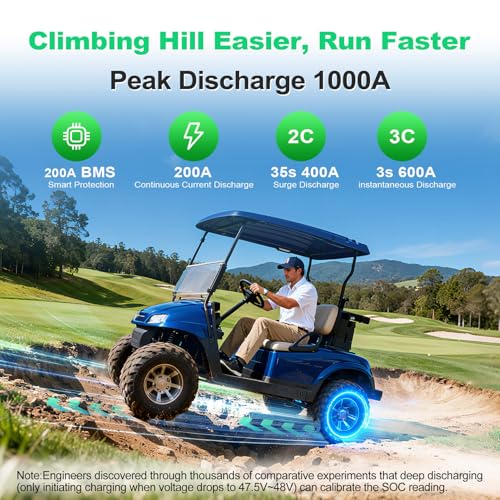
Power determines how well your 48V lithium golf cart battery delivers acceleration, starting performance, hill-climbing strength, and consistent speed under load. Look for a battery with enough continuous and peak power output for your cart, passengers, cargo, and terrain, and watch out for options that meet the voltage requirement but lack the cranking power or discharge capacity to maintain performance on hills or during hard starts.
For power, check the battery’s continuous and peak BMS discharge ratings against your cart’s controller, motor, tire size, terrain, and passenger load; a pack with enough voltage but too little current can trip the BMS on steep hills or hard acceleration. Also confirm the fully charged lithium voltage is acceptable for your 48V controller and that the main cables, fuse, and solenoid are sized for the amperage. Owner feedback supports the payoff when the match is right: shoppers consistently report a major upgrade over lead-acid, with steadier voltage, stronger acceleration, better hill strength, quicker pickup, and a cart that feels refreshed.
Installation
A 48V lithium golf cart battery should be simple to install, especially if you’re replacing older lead-acid batteries or upgrading from a multi-battery setup. Look for a true drop-in fit with clear wiring instructions, compatible voltage and charger requirements, secure mounting, and straightforward connections to the cart’s controller and accessories. Watch out for conversions that need extra cables, trays, charger changes, or professional help, because those can add cost and complexity beyond the battery itself.
For installation, do not assume “48V drop-in” means no conversion work: measure the battery tray, check terminal orientation, cable reach, hold-down options, charger-port compatibility, and whether your cart needs its onboard charge computer bypassed or a new state-of-charge display wired in. Look for kits that include a lithium-specific charger, clear wiring instructions, monitor or display, proper cables, straps or brackets, and guidance for 12V accessories or a DC-DC reducer if your lights and extras need one. Owners generally describe these conversions as straightforward when the kit is complete, and many say the lighter pack makes handling and installation easier, though some carts still require bracket changes or wire rerouting.
Quality
Quality matters because a 48V lithium golf cart battery has to handle vibration, heat, charging cycles, and regular high-current use without becoming unreliable. Look for solid construction, well-protected cells, a dependable battery management system, clean terminals, and clear safety certifications, and be cautious of vague specs, flimsy casing, or sellers that do not explain the battery’s components and protections.
For quality, prioritize LiFePO4 chemistry, a BMS with over-current, short-circuit, over/under-voltage, temperature protection, and low-temperature charge cutoff, plus a rugged enclosure that can handle vibration, moisture, and under-seat debris. Inspect the quality of terminals, busbars, cable lugs, documentation, and included monitoring, because poor connection hardware or unclear instructions can become the weak point in a high-current golf cart setup. Owner sentiment backs the benefit of a well-built conversion: buyers often view lithium packs as a clear step up from leaky, maintenance-heavy lead-acid banks, with better voltage consistency, cleaner packaging, and more reliable cart behavior.
Runtime
Runtime determines how far you can drive on a single charge, so it matters if you use your cart for long rounds, neighborhood trips, hills, passengers, or accessories. Look for a 48V lithium battery with enough usable capacity for your normal route plus a safety margin, and remember that load, terrain, speed, tire pressure, and weather can all shorten real-world battery life. Also watch for owner feedback on whether the battery maintains range over repeated cycles, not just how it performs when new.
For runtime, compare usable energy, not just voltage: multiply amp-hours by 51.2V nominal for a 48V LiFePO4 pack, then size up for hilly courses, heavy passenger loads, rear seats, utility use, oversized tires, or long neighborhood rides. Avoid choosing the smallest pack only because lithium has deeper usable discharge; you still want reserve capacity so the BMS is not stressed and the cart does not slow or shut down far from the charger. Owners commonly report much longer run time than with older wet-cell or lead-acid batteries, including longer rides, multi-day use between charges, and better charge retention after extended outings.
Value
You want a 48V lithium golf cart battery that justifies its higher upfront price through longer life, lower maintenance, better usable capacity, and fewer replacements compared with lead-acid. Look beyond the purchase price and consider total cost over time, including charger compatibility, warranty strength, included accessories, and whether the battery’s range and performance match how you actually use your cart.
For value, judge the total conversion cost, not just the battery: account for the lithium charger, charge port, battery monitor or Bluetooth app, cables, fuse, mounting hardware, DC-DC converter for accessories, disposal of old batteries, and any professional help if you are not comfortable with high-current wiring. A kit that costs more upfront can be the better buy if it avoids add-on purchases and reduces maintenance like watering cells, cleaning corrosion, and replacing multiple lead-acid batteries. Owners often call these kits a strong value when they include the needed components, deliver meaningful performance gains, and cost less than repeated lead-acid replacement or dealer-installed conversions.
Weight
Weight matters because a lighter 48V lithium battery can make your golf cart easier to handle, reduce overall load, and sometimes improve responsiveness or range compared with a heavier setup. Look for a battery or battery kit you can safely lift and mount in your cart’s available space, but don’t judge by weight alone—verify that the capacity, discharge rating, and mounting hardware still match your cart and driving needs.
For weight, plan for how the lighter pack changes the cart, not just how easy it is to lift: reduced rear weight can improve acceleration and ride height, but the battery still needs firm mounting so it cannot bounce, slide, or stress cables on rough paths. If your cart was balanced around a heavy lead-acid bank, check suspension stance, braking feel, traction on hills, and cargo/passenger distribution after the swap. Owner feedback strongly supports the weight advantage, with buyers saying the cart feels quicker, handles better, frees space under the seat, and is much easier to work on after removing the heavy lead-acid bank.
1,000,000+ shoppers use Buyer's Guide every week to find the best products and services online.

Helping millions of users make smarter purchases online.


